- 1. 1. Does a Cannabis Package Sent to Your Home Make You Guilty?
- 2. 2. Why Were the Charges So Serious?
- 3. 3. Case Background: Foreign English Teacher Charged Over an International Package
- 4. 4. What Must Prosecutors Prove in a Drug Transportation Case?
- 5. 5. Three Key Reasons the Court Entered a Not-Guilty Judgment
- 6. 6. Suspicion Versus Proof Beyond a Reasonable Doubt
- 7. 7. What Evidence May Increase the Risk of Conviction?
- 8. 8. What Should a Foreign Resident Do After a Package Is Intercepted?
- 9. 9. How Can a Taiwan Drug Crime Lawyer Assist?
-
10.
10. Frequently Asked Questions
- 10.1. Q1: Does a cannabis package sent to my home automatically make me guilty in Taiwan?
- 10.2. Q2: What if my name appears on the package?
- 10.3. Q3: Can cannabis-related internet searches prove that I ordered the package?
- 10.4. Q4: What if cannabis-related items were found in my residence?
- 10.5. Q5: Must I prove that I did not know about the package?
- 10.6. Q6: What are the penalties for transporting cannabis in Taiwan?
- 10.7. Q7: Can drug transportation and illegal importation be charged together?
- 10.8. Q8: What should I do if police seize my phone?
- 10.9. Q9: What is the difference between non-prosecution and acquittal?
- 10.10. Q10: Can a foreign defendant request an interpreter and defense lawyer?
- 11. 11. Conclusion: A Delivery Address Is Not Proof of Criminal Intent
- 12. 📢【24h免費法律諮詢】
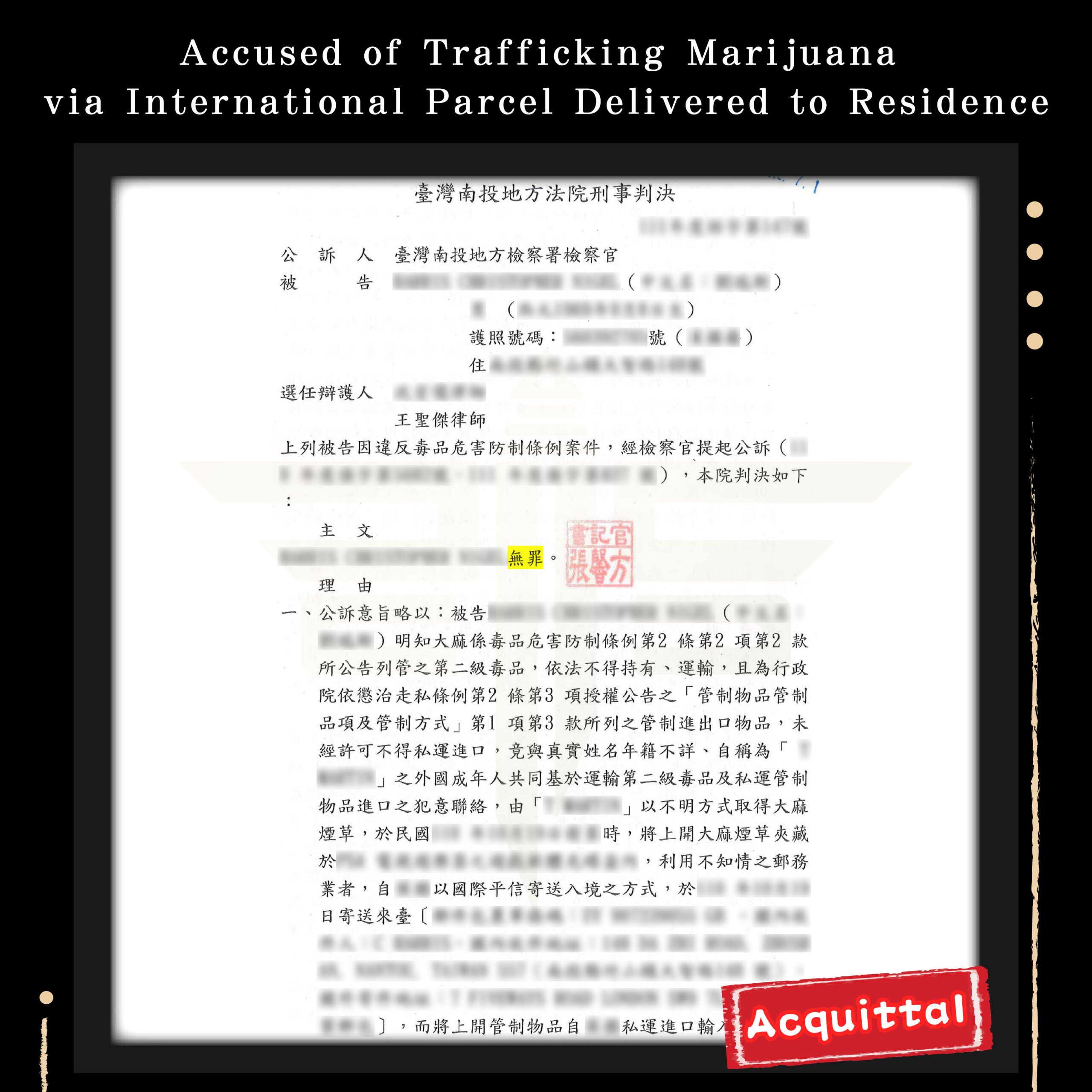
A Taiwan drug crime lawyer will begin with one essential point: an international package containing cannabis does not automatically make the person living at the delivery address guilty. The prosecution must still prove that the accused knew what the package contained and intentionally participated in transporting or importing the cannabis.
In this case, the client was a foreign English teacher living and working in Taiwan. Customs authorities intercepted a package sent from overseas and discovered cannabis inside. Because the recipient information and delivery address were associated with the client, prosecutors charged the client with jointly transporting Category II narcotics and illegally importing controlled articles.
With the assistance of Attorney Wang Sheng-Jie of Chien Sheng International Law Firm, the court found that the evidence did not establish a shared criminal intent between the client and the sender. There was no sufficient proof that the client ordered, paid for, requested, or agreed to the cannabis shipment. The court therefore rendered a not-guilty judgment.
📝To protect the client’s privacy, this article has been fully de-identified. It does not disclose the client’s nationality, name, employer, address, case number, court, postal information, communications, or other identifying details.
1. Does a Cannabis Package Sent to Your Home Make You Guilty?
No. A package addressed to your home may create suspicion and justify an investigation, but an address alone does not prove a crime.
In an international cannabis package case, investigators may ask:
- Who ordered the package?
- Who paid for the goods and shipping?
- Who provided the recipient’s name and address?
- Did the recipient know the sender?
- Did the recipient communicate with the sender?
- Did anyone discuss cannabis, drugs, packaging, or customs inspections?
- Did the accused track or collect the package?
- What was supposed to happen after delivery?
A delivery address establishes a physical connection between a package and a location. It does not automatically establish that a particular resident knowingly arranged the shipment.
➠A person’s name, telephone number, or address may have been provided, copied, reused, or misused by someone else. Even where the information is accurate, prosecutors must still connect the accused to the contents of the package and the decision to transport those contents.
➠In plain terms, “the package was sent here” is not the same as “the person living here knowingly ordered cannabis.”
2. Why Were the Charges So Serious?
2.1 Transportation of Category II Narcotics
Taiwan’s official English translation of the law uses the term “Category two narcotics.” Cannabis is expressly listed as a Category two narcotic under Article 2 of the ►Narcotics Hazard Prevention Act.
Under Article 4, a person who manufactures, transports, or sells Category two narcotics may face life imprisonment or imprisonment for at least ten years, together with a possible fine of up to NT$15 million. An attempted offense is also punishable.
These Category II narcotics penalties in Taiwan are extremely severe. A person investigated over an international cannabis package may therefore face search, seizure of electronic devices, questioning, restrictions on travel, detention proceedings, prosecution, and a lengthy criminal trial.
The seriousness of the punishment, however, does not reduce the prosecution’s burden of proof. A court cannot infer knowledge merely because cannabis was discovered inside a package connected to the accused’s address.
2.2 Illegal Importation of Controlled Articles
An international cannabis package may also result in charges under Taiwan’s Smuggling Penalty Act.
Article 2 of the ►Smuggling Penalty Act provides that illegally importing or exporting controlled articles may be punished by imprisonment for up to seven years and a fine of up to NT$3 million. Attempted offenses are also punishable.
Prosecutors may therefore charge both transportation of Category II narcotics and illegal importation of controlled articles arising from the same package.
➠However, the legal elements must still be examined separately. The prosecution must prove more than the existence of cannabis and a delivery address. It must establish that the accused knowingly participated in the prohibited shipment.
3. Case Background: Foreign English Teacher Charged Over an International Package
The client was a foreign national working as an English teacher in Taiwan. An international postal package was sent to an address connected to the client. Customs officers inspected the package and discovered cannabis concealed inside.
Because part of the recipient information corresponded with the client and the package was sent to the client’s residence, investigators treated the client as a possible participant in the cross-border shipment.During a search of the residence, authorities also recovered items that could be associated with cannabis use. The client’s phone contained cannabis-related searches and certain contact information.
💡Viewed superficially, these circumstances appeared unfavorable:
- An overseas package contained cannabis.
- The package was sent to the client’s residence.
- Part of the recipient information was associated with the client.
- Cannabis-related items were found in the residence.
- The client’s phone contained cannabis-related searches.
The prosecution relied on these circumstances to charge the client with jointly transporting Category II narcotics and illegally importing controlled articles.
➠The central issue in this Taiwan drug case was not whether the package existed or whether cannabis was discovered. Those facts were not disputed. The decisive issue was whether the evidence proved that the client knowingly participated in this specific shipment.
4. What Must Prosecutors Prove in a Drug Transportation Case?
4.1 A Connection to the Address Is Not Enough
A recipient name and delivery address may support an investigation, but they do not necessarily prove who ordered the package or knew what it contained.
To move from suspicion to criminal responsibility, the prosecution generally needs evidence connecting the accused to the shipment, such as:
- Online ordering records
- Payment or cryptocurrency transactions
- Messages discussing the product or quantity
- Instructions concerning packaging or concealment
- Communications with the sender
- Requests to use a particular name or address
- Shipping or tracking messages
- Instructions for collecting or forwarding the package
- Evidence showing what the accused planned to do after delivery
➠In this case, there was no evidence that the client placed an order for cannabis. There was no payment trail, no shipment request, and no communication proving that the client instructed or authorized the sender to mail cannabis to Taiwan.
A partially matching recipient name and a residential address could create suspicion. They could not, standing alone, establish knowing participation in drug transportation.
When prosecutors allege joint drug transportation, they must prove a shared criminal purpose and participation in the conduct.
The question is not merely whether the accused was physically associated with the destination. The court must examine whether the accused:
- Knew the package contained cannabis;
- Intended to bring or help bring the cannabis into Taiwan; or
- Actually foresaw that the package might contain narcotics and nevertheless accepted that result.
Mere carelessness, association with cannabis, or failure to provide a convincing explanation does not automatically establish an intentional transportation offense.
A Taiwan drug crime lawyer must therefore separate the evidence into precise categories. Evidence of possible cannabis use is not automatically evidence of ordering cannabis from overseas. Evidence connecting someone to a residence is not automatically evidence of communication with the sender. Evidence establishing familiarity with cannabis does not necessarily establish participation in a particular international shipment.
5. Three Key Reasons the Court Entered a Not-Guilty Judgment
5.1 No Order, Payment, or Shipment Instructions
The first major weakness in the prosecution’s case was the absence of direct evidence linking the client to the sender and the shipment.
💡Investigators did not find evidence showing that the client:
- Ordered cannabis from the sender;
- Paid for the cannabis or shipping;
- Asked the sender to mail anything;
- Provided instructions about packaging or concealment;
- Agreed to receive cannabis in Taiwan; or
- Discussed the package with the sender.
There were also no communications establishing that the client and the sender shared a plan to transport cannabis.
➠The recipient information and delivery address were relevant, but they did not answer how the information appeared on the package or whether the client knowingly supplied it for an illegal purpose.Criminal liability cannot be based on an assumption that only the resident could have provided the address. The prosecution must support that proposition with evidence.
5.2 Cannabis-Related Materials Did Not Prove Transportation
The second key issue was the proper use of the materials found during the search.
Authorities recovered items that could be associated with cannabis use, and the client’s phone contained cannabis-related internet searches. Those facts could reasonably prompt further investigation. They did not, however, prove that the client ordered this package or communicated with its sender.
The court distinguished between three separate questions:
- Was the client familiar with cannabis?
- Did the client possibly possess or use cannabis on another occasion?
- Did the client knowingly participate in transporting the cannabis found in this international package?
Evidence relevant to the first or second question does not automatically answer the third.
➠This distinction is central to Taiwan drug litigation. Each alleged offense has its own legal elements. Prosecutors cannot use general drug-related behavior as a substitute for evidence proving the specific transportation offense charged in the indictment.
For example, an internet search may show that a person viewed cannabis-related information. It does not necessarily show that the person ordered a particular product, contacted the sender, paid for the package, or agreed to import it.Likewise, an object found inside a residence may be relevant to possible possession or use. Without a reliable connection to the intercepted package, however, it does not prove participation in that shipment.
5.3 The Burden of Proof Remained With the Prosecution
The third key reason for the acquittal was that the burden of proof did not shift to the client.
The client denied knowing that the package contained cannabis and denied asking anyone to send it. The client may not have been able to produce complete documentation supporting every part of that explanation. Nevertheless, an incomplete defense explanation does not become affirmative evidence of guilt.
Under Article 154 of Taiwan’s ►Code of Criminal Procedure, an accused is presumed innocent until proven guilty by a final judgment. Criminal facts must be established by evidence and may not be established in the absence of evidence.
Article 301 further provides that if it cannot be proven that an accused committed an offense, a judgment of not guilty must be pronounced.
Accordingly, the client did not have to prove who sent the package or why the sender used the address before the court could acquit. The prosecution remained responsible for proving that the client knowingly joined the criminal shipment.
The absence of a complete alternative explanation could be considered when evaluating credibility. It could not fill the gaps in the prosecution’s evidence.
6. Suspicion Versus Proof Beyond a Reasonable Doubt
This case did not establish that the intercepted cannabis package was imaginary or legally insignificant. Nor did the court hold that the recipient information, phone searches, and items found during the search had no evidentiary value.
The court instead examined what each piece of evidence could actually prove.The package proved that cannabis had been sent from overseas. The address connected the package to the residence. The phone records indicated an interest in cannabis-related information. The search results suggested a possible broader association with cannabis.
What remained missing was evidence linking the client to the sender’s decision to mail the package.There were no messages, payment records, requests, shipment instructions, or other mutually corroborating evidence demonstrating a shared criminal plan. The surrounding circumstances therefore created suspicion but did not eliminate reasonable doubt.
➠Attorney Wang Sheng-Jie focused the defense on this evidentiary gap. Rather than treating every unfavorable circumstance as irrelevant, the defense explained the limited fact each item could prove and why it did not establish the specific transportation and importation offenses.
That distinction enabled the court to separate “possibly connected to cannabis” from “proven to have jointly transported cannabis.” The result was a not-guilty judgment.
7. What Evidence May Increase the Risk of Conviction?
A package address alone may be insufficient, but the risk changes significantly when additional evidence exists.
Evidence that may support a transportation allegation includes:
- Direct messages discussing cannabis, quantity, price, or delivery
- Online purchase records
- Bank transfers or cryptocurrency payments
- Instructions to disguise the contents
- Requests to use a false name or another person’s address
- Messages about avoiding customs inspections
- Repeated tracking of the shipment
- Arrangements for collecting or forwarding the package
- Multiple similar international packages
- Admissions that the accused expected cannabis
- Communications with the identified sender
- Deletion of messages after the package was intercepted
- Attempts to coordinate accounts with other suspects
➠No single factor necessarily decides the case. Courts evaluate the entire evidentiary record, including whether the different pieces of evidence corroborate one another.
For example, tracking a package may be innocent if the accused expected lawful goods. The same conduct may be viewed differently if accompanied by messages discussing hidden cannabis and payment records.
★This is why an effective Taiwan drug crime lawyer must examine the complete context rather than rely on isolated favorable or unfavorable facts.
8. What Should a Foreign Resident Do After a Package Is Intercepted?
8.1 Preserve All Original Records
Do not delete emails, text messages, shopping records, payment information, photographs, or delivery notifications.
Electronic records may contain unfavorable material, but they may also show that the accused never placed an order, never communicated with the sender, or expected an entirely different item. Selective screenshots are less persuasive than complete, verifiable records.
Do not alter dates, create substitute conversations, or ask another person to provide a false explanation.
8.2 Review the Search and Seizure Documents
If investigators search a residence, obtain and retain copies of:
- The search warrant
- The search and seizure record
- The inventory of seized property
- Receipts for phones, computers, or other devices
- Summonses and other procedural documents
The warrant should identify the offense, location, person, property, or electronic records within the authorized scope. Whether the search and digital examination were conducted lawfully may affect the admissibility or weight of the resulting evidence.
8.3 Do Not Guess During Questioning
Foreign residents may feel pressure to answer quickly, particularly when the investigation is conducted in an unfamiliar language.
➠If a question is unclear, request an explanation or interpreter. If the answer is unknown or not remembered, say so truthfully. Do not guess about who sent the package, why the sender used the address, or what another person intended.
A speculative answer can later be recorded as a definite admission and create inconsistencies in the case.
8.4 Request Legal Assistance and Interpretation
An accused person has the right to consult and retain defense counsel. Where language assistance is necessary, the accuracy and completeness of interpretation can be critical.
Before signing an interview record, review it carefully. Confirm that the translated questions and answers reflect what was actually said. Request corrections if the record is inaccurate or incomplete.
8.5 Consider Immigration and Employment Issues Separately
A foreign national facing serious criminal charges may also be concerned about residency, employment, travel restrictions, or future immigration consequences.
These consequences do not arise identically in every case. They depend on the person’s immigration status, procedural stage, court orders, and final result. Criminal defense and immigration-related consequences should therefore be assessed together at an early stage.
9. How Can a Taiwan Drug Crime Lawyer Assist?
An international package case may involve customs records, foreign-language communications, digital forensics, search and seizure, overseas payments, controlled-delivery evidence, and several government agencies.
A Taiwan drug crime lawyer may assist by:
- Identifying the precise offenses under investigation
- Reviewing the international postal and customs records
- Determining how the recipient information was obtained
- Examining whether the client ordered or paid for the package
- Reconstructing the complete communication history
- Distinguishing general cannabis evidence from shipment-specific evidence
- Reviewing search, seizure, and digital examination procedures
- Protecting the client’s rights during police and prosecutorial questioning
- Coordinating accurate interpretation
- Challenging unsupported allegations of shared criminal intent
- Addressing detention, travel restrictions, and related procedural risks
- Preparing a defense for trial where the case has already been prosecuted
➠Chien Sheng International Law Firm handles drug cases involving international packages, cannabis, drug transportation, searches, digital evidence, and foreign defendants. Related Chinese-language resources include Drug Transportation Charges and Key Defense Issues and How to Defend a Drug Case and Seek an Acquittal.
10. Frequently Asked Questions
Q1: Does a cannabis package sent to my home automatically make me guilty in Taiwan?
No. The address may connect the package to your residence, but the prosecution must still prove that you knew the contents and intentionally participated in transporting or importing the cannabis.
Q2: What if my name appears on the package?
A matching name is relevant evidence, but it is not automatically conclusive. Investigators should examine who supplied the name, whether you knew the sender, and whether ordering, payment, or communication records connect you to the shipment.
Not by themselves. Search history may indicate an interest in cannabis, but it does not necessarily prove that you ordered a specific package or agreed with the sender to transport cannabis into Taiwan.
Those items may support a separate investigation into possession or use. The prosecution must still connect them to the particular international package before they can prove transportation.
Q5: Must I prove that I did not know about the package?
No. The prosecution bears the burden of proving the charged offense. Your explanation and supporting evidence remain important, but an inability to prove every detail of your account does not automatically establish guilt.
Q6: What are the penalties for transporting cannabis in Taiwan?
Cannabis is classified as a Category two narcotic. Under Article 4 of the Narcotics Hazard Prevention Act, transporting Category two narcotics is punishable by life imprisonment or imprisonment for at least ten years, with a possible fine of up to NT$15 million.
Q7: Can drug transportation and illegal importation be charged together?
Yes. An overseas cannabis shipment may lead to charges under both the Narcotics Hazard Prevention Act and the Smuggling Penalty Act. The prosecution must still prove the elements of each offense.
Q8: What should I do if police seize my phone?
Keep the search warrant, seizure record, and property inventory. Do not remotely delete or alter data. Ask a Taiwan drug crime lawyer to review the legal basis and scope of the search and digital examination.
Q9: What is the difference between non-prosecution and acquittal?
A non-prosecution disposition is issued by a prosecutor during the investigation stage. An acquittal, or not-guilty judgment, is issued by a court after the case has been prosecuted. This case resulted in a court judgment of not guilty.
Q10: Can a foreign defendant request an interpreter and defense lawyer?
Yes. If language assistance is required, the defendant should request an interpreter and verify that all interview records accurately reflect the questions and answers. Legal representation should be sought as early as possible.
11. Conclusion: A Delivery Address Is Not Proof of Criminal Intent
An international cannabis package sent to a person’s residence may create serious suspicion, but criminal responsibility cannot be determined solely by the destination printed on the package.
The prosecution must prove that the accused knew the package contained cannabis and intentionally participated in the transportation or illegal importation. Ordering records, payment trails, communications with the sender, shipment instructions, and post-delivery arrangements may be important. Without evidence establishing that connection, a court cannot replace proof with speculation.
In this case, the prosecution relied on recipient information, the residential address, cannabis-related searches, and items recovered during a search. However, there were no messages, payments, requests, or other evidence proving that the foreign English teacher had ordered or agreed to the shipment.Attorney Wang Sheng-Jie of Chien Sheng International Law Firm separated the suspicious surrounding circumstances from the evidence required to prove the charged offenses. Because the prosecution failed to establish a shared criminal intent beyond a reasonable doubt, the court rendered a not-guilty judgment.
If you or a family member is investigated in Taiwan because an overseas package contains cannabis or another controlled substance, preserve the original evidence and seek assistance from a Taiwan drug crime lawyer as early as possible. Every package, communication record, payment trail, search, and statement may affect the outcome.
📣Disclaimer: This article provides general legal information and a de-identified case summary. It does not constitute legal advice for any individual case. Results depend on the specific evidence, procedural history, communications, payment records, and other circumstances.
ㅤㅤㅤㅤ
📢【24h免費法律諮詢】
🏛 台北所:台北市萬華區康定路64號6樓|02-2388-8962
🏛 桃園所:桃園市桃園區新埔六街95號17樓|(03)3150-034
🏛 高雄所:高雄市鼓山區明誠三路687號3樓
LINE 免費諮詢:@lawuicc001
IG:chien.sheng_
FB:謙聖國際法律事務所
💳 提供多種支付方式:現金、信用卡、銀行轉帳
|
詐欺案件處理 |
毒品案件辯護 |
|
車手案件諮詢 |
家事訴訟服務 |