
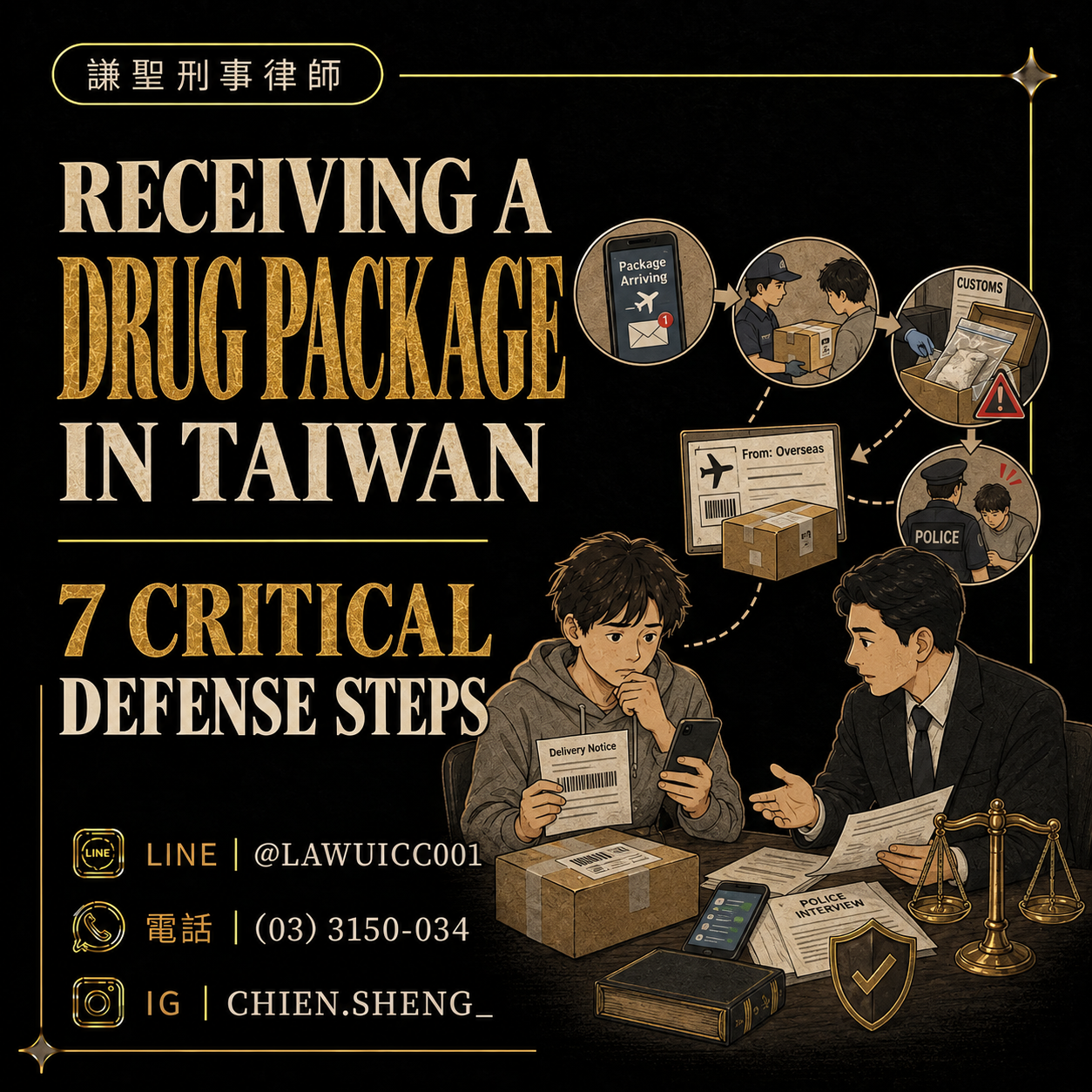
- 1. 1. What Charges May Be Investigated?
- 2. 2. When Can Receiving a Drug Package in Taiwan Become a Crime?
- 3. 3. Joint Principal Offender or Accessory: What Is the Difference?
- 4. 4. Can You Remain Silent During Police Questioning?
- 5. 5. Should You Explain Immediately or Wait for a Lawyer?
- 6. 6. Why Is Early Legal Representation Important?
- 7. 7. What Evidence Will Investigators Usually Examine?
- 8. 8. What Is a Controlled Delivery?
- 9. 9. What If the Police Search Your Home or Seize Your Phone?
- 10. 10. How Should You Review the Police Interview Record?
- 11. 11. What Evidence Should Be Preserved?
- 12. 12. What Should You Avoid Doing?
-
13.
13. Main Defense Issues in a Drug-Parcel Case
- 13.1. ▪️Did the recipient know the actual contents?
- 13.2. ▪️Did the recipient foresee an illegal possibility?
- 13.3. ▪️Was the recipient part of a shared criminal plan?
- 13.4. ▪️Did the recipient intentionally assist another person?
- 13.5. ▪️Was any payment promised or received?
- 13.6. ▪️What was supposed to happen after delivery?
- 13.7. ▪️Was the recipient’s statement accurately recorded?
- 13.8. ▪️Were search and seizure procedures lawful?
-
14.
14. Frequently Asked Questions
- 14.1. 1. Is Receiving a Drug Package in Taiwan automatically a drug-transportation offense?
- 14.2. 2. Can I remain silent if the police question me?
- 14.3. 3. Will remaining silent make the police think I am guilty?
- 14.4. 4. I only signed for the package. Can I still be investigated?
- 14.5. 5. What if the package was addressed to someone else?
- 14.6. 6. What if a friend said the package contained clothes or gifts?
- 14.7. 7. Should I delete messages that might look suspicious?
- 14.8. 8. Can my family retain a lawyer for me?
- 14.9. 9. Does having no criminal record guarantee non-prosecution?
- 14.10. 10. Can a lawyer guarantee an acquittal or non-prosecution decision?
- 15. 15. How Chien Sheng International Law Firm Can Assist
- 16. Conclusion: Accepting a Parcel Is Not Automatic Proof of Guilt
- 17. 📢【24-Hour Free Legal Consultation】
📢 Receiving a Drug Package in Taiwan for a friend may appear to be a simple favor. However, if customs officers, police, investigators, or prosecutors later state that the parcel contained controlled drugs, the recipient may suddenly face investigation for drug transportation, joint criminal participation, aiding an offense, possession, or other serious charges.
Being summoned does not mean that the recipient has already been proven guilty. Accepting a parcel also does not automatically establish the offense of transporting drugs. Investigators must still examine whether the recipient knew what was inside, anticipated that the package might contain drugs, received payment, agreed to store or transfer it, or participated in communications and delivery arrangements.
The first few hours of an investigation are especially important. A frightened person may repeatedly insist, “I did not know,” guess at details, agree with an inaccurate question, or sign an incomplete interview record. These actions may affect how prosecutors interpret the person’s knowledge and role.
The safest principles are straightforward: do not fabricate an explanation, do not delete messages, do not contact other involved persons to coordinate a story, and do not guess about facts you cannot remember. A suspect may lawfully exercise the right to remain silent and request a lawyer before answering substantive questions.
1. What Charges May Be Investigated?
The possible charge depends on the type and quantity of drugs, where the parcel originated, how it was shipped, what the recipient knew, and what the recipient was expected to do after delivery.
If the package was shipped from another country or moved across Taiwan’s border, investigators may consider:
- Transportation of controlled drugs.
- Attempted transportation of controlled drugs.
- Joint participation in transporting drugs.
- Aiding another person’s transportation offense.
- Importation of prohibited or controlled goods.
- Possession of controlled drugs.
- Possession with intent to sell.
- Sale, transfer, or storage connected with a larger drug operation.
If the parcel was sent domestically, prosecutors may still examine whether the recipient assisted in transporting, storing, transferring, selling, or possessing the substance.The official Narcotics Hazard Prevention Act imposes severe penalties for manufacturing, transporting, or selling controlled drugs.
Under Article 4:
- Transporting Category One narcotics may be punished by death or life imprisonment.
- Transporting Category Two narcotics may be punished by life imprisonment or imprisonment for at least ten years.
- Transporting Category Three narcotics may be punished by imprisonment for at least seven years.
- Transporting Category Four narcotics may be punished by imprisonment for five to twelve years.
- Attempts to commit these offenses are also punishable.
➟These penalties explain why an apparently simple parcel pickup can quickly become a major criminal investigation. Nevertheless, the arrival of a package at a person’s home does not, by itself, prove criminal intent.
2. When Can Receiving a Drug Package in Taiwan Become a Crime?
The principal issue is whether the recipient knew or at least accepted the possibility that the parcel contained drugs.
Article 13 of Taiwan’s Criminal Code recognizes both direct and indirect intent. Direct intent exists when a person knows the relevant criminal facts and intends the offense to occur. Indirect intent may exist when the person foresees that the criminal result could occur and does not consider that result contrary to his or her wishes.
💡Investigators may therefore ask:
- Did the recipient know the sender’s real identity?
- Had the recipient accepted parcels for this person before?
- Was the package sent under a false name?
- Was the recipient instructed not to open the package?
- Did the sender describe the contents?
- Was the recipient paid or promised compensation?
- Was the recipient expected to transfer the package immediately?
- Did the recipient provide an address, phone number, identification document, or tracking information?
- Did the recipient communicate with overseas senders or local couriers?
- Did the recipient notice suspicious packaging, weight, odor, or delivery arrangements?
- Did the recipient continue after receiving warnings or discovering inconsistencies?
➟Foreseeability cannot be established merely because the transaction appears suspicious in hindsight. The prosecution should connect the surrounding facts to what the particular person actually knew or accepted at the relevant time.
A person who reasonably believed the package contained clothing, gifts, documents, ordinary merchandise, or personal belongings may have a materially different defense from someone who was paid to receive a parcel under a false name and immediately deliver it to an unknown person.
3. Joint Principal Offender or Accessory: What Is the Difference?
Article 28 of the Criminal Code of the Republic of China provides that two or more persons acting jointly in the commission of an offense are principal offenders.
A person does not have to perform every part of the drug operation to be treated as a joint principal offender. Prosecutors may allege joint participation when a person knowingly performs an important role within a shared criminal plan, such as:
- Providing a delivery address.
- Tracking the parcel.
- Receiving the package.
- Storing it temporarily.
- Contacting the sender after arrival.
- Arranging the handover.
- Delivering the parcel to another participant.
- Collecting or distributing payment.
However, the prosecution must still prove a shared criminal intent and a division of conduct. The fact that someone signed for a package is evidence that may require explanation, but it does not automatically prove an agreement to transport drugs.Article 30 concerns accessories. A person who intentionally aids another person in committing a crime may be punished as an accessory, even if the principal offender was unaware of the assistance. The punishment for an accessory may be reduced from the punishment imposed on the principal offender.
Accessory liability still requires intent to assist the crime. If the recipient genuinely did not know that drugs were involved and did not accept that possibility, the requirements for intentional assistance must be carefully examined.
4. Can You Remain Silent During Police Questioning?
Yes. A suspect or defendant has the right to remain silent and is not required to make a statement against his or her own will.
Under Article 95 of Taiwan’s Code of Criminal Procedure, a defendant must be informed before interrogation of:
- The suspected criminal conduct and all relevant charges.
- The right to remain silent.
- The right to retain defense counsel.
- The right to request investigation of favorable evidence.
Exercising the right to remain silent is not an admission of guilt. Article 156 further provides that guilt may not be presumed merely because a defendant refuses to make a statement or remains silent when there is no confession and no other evidence.
A person may clearly state:
“I wish to exercise my right to remain silent for the time being and would like to consult with my defense attorney before answering substantive questions.”
This does not mean the person may ignore a lawful summons, obstruct officers, destroy evidence, refuse identity verification, or violate a lawful search or seizure procedure. It means that the suspect may choose not to answer questions that could expose him or her to criminal liability before receiving legal advice.
5. Should You Explain Immediately or Wait for a Lawyer?
💡There is no single answer that applies to every investigation.
If the facts are straightforward and supported by complete records, a carefully prepared explanation may help clarify that the recipient was deceived or had no knowledge of the drugs. On the other hand, an unprepared explanation made under pressure may create contradictions that are later used against the recipient.
🔎Immediate risks include:
- Guessing why the sender used a particular address.
- Claiming to know the contents without any basis.
- Giving inaccurate dates or amounts.
- Minimizing a relationship that is documented in the phone.
- Denying communications that investigators already possess.
- Adopting wording suggested by the interviewer without understanding it.
- Trying to make the story sound more complete than the person’s actual memory.
➟If the allegations, evidence, or legal status are unclear, it may be safer to identify yourself, comply with lawful procedural requirements, and request legal consultation before discussing the substance of the case.Silence should be a considered exercise of a legal right, not a substitute for preserving favorable evidence or preparing an accurate defense.
6. Why Is Early Legal Representation Important?
Article 27 of the Code of Criminal Procedure permits a defendant to retain defense counsel at any time. The same right applies to a suspect being investigated by judicial police officers.A spouse, statutory agent, lineal blood relative, collateral blood relative within the third degree, head of household, or family member may also independently retain a lawyer for the suspect or defendant.
👨🏻⚖️A defense lawyer can assist by:
- Confirming whether the person is a witness, suspect, or defendant.
- Identifying the suspected offense and possible punishment.
- Reviewing the sender-recipient relationship.
- Reconstructing the parcel and communication timeline.
- Distinguishing confirmed facts from assumptions.
- Advising whether and when to answer questions.
- Attending police, investigation bureau, or prosecutor questioning.
- Taking notes and stating procedural opinions.
- Checking whether the interview record accurately reflects the answers.
- Reviewing search, seizure, and phone-extraction issues.
- Preparing for possible detention proceedings.
- Requesting investigation of favorable evidence.
➟Under Article 245, defense counsel may be present and state opinions when prosecutors, prosecutor investigators, judicial police officers, or police question a suspect or defendant during an investigation, subject to limited statutory exceptions.
The lawyer’s function is not to invent a defense or obstruct a lawful investigation. The purpose is to ensure that the person understands the questions, uses procedural rights correctly, and does not turn uncertainty into a false or damaging statement.
7. What Evidence Will Investigators Usually Examine?
Drug-parcel cases are rarely decided by one statement alone. Investigators may combine parcel evidence, digital records, surveillance, communications, financial activity, and the recipient’s conduct.
🚨Common evidence includes:
- Shipping documents and customs declarations.
- The name, address, and telephone number on the parcel.
- Tracking records and delivery notifications.
- Package weight and packaging method.
- Fingerprints or biological traces.
- Surveillance footage.
- Customs inspection records.
- Laboratory analysis of the substance.
- Communications with the sender or other participants.
- Search histories and deleted messages.
- Phone location and call records.
- Payment, bank, or cryptocurrency records.
- Prior deliveries to the same address.
- Instructions concerning collection or handover.
- Conduct during a controlled delivery.
- Statements made by co-defendants or witnesses.
➟Investigators may also compare the recipient’s statement with objective records. A denial that directly conflicts with clear messages, payment records, or video footage may harm credibility even when other parts of the explanation are true.For this reason, the recipient should review the available information with a lawyer before providing a detailed narrative.
8. What Is a Controlled Delivery?
In some cases, customs or law-enforcement officers discover suspected drugs before the package reaches the listed address. Instead of immediately ending the delivery, investigators may preserve or replace the contents and allow the parcel to proceed under surveillance.
The purpose may be to identify:
- Who tracks the package.
- Who accepts it.
- Whether the recipient appears to expect it.
- Who the recipient contacts after delivery.
- Whether the parcel is opened.
- Whether another person arrives to collect it.
- Where the package is ultimately taken.
- Whether payment or instructions follow.
➟Accepting a package during a controlled delivery may become important evidence, but it is not the only issue. Investigators must still consider whether the person knew what the parcel contained and whether the conduct reflected participation in a criminal plan.If officers arrive immediately after delivery, the recipient should not resist, conceal the parcel, delete messages, or contact others to warn them. The person should remain calm, ask to understand the legal basis of the procedure, and contact a criminal defense lawyer.
9. What If the Police Search Your Home or Seize Your Phone?
A drug-parcel investigation may be followed by a search of the residence, vehicle, workplace, phone, computer, or storage space.
The person should:
- Ask whether officers have a search warrant.
- Review the place, objects, and electronic records described in the warrant.
- Record the executing agency and officers’ information when possible.
- Keep copies of the search and seizure records.
- Review the inventory of seized property.
- Note whether officers request phone passwords or consent to access data.
- Avoid physically interfering with lawful enforcement.
- Avoid signing a consent document without understanding its scope.
➟The seizure of a phone does not make every message incriminating. Complete conversations may show that the sender concealed the true contents or misled the recipient.
However, deleting, remotely erasing, modifying, or instructing another person to remove data after learning of the investigation may seriously damage the defense and create additional legal risks.
10. How Should You Review the Police Interview Record?
An interview record may later be reviewed by prosecutors and courts. It should not be treated as a routine form that can be corrected casually after signing.
Before signing, verify:
- Whether the suspected offense and rights were explained.
- Whether the questions and answers are complete.
- Whether uncertain statements were recorded as uncertain.
- Whether denials of knowledge were included accurately.
- Whether the context of the relationship was preserved.
- Whether dates, amounts, names, and locations are correct.
- Whether important favorable explanations were omitted.
- Whether the translation is accurate.
- Whether corrections have actually been entered.
The following statements do not mean the same thing:
- “I did not know what was inside.”
- “I did not ask what was inside.”
- “I suspected it might be illegal.”
- “I knew it was drugs.”
- “I do not remember what the sender said.”
Similarly, “I once accepted a package” is materially different from “I regularly received packages for this person.”
If the record changes the meaning of the answer, request correction before signing. If the record contains blank spaces or statements that were never made, raise the issue immediately.
11. What Evidence Should Be Preserved?
A recipient who was deceived or unaware of the contents should preserve the original context rather than only a few favorable screenshots.
Potentially useful evidence includes:
- Complete conversations with the sender.
- The sender’s profile, account name, and contact details.
- The original request to receive the package.
- Statements describing the alleged contents.
- Shipping notifications and tracking screenshots.
- Previous legitimate transactions with the same person.
- Records showing whether payment was promised or received.
- Work, travel, or appointment records.
- Evidence showing who actually tracked or collected the parcel.
- Call histories and email records.
- Proof of contacting the police, carrier, or sender after discovering the problem.
- Evidence showing that the recipient did not open, move, or transfer the package.
➟Preserve original files, metadata, full chat histories, and timestamps whenever possible. Selected screenshots may not show the complete context and may be challenged as incomplete.
Do not create a new agreement, ask another person to provide a false explanation, or edit existing messages. A defense must be based on genuine and verifiable evidence.
12. What Should You Avoid Doing?
After learning that a package may contain drugs, do not:
- Destroy or discard the parcel.
- Open, divide, hide, or move the contents.
- Delete messages or call records.
- Reset or remotely erase a phone.
- Contact possible participants to coordinate statements.
- Warn another person that police are investigating.
- Manufacture a purchase record or false contract.
- Guess during questioning.
- Sign an inaccurate interview record.
- Assume that being called a witness means there is no criminal risk.
- Assume that silence alone will make the case disappear.
The correct response is to preserve the evidence, confirm your procedural status, understand the suspected charge, and obtain legal advice before making irreversible decisions.
13. Main Defense Issues in a Drug-Parcel Case
A complete defense should address the following questions.
▪️Did the recipient know the actual contents?
The sender’s explanation, prior relationship, package appearance, communications, and delivery arrangements must be examined.
▪️Did the recipient foresee an illegal possibility?
The prosecution may rely on indirect intent. The defense should explain why any suspicious circumstances did or did not create actual awareness of a drug-related risk.
Joint principal liability requires evidence of shared criminal intent and participation, not merely physical receipt of the package.
▪️Did the recipient intentionally assist another person?
Accessory liability requires an intention to provide assistance. An ordinary favor performed without awareness of the crime is not automatically intentional aid.
▪️Was any payment promised or received?
Compensation may affect how investigators interpret the arrangement. The amount, timing, purpose, and payment records should be reviewed.
▪️What was supposed to happen after delivery?
Instructions to store, open, transfer, relabel, or hand over the package may be highly significant.
▪️Was the recipient’s statement accurately recorded?
Inconsistencies may result from stress, unclear questioning, translation problems, or inaccurate records. The original interview process must be reviewed.
▪️Were search and seizure procedures lawful?
The scope of the warrant, seizure inventory, consent documents, phone extraction, and handling of digital evidence may require examination.
14. Frequently Asked Questions
1. Is Receiving a Drug Package in Taiwan automatically a drug-transportation offense?
No. The prosecution must still establish the required criminal intent and conduct. The fact that the parcel was delivered to a person’s address is important evidence, but it does not automatically prove that the person knew drugs were inside.
2. Can I remain silent if the police question me?
Yes. A suspect or defendant may lawfully remain silent and request a lawyer. However, silence does not permit anyone to ignore a lawful summons, resist officers, destroy evidence, or interfere with witnesses.
3. Will remaining silent make the police think I am guilty?
The law does not permit guilt to be presumed solely from silence when there is no confession or other evidence. Whether to answer immediately should still be assessed according to the available facts and evidence.
4. I only signed for the package. Can I still be investigated?
Yes. Police may investigate because you are connected to the delivery. Whether criminal liability exists depends on your knowledge, communications, agreement, payment, and expected role after receipt.
5. What if the package was addressed to someone else?
This may be relevant but is not conclusive. Investigators will examine why it was sent to your address, who tracked it, who asked you to receive it, and what you were expected to do afterward.
6. What if a friend said the package contained clothes or gifts?
Preserve the complete conversation and any evidence supporting that explanation. The credibility of the defense depends on the surrounding circumstances and whether the belief was reasonable.
7. Should I delete messages that might look suspicious?
No. Deletion can remove favorable context and may be interpreted as evidence concealment. Preserve the original records and let your lawyer assess their meaning.
8. Can my family retain a lawyer for me?
Yes. Taiwan’s Code of Criminal Procedure allows specified family members, including a spouse and certain relatives, to retain defense counsel for a suspect or defendant.
9. Does having no criminal record guarantee non-prosecution?
No. A clean record may be relevant to detention or sentencing issues, but it does not determine whether the alleged offense is established.
10. Can a lawyer guarantee an acquittal or non-prosecution decision?
No. The result depends on the parcel, communications, forensic evidence, testimony, financial records, and other facts. A lawyer can assess the evidence, protect procedural rights, and develop a defense consistent with the actual record.
15. How Chien Sheng International Law Firm Can Assist
Drug-parcel investigations may involve severe statutory penalties, controlled deliveries, digital evidence, international shipping records, searches, phone seizures, detention applications, and statements from multiple suspects.
Chien Sheng International Law Firm can assist with:
- Legal consultation before police questioning.
- Attendance during police or Investigation Bureau interviews.
- Representation during prosecutorial investigation.
- Analysis of direct and indirect criminal intent.
- Review of joint-principal and accessory allegations.
- Reconstruction of parcel and communication timelines.
- Review of searches, seizures, and digital evidence.
- Preparation for detention hearings.
- Requests to investigate favorable evidence.
- Development of trial and sentencing strategies when necessary.
📝Related drug-case discussions include:
- Accused of selling Category Three drugs—acquittal obtained
- Accused of selling Category Two drugs—non-prosecution obtained
- Drug accusation based on another person’s statement—acquittal obtained
Conclusion: Accepting a Parcel Is Not Automatic Proof of Guilt
A parcel containing drugs may expose the recipient to a serious criminal investigation, but criminal responsibility cannot be decided solely by the delivery address or signature.
💡The essential questions are:
- What did the recipient know?
- Did the recipient foresee and accept the possibility of drugs?
- Was there a shared criminal plan?
- What role was the recipient expected to perform?
- What objective evidence supports or contradicts the recipient’s explanation?
If police, the Investigation Bureau, customs officers, or prosecutors contact you about a suspicious parcel, remain calm. Do not guess, delete records, coordinate stories, or sign an inaccurate statement. Preserve the full evidence, confirm whether you are a witness or suspect, and obtain legal advice before making statements that may affect the entire investigation.
👨🏻⚖️Chien Sheng International Law Firm reminds readers that this article provides general legal information only. It does not guarantee an acquittal, non-prosecution decision, release from detention, or any particular result. Each case must be assessed according to the drug type, quantity, shipping records, communications, financial evidence, search and seizure process, and the individual’s actual conduct.
Legal information reviewed on September 21, 2026. If the English translation differs from the official Chinese text, the Chinese text published by Taiwan’s Ministry of Justice prevails.
📢【24-Hour Free Legal Consultation】
🏛 Taipei Office: 6F., No. 64, Kangding Rd., Wanhua Dist., Taipei City|02-2388-8962
🏛 Taoyuan Office: 17F., No. 95, Xinpu 6th St., Taoyuan Dist., Taoyuan City|(03)3150-034
🏛 Kaohsiung Office: 3F., No. 687, Mingcheng 3rd Rd., Gushan Dist., Kaohsiung City
Contact Us on LINE for a Free Consultation: @lawuicc001
IG: chien.sheng_
FB: Chien Sheng International Law Firm
💳 We Accept Cash, Credit Cards, and Bank Transfers