
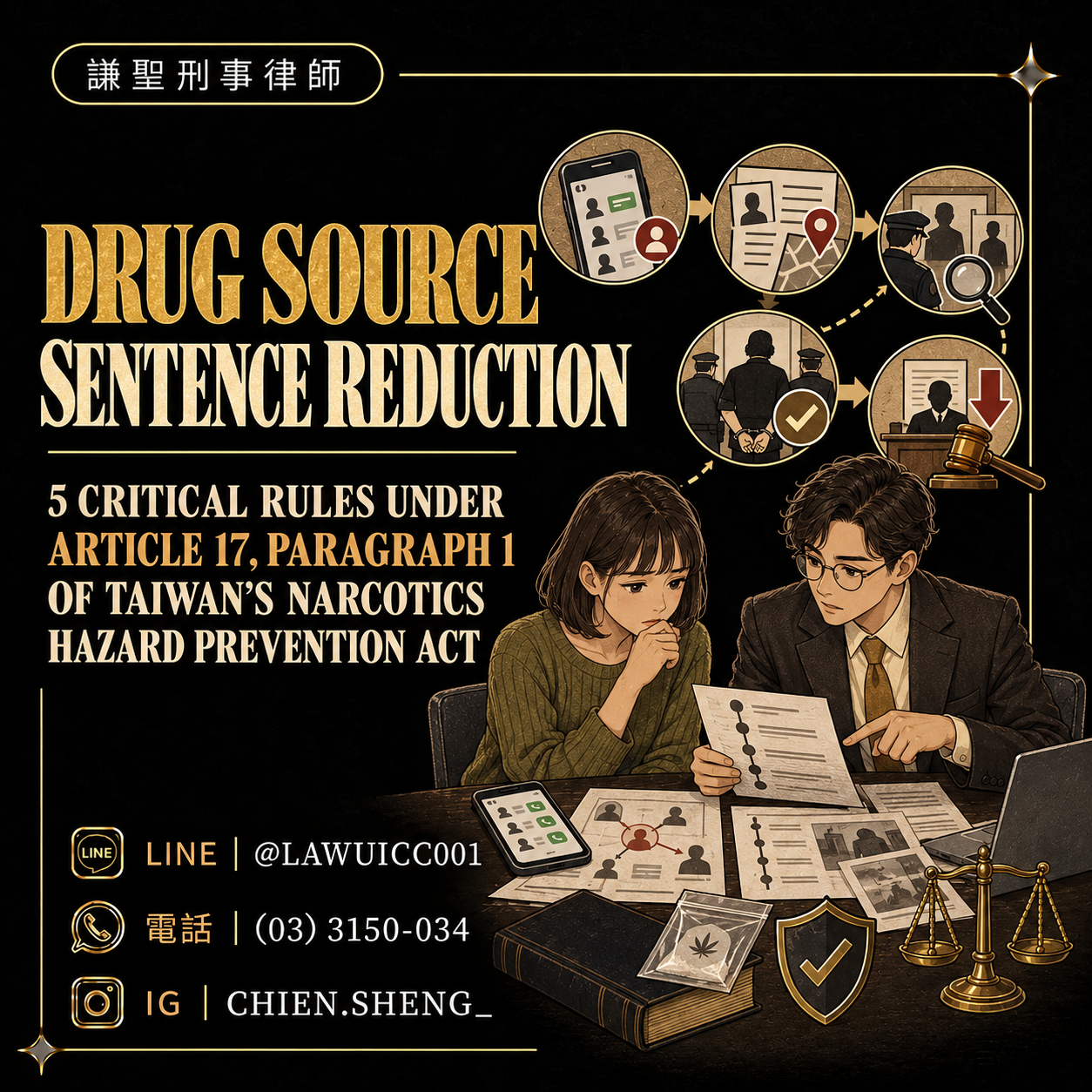
- 1. How Drug Source Sentence Reduction Works Under Article 17(1)
- 2. Article 17(1) and Article 17(2) Are Different Routes to a Reduced Sentence
-
3.
The Five Requirements for Article 17(1) Relief
- 3.1. 1. The offense must fall within the statutory list
- 3.2. 2. The disclosed person must be connected to the drugs in the defendant’s case
- 3.3. 3. The information must be truthful, specific, and actionable
- 3.4. 4. The disclosure must cause the investigation or discovery
- 3.5. 5. Authorities must actually discover the person and the related offense
- 4. Who May Qualify as the “Drug Source”?
- 5. Why Naming Another Dealer May Still Fail
- 6. ▪️Build a Case-Specific Drug-Flow Timeline
- 7. What Evidence Should Be Preserved?
- 8. When Should the Source Be Disclosed?
- 9. How a Defense Lawyer Proves “Thereby Leading to Discovery”
- 10. Conduct That Must Be Avoided
- 11. What If the Case Has Already Been Indicted?
-
12.
Frequently Asked Questions
- 12.1. ▪️Is drug source sentence reduction automatic?
- 12.2. ▪️Is a nickname enough?
- 12.3. ▪️What if police already knew the supplier?
- 12.4. ▪️Must the disclosed person be convicted?
- 12.5. ▪️Can disclosing a co-defendant qualify?
- 12.6. ▪️Must the defendant confess the charged offense first?
- 12.7. ▪️What if the information helps solve an unrelated drug case?
- 13. How Chien Sheng International Law Firm Can Assist
- 14. Conclusion: Naming a Person Is Not Enough
- 15. 📢【24-Hour Free Legal Consultation】
Drug source sentence reduction is one of the most misunderstood issues in Taiwan narcotics cases. Many defendants assume that naming a supplier, providing a telephone number, or telling investigators that they are willing to cooperate will automatically reduce their sentence.
💡That assumption is incorrect.
Article 17(1) of Taiwan’s Narcotics Hazard Prevention Act requires more than cooperation in a general sense. The disclosed person must be connected to the drugs or criminal conduct at issue, the information must be sufficiently specific for investigators to act on, and the disclosure must actually lead to the discovery of another principal offender or accomplice and the relevant offense.Once all statutory requirements are established, the court must grant either a reduction of punishment or an exemption from punishment. However, exemption is not automatic, and merely providing information does not guarantee that Article 17(1) will apply.
➠This article explains the five critical requirements, the difference between source disclosure and confession, the most common reasons Article 17(1) claims fail, and the evidence a defense lawyer should preserve.
How Drug Source Sentence Reduction Works Under Article 17(1)
Under Article 17 of the Narcotics Hazard Prevention Act, a person who commits an offense under Articles 4 through 8, Article 10, or Article 11 and discloses the source of the narcotics, thereby leading authorities to another principal offender or accomplice, must receive a reduced sentence or an exemption from punishment.
The provision may therefore apply to qualifying offenses involving:
- Manufacturing narcotics
- Transporting narcotics
- Selling narcotics
- Possession with intent to sell
- Inducing or facilitating narcotics use
- Transferring narcotics
- Using Category One or Category Two narcotics
- Possessing narcotics under Article 11
➠The first question is always whether the charged or adjudicated offense falls within the articles listed in Article 17(1). Article 17 does not apply to every offense that happens to involve drugs.
The date of the alleged offense also matters. Because the statute has been amended, older cases may require a comparison of the law in effect at different times. The applicable version should be determined from the offense date, procedural history, and Taiwan’s rules on changes in criminal law.
🚨Is the reduction mandatory after all requirements are met?
Yes. The current text states that the punishment shall be reduced or exempted once the statutory conditions are satisfied.
This means the court cannot acknowledge that every Article 17(1) requirement has been met and then refuse to grant any statutory benefit. However, the defendant is not automatically entitled to a complete exemption from punishment. Whether the appropriate result is a sentence reduction or an exemption must still be decided by the court according to the circumstances of the case.
Article 17(1) and Article 17(2) Are Different Routes to a Reduced Sentence
Article 17 contains separate sentence-reduction provisions that should not be confused.
💡Article 17(1): disclosing the source and causing an investigative result
Article 17(1) focuses on whether the defendant disclosed the source of the drugs and whether that disclosure actually led investigators to another principal offender or accomplice.
Its core requirements concern:
- The connection between the disclosed person and the drugs in the defendant’s case
- The specificity and usefulness of the information
- The sequence between the disclosure and the investigation
- The resulting discovery of the person and the related offense
💡Article 17(2): confession during investigation and every trial stage
Article 17(2) applies to offenses under Articles 4 through 8. It requires the defendant to confess during the investigation and throughout each level of trial.
Admitting one’s own offense is different from disclosing the drug source. A defendant may confess without identifying a source, while another defendant may provide information about a source without satisfying the continuous-confession requirement under Article 17(2).
➠Depending on the facts, both paragraphs may need to be evaluated separately. A defendant should not assume that satisfying one paragraph automatically satisfies the other.
The Five Requirements for Article 17(1) Relief
1. The offense must fall within the statutory list
The defendant’s offense must be one of the crimes listed in Article 17(1): Articles 4 through 8, Article 10, or Article 11 of the Narcotics Hazard Prevention Act.
The legal classification matters. A lawyer should review the indictment, investigation records, alleged offense date, and the final offense recognized by the court. If the case involves several charges, the applicability of Article 17(1) may need to be evaluated separately for each charge.
2. The disclosed person must be connected to the drugs in the defendant’s case
A “drug source” does not mean every dealer, user, or person involved in narcotics whom the defendant happens to know.The disclosed person ordinarily must be connected to the origin, supply, manufacture, transportation, or circulation of the drugs involved in the specific offense for which the defendant seeks relief.
For example, if a defendant is prosecuted for selling a particular quantity of narcotics on a particular date, disclosing a dealer involved only in a separate transaction may not satisfy Article 17(1). Even if the information helps the police solve another drug case, the required connection to the defendant’s own case may be missing.
➠Where an indictment contains multiple sales or several batches of narcotics, the source must be analyzed count by count. Identifying the source of one batch does not automatically establish the source of every other batch.
3. The information must be truthful, specific, and actionable
A defendant does not necessarily need to know the source’s complete legal name. However, the information must be sufficiently specific for investigators to identify and investigate the person.
Useful identifying information may include:
- A real name or nickname
- A telephone number
- A LINE, Telegram, Signal, or other messaging account
- A residential or business address
- A workplace or frequently visited location
- A vehicle model or license plate number
- A photograph or physical description
- Transaction dates and locations
- Delivery or collection methods
- Bank transfers or payment records
- Parcel, shipment, or logistics information
- Complete communications connected to the transaction
➠A nickname alone may be enough in an unusual case if it is combined with other details that allow investigators to identify the person. Conversely, a name alone may be insufficient if many people use the same name and no additional information is available.Specificity does not permit fabrication. A defendant should clearly distinguish between facts personally observed, information received directly from another person, and unverified assumptions.
4. The disclosure must cause the investigation or discovery
📢 The words “thereby leading to” create a causation requirement.
Investigators must have used the defendant’s information to begin, expand, or materially advance the investigation that resulted in the discovery. The defense should therefore establish a clear sequence:
- When the defendant first disclosed the information
- What information was provided
- What investigators already knew at that time
- What investigative measures followed
- What person and offense were eventually discovered
If police had already identified, monitored, searched, or arrested the same person before the defendant’s disclosure, causation may be difficult to prove.However, prior awareness of a person’s identity does not always end the analysis. The defendant may still have supplied new and decisive information about a different offense, location, communication account, delivery arrangement, or criminal role. The issue is whether the information made a genuine contribution to the relevant discovery.
➠A drug source sentence reduction argument should therefore rely on a documented investigation timeline, not merely the defendant’s statement that the police “used my information.”
Article 17(1) requires more than an attempt to cooperate. Authorities must actually discover another principal offender or accomplice and the relevant criminal conduct.Calling a person for questioning, confirming that the person exists, or writing the person’s name in a police report may not be enough. Investigators must obtain evidence that objectively identifies both the person and the relevant offense.
A final conviction is not necessarily required. The disclosed person does not always need to have been convicted, or even formally indicted, before Article 17(1) can be considered. The key question is whether the available evidence is sufficient to establish that authorities actually discovered the person and the relevant criminal conduct.
Who May Qualify as the “Drug Source”?
The concept of a drug source is not always limited to the person who directly handed narcotics to the defendant.
Taiwan Supreme Court practice recognizes that the provision may include an opposing principal offender or another principal, instigator, or accessory connected to the origin of the drugs. In manufacturing cases, the source analysis may also extend to persons knowingly supplying precursor materials, funding, technical assistance, premises, or equipment connected to the manufacturing process.
The Supreme Court’s 103rd-Year Sixth Criminal Chambers Meeting Resolution explains that the focus is on whether the information concerns a person connected to the origin of the drugs and enables investigators to discover that person and the offense.
➠This does not mean that naming any co-defendant is sufficient. A person who merely appears elsewhere in the criminal organization may not qualify unless the evidence establishes the necessary relationship to the source, circulation, manufacture, or relevant criminal conduct.
Why Naming Another Dealer May Still Fail
Several recurring problems cause Article 17(1) claims to be rejected.
▪️The information concerns a different case
The person may be a real dealer, and the police may successfully investigate that person, but the discovered crime may involve different narcotics, a different period, or an unrelated transaction.Information about an unrelated offense may still be considered as cooperation or favorable post-offense conduct at sentencing. That is different from satisfying Article 17(1).
▪️The information is too vague
Statements such as “a person called Kevin sold it to me” or “the supplier is often in Taipei” may not give investigators enough information to identify or locate the person.The defense should show exactly how each detail could be verified and how it connected to later investigative action.
▪️Police already possessed the decisive information
If investigators had already identified the person and commenced the same investigation, the defendant’s later statement may not have caused the discovery.
A name repeated after police have already obtained it is different from a new telephone number, location, account, delivery schedule, or transaction record that allows investigators to uncover previously unknown conduct.
▪️The person was found, but the relevant offense was not
Locating a person does not necessarily prove that the person supplied the drugs or participated in the defendant’s offense. Article 17(1) requires a discovery connected to the relevant criminal conduct.
▪️The defendant’s statements are inconsistent
Major changes concerning the source’s identity, drug type, quantity, payment method, transaction date, or delivery location may undermine credibility.
An inconsistency does not always mean the disclosure is false. Memory limitations, incomplete questioning, translation problems, and inaccurate police summaries may need to be examined. Nevertheless, unexplained contradictions can make it difficult to prove that investigators relied on a clear and reliable disclosure.
▪️Build a Case-Specific Drug-Flow Timeline
A defendant who genuinely knows the source should organize the information by transaction rather than give a broad and unstructured account.
For each alleged offense, the defense should identify:
- The type and quantity of narcotics
- The date and approximate time of acquisition
- The meeting, delivery, or collection location
- The person who supplied or arranged the narcotics
- The communication method
- Any intermediary or accompanying person
- The agreed price and payment method
- The account or wallet used for payment
- How the narcotics were transported or delivered
- What happened after the defendant received them
- Which original records support the account
This process helps separate direct knowledge from assumptions. It also allows counsel to connect each disclosure to a specific count in the indictment.
What Evidence Should Be Preserved?
Useful evidence may include:
- Complete messaging histories
- Original screenshots with date and account information
- Call logs
- Bank transfer records
- Cryptocurrency wallet records
- Ride, taxi, or transportation records
- Mobile location data
- Parcel and customs documents
- Photographs
- Vehicle information
- Hotel, parking, or access records
- Prior police, prosecutor, or court transcripts
- Receipts or notes made at the time of the transaction
The original data should be preserved whenever possible. A single cropped screenshot may omit surrounding messages needed to establish identity, context, timing, or authenticity.No information should be deleted, altered, recreated, or selectively edited. The fact that a record contains unfavorable material does not justify changing it. Counsel needs the complete record to assess both the benefit and the risk.
When Should the Source Be Disclosed?
Article 17(1) does not simply state that the information must be disclosed on one particular day. In practice, timing remains critical.
A late disclosure may create several problems:
- Investigators may already have discovered the person independently.
- Communications and location data may no longer be available.
- The source may have disappeared or changed accounts.
- Earlier statements may conflict with the new account.
- There may be insufficient time to complete the investigation before the relevant trial stage ends.
➙If the defendant possesses truthful and case-related information, it should be reviewed with counsel as early as possible. Early disclosure does not mean making guesses during an unprepared police interview. The defendant and lawyer should first identify what is personally known, what can be verified, and how the information relates to the charged offense.
How a Defense Lawyer Proves “Thereby Leading to Discovery”
A complete Article 17(1) argument should do more than state that the defendant cooperated.
📝Counsel may need to:
- Review every police and prosecutor interview transcript
- Confirm when the source was first identified
- Compare that date with search, arrest, surveillance, and seizure records
- Determine what investigators knew before the disclosure
- Identify the investigative steps taken afterward
- Confirm that the discovered person matches the disclosed information
- Determine whether the discovered offense relates to the defendant’s case
- Request clarification from the investigative agency
- Submit a written motion explaining the chronological and causal connection
- Address each charged transaction separately
The Taiwan High Court’s published analysis emphasizes the need for information that enables authorities to commence an investigation and actually discover the person and criminal conduct.This is why a drug source sentence reduction claim is fundamentally an evidence and causation issue—not merely a question of whether the defendant was willing to cooperate.
Conduct That Must Be Avoided
▫️Do not invent a supplier or accomplice
Falsely naming another person can expose that person to an improper investigation and seriously damage the defendant’s credibility. It may also create additional criminal liability.
▫️Do not coordinate testimony
A defendant must not contact co-defendants, witnesses, or the suspected source to agree on a common story. Such conduct may create evidence-tampering or collusion concerns and may affect detention decisions.
▫️Do not delete or edit communications
Deleting messages, resetting a device, altering screenshots, or remotely erasing cloud data may destroy evidence that could have supported the defense.
▫️Do not present hearsay as personal knowledge
The defendant should explain whether a fact was personally observed, directly communicated, or learned from someone else. Those categories carry different evidentiary weight.
▫️Do not disclose information without considering the overall defense
Source disclosure may affect a defense based on lack of knowledge, mistaken identity, lack of intent, or nonparticipation. Although Article 17(1) and Article 17(2) have different requirements, a statement made to obtain one benefit may contradict another part of the defense.The complete case strategy should therefore be assessed before a formal statement is made.
What If the Case Has Already Been Indicted?
An Article 17(1) issue may still arise after indictment. The decisive questions remain whether the information was sufficiently specific, whether authorities acted because of it, and whether another principal offender or accomplice and the related offense were actually discovered.
However, a post-indictment disclosure presents practical difficulties. Investigation takes time, and an appellate court may be unable to apply the provision if the necessary facts and investigation results were never developed in the record.
⚠️A defendant who has already been indicted should promptly ask counsel to review:
- The indictment
- Police and prosecutor transcripts
- Search and seizure records
- Communications and financial records
- Any reports concerning investigation of the disclosed person
- Whether the trial record contains findings on causation and discovery
Frequently Asked Questions
▪️Is drug source sentence reduction automatic?
No. Providing a name or expressing willingness to cooperate is not enough. The information must concern the relevant drug source, be sufficiently actionable, cause investigative activity, and result in the discovery of another principal offender or accomplice and the relevant offense.Once every statutory requirement is proven, the court must reduce or exempt the punishment. A complete exemption, however, is not guaranteed.
▪️Is a nickname enough?
Possibly, but rarely by itself. A nickname may become useful when combined with a phone number, messaging account, photograph, workplace, vehicle, delivery location, payment record, or other identifying information.
▪️What if police already knew the supplier?
If police had already identified the person and begun investigating the same conduct, causation may be missing. If the defendant provides new and decisive information that reveals previously unknown conduct or materially advances the investigation, the result may be different.
▪️Must the disclosed person be convicted?
Not necessarily. A final conviction is not always required. The evidence must nevertheless be sufficient to show that authorities actually discovered the person and the relevant criminal conduct.
▪️Can disclosing a co-defendant qualify?
It may qualify if the person is connected to the source, manufacture, circulation, or relevant drug offense and the disclosure leads to discovery of that person and the offense. Merely naming any co-defendant does not automatically satisfy Article 17(1).
▪️Must the defendant confess the charged offense first?
Article 17(1) and Article 17(2) are different provisions. Article 17(1) is not formally identical to the continuous-confession rule under Article 17(2). However, disclosing a drug source may carry implications for the defendant’s factual and legal position, so the overall defense strategy must be evaluated first.
The cooperation may be considered as favorable sentencing material, but it may not satisfy Article 17(1) unless the discovered person and offense have the required connection to the drugs or criminal conduct in the defendant’s own case.
How Chien Sheng International Law Firm Can Assist
Article 17(1) cases often involve complicated interactions between police interviews, prosecutor questioning, digital evidence, confidential investigations, multiple defendants, and sentencing law.
👨🏻⚖️Chien Sheng International Law Firm can assist by:
- Reviewing the indictment and investigation record
- Identifying the applicable version of Article 17
- Separating Article 17(1) source disclosure from Article 17(2) confession
- Mapping each alleged drug transaction and source
- Assessing whether the disclosed person is connected to the charged conduct
- Preserving communications, financial records, and logistics evidence
- Comparing the disclosure date with later investigative action
- Determining what authorities already knew
- Confirming whether the person and relevant offense were actually discovered
- Filing motions for evidence investigation
- Presenting the causal connection to prosecutors and courts
- Evaluating other sentencing provisions if Article 17(1) is unavailable
- Preventing contradictory, speculative, or inaccurate statements
📑Related Chien Sheng resources include:
- Cross-border transportation of 1,234.5 grams of MDMA: Article 17 relief and a suspended sentence
- What happens when disclosure does not lead to an arrest? Article 59 sentencing analysis
Conclusion: Naming a Person Is Not Enough
Drug source sentence reduction requires a complete evidentiary chain. The disclosed information must relate to the drugs or criminal conduct at issue, be sufficiently specific for investigators to act on, cause the relevant investigation, and result in the discovery of another principal offender or accomplice and the associated offense.
📢The most important questions are:
- Who was disclosed?
- How was that person connected to the drugs in the case?
- What exact information was provided?
- What did investigators know beforehand?
- What action did they take because of the disclosure?
- What person and offense were ultimately discovered?
If you or a family member is under investigation, detained, indicted, or tried for manufacturing, transporting, selling, transferring, using, or possessing narcotics, preserve all original records and obtain legal advice before making an unstructured statement.
★Chien Sheng International Law Firm handles narcotics investigations and trials throughout Taiwan. Our lawyers evaluate Article 17 source disclosure, continuous confession, evidentiary disputes, criminal roles, sentencing mitigation, detention, and related defense issues according to the actual case record.
Legal disclaimer: This article provides general information about Taiwan law and does not constitute legal advice for any particular case. Whether Article 17(1) applies depends on the offense date, applicable statutory version, charged offense, disclosure, investigation chronology, discovered evidence, and complete court record. No specific sentence reduction, exemption, dismissal, acquittal, deferred prosecution, or suspended sentence is guaranteed.
📢【24-Hour Free Legal Consultation】
🏛 Taipei Office: 6F., No. 64, Kangding Rd., Wanhua Dist., Taipei City|02-2388-8962
🏛 Taoyuan Office: 17F., No. 95, Xinpu 6th St., Taoyuan Dist., Taoyuan City|(03)3150-034
🏛 Kaohsiung Office: 3F., No. 687, Mingcheng 3rd Rd., Gushan Dist., Kaohsiung City
Contact Us on LINE for a Free Consultation: @lawuicc001
IG: chien.sheng_
FB: Chien Sheng International Law Firm
💳 We Accept Cash, Credit Cards, and Bank Transfers