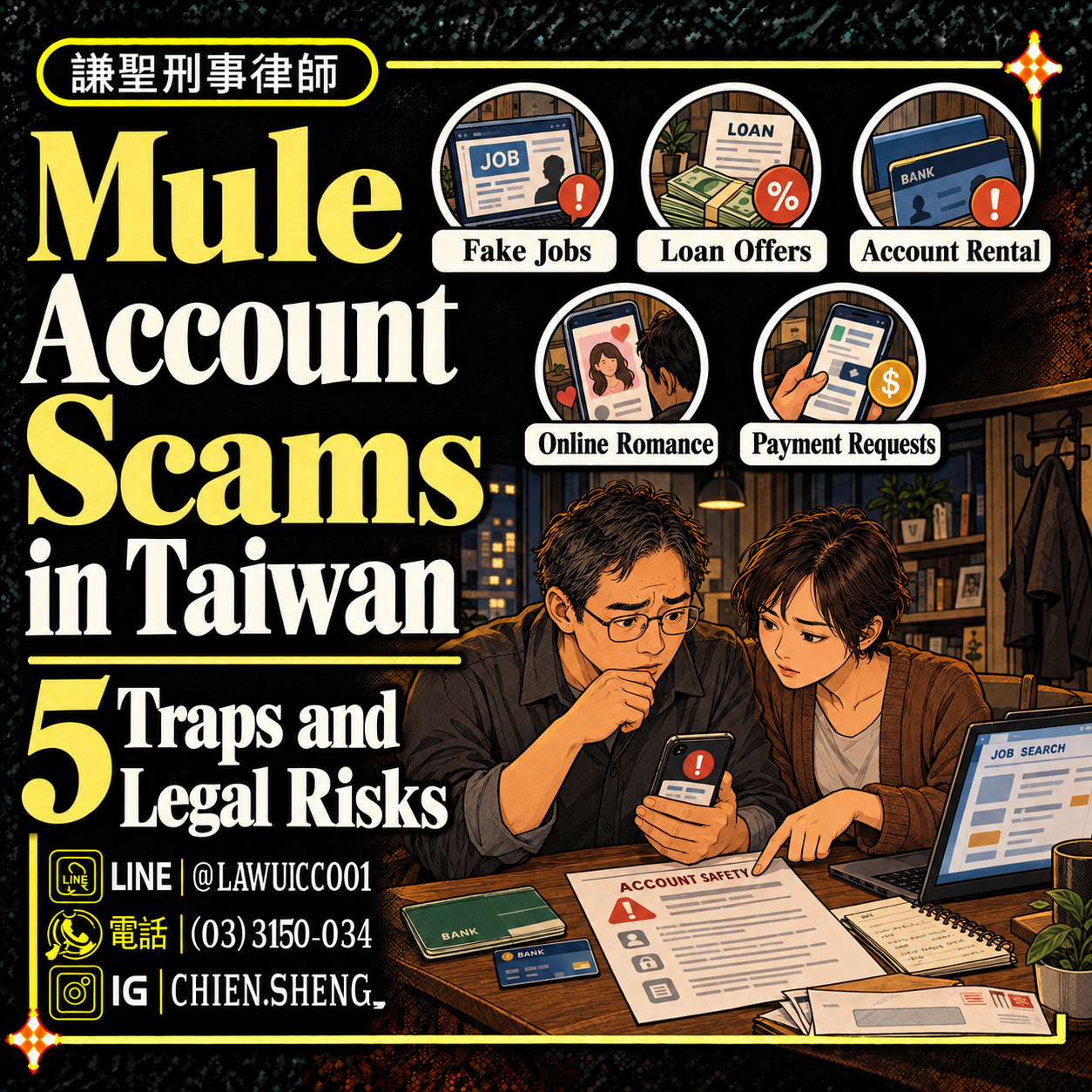
- 1. 1. Mule Account Scams in Taiwan: What Does the Label Mean?
- 2. 2. Three Legal Issues Must Be Considered Separately
- 3. 3. Five Common Scenarios That Can Lead to an Investigation
- 4. 4. A Warning Account Is Different From a Police Warning
- 5. 5. What to Do Immediately After Discovering Misuse
- 6. 6. Evidence That Helps Explain Lack of Criminal Intent
- 7. 7. Possible Outcomes: Non-Prosecution, Acquittal and Other Dispositions
- 8. 8. How Chien Sheng International Law Firm Can Help
-
9.
Frequently Asked Questions
- 9.1. Q1. Can Victims of Mule Account Scams in Taiwan Avoid Prosecution?
- 9.2. Q2. Is giving my account number to an employer illegal?
- 9.3. Q3. Can I face trouble for lending an account to a friend?
- 9.4. Q4. If I received no payment, am I safe?
- 9.5. Q5. Does a warning account mean I have been convicted?
- 9.6. Q6. Should I delete the messages and return the suspicious money myself?
- 9.7. Q7. Does non-prosecution automatically restore all account functions?
- 9.8. Official Sources📝
- 10. 📢【24-Hour Free Legal Consultation】
Mule Account Scams in Taiwan can begin with a job offer, loan application, investment opportunity or request from someone you trust. If your account receives suspected fraud proceeds, you may face banking restrictions and a criminal investigation. However, an account being used does not automatically establish that its holder knowingly assisted a crime.
The first priority is to secure the account, preserve the evidence and identify the procedure you are facing. Giving an employer payment details for salary deposits is different from handing over an ATM card, passwords or verification codes.
👨🏻⚖️Chien Sheng International Law Firm explains five common scenarios below, followed by the legal issues, evidence and practical steps that account holders should understand.
1. Mule Account Scams in Taiwan: What Does the Label Mean?
A “mule account” generally describes an account used to receive or move money for someone else, often as part of fraud or money laundering. The label does not itself establish a specific criminal offence.
💡Investigators need to determine who controlled the account, what its holder actually did and what they understood at the relevant time. An account opened using stolen identity information presents different issues from an account deliberately rented out for payment.
Likewise, providing an account number to receive an ordinary payment is not automatically the same as allowing another person to operate the account.
🚨Relevant questions include:
- Who could log in, withdraw funds or approve transfers?
- Were cards, passwords, devices or verification codes provided?
- Did the holder transfer money personally under instructions?
- What explanation was given for each payment?
- When did the holder discover something was wrong?
Account ownership is an important starting point, but it does not answer every question about responsibility.
2. Three Legal Issues Must Be Considered Separately
▫️Account provision under Article 22
Article 22 of Taiwan’s Money Laundering Control Act covers providing financial, virtual asset service and third-party payment accounts for another person’s use. It contains exceptions involving ordinary commercial or financial practices, trust between relatives or friends, and other legitimate reasons.
A breach may lead to a police warning. Criminal liability can arise where payment is promised or received, three or more accounts are provided, or a further breach occurs within five years after a warning. The criminal provision permits imprisonment of up to three years, short-term imprisonment, and/or a fine of up to NT$1 million.law.moj.gov.tw
➠Neither “only one account” nor “a friend asked me” settles the case. The applicable requirements and evidence must still be examined.
▫️Assisting fraud
Providing an account can support an allegation of assisting fraud where the required intent and assistance are established. Under Criminal Code Article 30, an accessory’s punishment may be reduced relative to the principal offence.law.moj.gov.tw
➠There is no universal rule that account-related fraud assistance carries a maximum sentence of three years. The underlying offence, the person’s role and applicable law matter.
▫️Money laundering
Moving suspected proceeds may also raise money laundering allegations. However, an unexplained deposit is not, by itself, a complete finding of guilt.
➠Investigators must examine the relevant conduct, the nature of the funds and the required mental element. Genuine deception and lack of criminal intent must be distinguished from knowingly accepting a criminal risk.law.moj.gov.tw
3. Five Common Scenarios That Can Lead to an Investigation
💡The following examples are illustrative. They are not descriptions of five newly verified cases or guarantees about how similar cases will be decided.
Trap 1: A job offer that requires account access
A recruiter advertises remote order processing, online shopping assistance or customer service. After an apparent interview, the applicant is told to send an ATM card and password to “activate payroll” or “test the account.”
Providing bank details for a salary deposit does not require surrendering the means to withdraw or transfer funds. Requests for passwords, security codes or control of a personal banking device should prompt immediate verification.If the account is later misused, preserve the advertisement, interview messages, contract, work assignments and delivery records. These materials help explain how the recruiter presented the arrangement and why the applicant believed it.
➠The existence of a job advertisement is relevant evidence, not automatic immunity. Investigators will also consider whether later instructions exposed an obvious criminal purpose.
Trap 2: A loan requiring “credit improvement” transfers
A supposed lender claims that incoming transfers and cash withdrawals are needed to improve creditworthiness or demonstrate repayment ability.
The applicant may be instructed to withdraw a deposit and hand it to a representative, believing it is part of the loan process. The deposit may instead be linked to another person’s fraud complaint.An incoming payment is not proof that a lender is genuine. Verify the business independently before allowing it to use an account or directing money onward.
➠For an existing case, preserve the loan application, fee requests, promised terms, transfer instructions and any money you personally lost. Do not invent an explanation for payments you cannot identify.
Trap 3: A friend asks to borrow an account
A friend says their account is unavailable and asks to receive a customer payment through yours. They may offer a fee or ask for ongoing access.
A genuine relationship can matter when assessing legitimate reasons, but it is not a blanket exemption. The purpose, transaction history, actual control and any payment for access remain important.A request to bypass another person’s account restrictions deserves particular attention. Ask why the payment cannot go directly to the proper recipient and obtain documents supporting the transaction.
➠If the arrangement has already occurred, keep the full conversation. A selective screenshot saying “please help” will rarely explain the complete financial relationship.
Trap 4: Cryptocurrency conversion or investment instructions
An online contact asks you to receive Taiwan dollar payments, buy USDT and transfer it to a specified wallet. Alternatively, they ask you to open an exchange account and give them access.Separate several questions: who paid, who owned the money, who controlled the exchange account, who controlled the destination wallet and what you understood about the transaction.
Using a recognised platform does not make every transfer lawful. Nor does sending equivalent cryptocurrency automatically exclude fraud or laundering allegations.
Where a business provides virtual asset services in Taiwan, check its applicable regulatory status. Taiwan has an anti-money-laundering registration framework; “licensed exchange” should not be used as a vague assurance that every service or transaction is approved.law.fsc.gov.tw
➠Keep platform statements, wallet addresses, transaction hashes and complete instructions. Do not rely only on screenshots showing a successful transfer.
Trap 5: Selling or renting an unused account
Someone offers payment for an account, ATM card or online banking access, claiming that the arrangement is harmless because the account is rarely used.Payment for account access creates a distinct Article 22 risk. It can also be relevant to whether the holder knowingly assisted fraud or laundering. An agreement to pay can matter even if the promised fee never arrives.law.moj.gov.tw
Investigators must nevertheless establish the elements of each alleged offence.
➠Do not continue an arrangement to “recover the fee,” and do not provide replacement accounts when the first account becomes restricted.
4. A Warning Account Is Different From a Police Warning
🔔Several processes may operate alongside each other.
▪️A warning account designation, commonly called 警示帳戶, concerns an account reported through the relevant law-enforcement and banking procedures. It can restrict transactions and may affect other accounts through related controls.npa.gov.tw
▪️An Article 22 police warning, commonly called 告誡, is a separate administrative measure that can produce financial service restrictions.cib.npa.gov.tw
▪️A criminal investigation determines whether an offence can be established. Neither a banking restriction nor an administrative warning is itself a criminal conviction.
▪️Ask the bank and investigating authority which measure applies. Keep every notice rather than assuming that all restrictions have the same legal basis.
▪️A non-prosecution decision does not automatically resolve every warning or banking restriction. Check the applicable removal or administrative remedy procedure separately.
5. What to Do Immediately After Discovering Misuse
▫️Secure accounts through official channels
Contact the bank or platform using independently verified contact details. Explain which cards, passwords, devices or access permissions may have been compromised and request appropriate security measures.
➠Do not provide further verification codes to the original contact. Do not transfer suspicious funds merely because that person claims the transfer will “clear your name.”
▫️Preserve original evidence
Keep the original device and available message exports, emails, advertisements, contracts, delivery receipts and transaction records. Do not delete unfavourable messages or modify files.
➠Preserve context: a complete conversation may explain an instruction that looks suspicious when viewed alone.
▫️Report suspected deception and keep the record
Provide an accurate account of what happened and retain the report details. Reporting can help document the discovery timeline, but it does not automatically eliminate responsibility for earlier conduct.
➠If you are already a suspect, obtain advice about presenting the facts and supporting materials clearly.
▫️Check all official notices
Identify the issuing authority, case number, attendance date and your stated procedural status. Do not ignore a summons because you believe you were also a victim.
➠If attendance is genuinely impossible, contact the authority promptly and follow its requirements for requesting leave or rescheduling.
▫️Obtain advice before making assumptions
A lawyer can help separate account control, personal transfers, fraud allegations and administrative restrictions. You may also exercise applicable rights to silence, counsel and the investigation of favourable evidence.law.moj.gov.tw
➠If you give a statement, be accurate. Say when a date or amount needs checking rather than guessing.
6. Evidence That Helps Explain Lack of Criminal Intent
The central task is to reconstruct what you knew when you acted.
👨🏻⚖️Organise the evidence into a chronological account:
- How you encountered the recruiter, lender, trader or acquaintance.
- What explanation they gave and what documents they supplied.
- What account information or access you provided.
- Which payments you received, withdrew or transferred.
- Whether you received a fee or suffered a personal loss.
- When you first noticed a problem and what you did afterward.
➠No fee, limited experience or personal financial loss can be relevant, but none is conclusive by itself. Equally, following instructions does not automatically prove participation in a criminal plan.
➠The prosecution must establish the alleged offence. Providing supporting material helps clarify the facts; it does not shift the entire burden of proving innocence onto the account holder.
7. Possible Outcomes: Non-Prosecution, Acquittal and Other Dispositions
▫️Non-prosecution
If the evidence does not establish sufficient suspicion of an offence, the prosecutor may issue a non-prosecution disposition under the applicable statutory grounds. A genuine deception account should be supported by records, not simply a denial.law.moj.gov.tw
▫️Acquittal
If the case reaches court, the defence can still challenge the evidence and legal elements. An acquittal and a non-prosecution disposition arise at different stages, and their finality should be checked.law.moj.gov.tw
▫️Deferred prosecution
Deferred prosecution is subject to statutory eligibility and prosecutorial assessment. It is not automatically available for every fraud or laundering allegation, and compliance with imposed conditions matters.law.moj.gov.tw
▫️A suspended sentence
A suspended sentence follows a conviction. It requires the relevant sentence and prior-record conditions, as well as a judicial assessment that suspending execution is appropriate.law.moj.gov.tw
➠Settlement and repayment may influence sentencing, but neither guarantees a suspended sentence nor automatically erases liability. Account warnings and civil claims may require separate attention.
8. How Chien Sheng International Law Firm Can Help
The firm can review the alleged account handover, access records, payment instructions and communications; identify the relevant offence and legal version; and prepare a factual account supported by evidence.
🔎Where appropriate, the work may include interview attendance, submissions seeking non-prosecution, trial defence, settlement discussions or sentencing submissions. Advice should follow the evidence rather than start with a promised outcome.
📑Related firm case pages include:
- Online loan deception and an account-related non-prosecution outcome.
- A home-based work arrangement involving bank cards and an account-related investigation.
These links are provided as related case introductions. Their individual facts, legal dates and outcomes cannot be assumed to apply to another account holder.
👨🏻⚖️To arrange a consultation, contact Chien Sheng International Law Firm through its official LINE. Prepare the bank notice, summons, account statements and complete communications.
Frequently Asked Questions
Q1. Can Victims of Mule Account Scams in Taiwan Avoid Prosecution?
Possibly. The outcome depends on the alleged offence, the evidence and the person’s understanding when they acted. Being deceived is important, but it should be examined alongside the communications and financial records.
Q2. Is giving my account number to an employer illegal?
Not automatically. Ordinary salary payment details differ from giving someone an ATM card, passwords or authority to operate the account. The actual arrangement matters.
Q3. Can I face trouble for lending an account to a friend?
Yes, depending on the facts. A friendship is not automatic immunity, although genuine trust and legitimate reasons may be relevant to the applicable account-provision rules.
Q4. If I received no payment, am I safe?
Not necessarily. No payment does not exclude every account-provision, fraud or laundering issue. It is one fact among several.
Q5. Does a warning account mean I have been convicted?
No. A warning designation is different from a criminal judgment. You should still respond to the investigation and check the procedure for addressing the restriction.
Q6. Should I delete the messages and return the suspicious money myself?
Do not delete evidence or follow an unknown person’s repayment instructions. Contact the bank and authorities through verified channels and obtain advice about lawful handling of the funds.
Q7. Does non-prosecution automatically restore all account functions?
Not necessarily. Identify whether the restriction comes from a warning designation, an administrative warning or another banking measure, and follow the relevant process.This article provides general information based on sources checked on 19 October 2026. It is not individual legal advice or a guarantee of any outcome. The applicable Chinese legislation, offence date and complete case records remain essential.
Official Sources📝
- Money Laundering Control Act, Article 22
- Criminal Code, Article 30: Accessories
- Criminal Code, Article 339: Fraud
- Criminal Code, Article 74: Suspended Sentences
- FSC Regulations Governing AML Registration of Virtual Asset Service Providers
- Criminal Investigation Bureau: Removing a Warning Account Designation
📢【24-Hour Free Legal Consultation】
🏛 Taipei Office: 6F., No. 64, Kangding Rd., Wanhua Dist., Taipei City|02-2388-8962
🏛 Taoyuan Office: 17F., No. 95, Xinpu 6th St., Taoyuan Dist., Taoyuan City|(03)3150-034
🏛 Kaohsiung Office: 3F., No. 687, Mingcheng 3rd Rd., Gushan Dist., Kaohsiung City
Contact Us on LINE for a Free Consultation: @lawuicc001
IG: chien.sheng_
FB: Chien Sheng International Law Firm
💳 We Accept Cash, Credit Cards, and Bank Transfers.