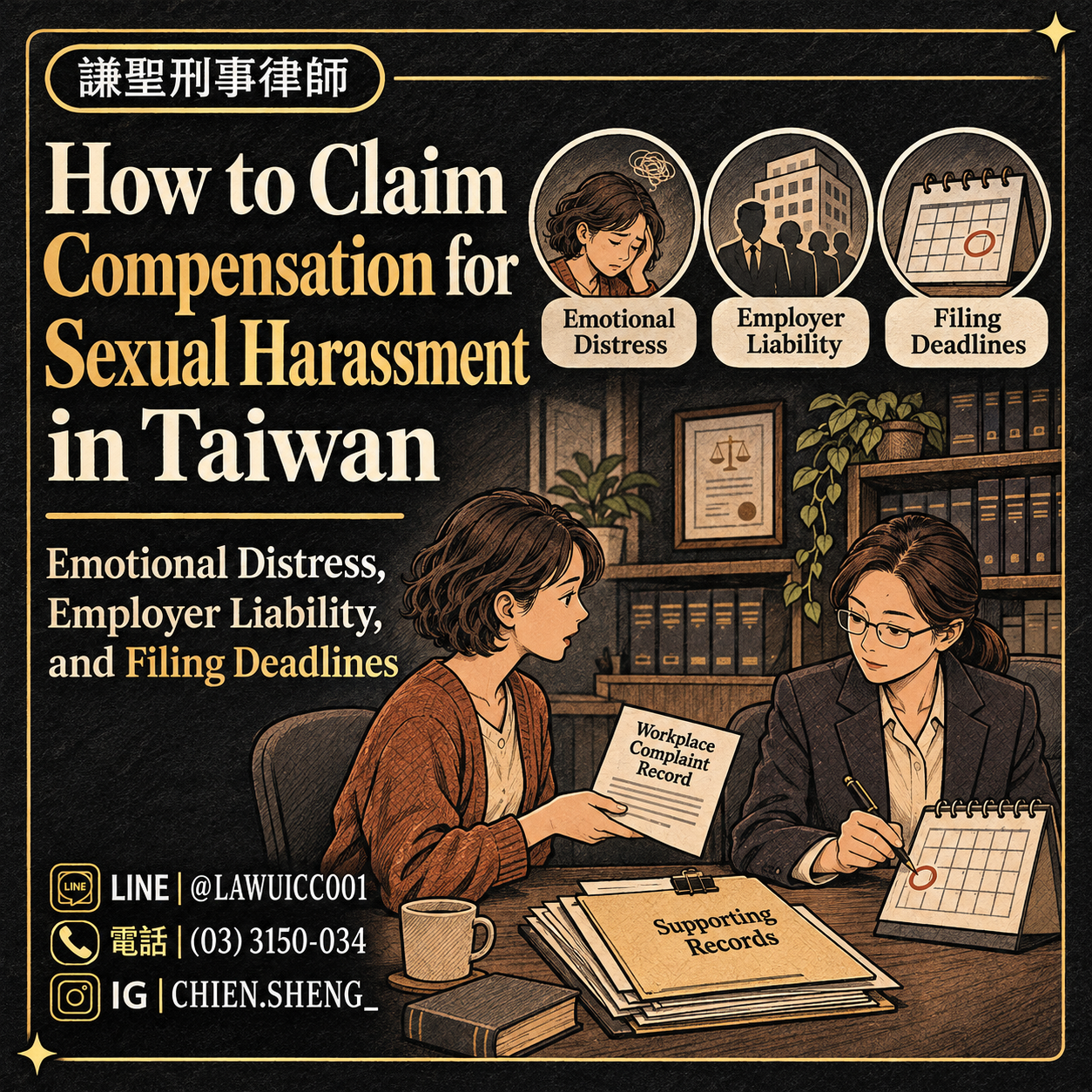
- 1. 1.How to Claim Compensation for Sexual Harassment in Taiwan: What Can You Recover?
- 2. 2.Who Can Be Held Liable?
- 3. 3.When Can You Ask for Punitive Damages?
- 4. 4.Filing Deadlines: Civil Claims, Administrative Complaints, and Criminal Complaints
- 5. 5.How to Prepare a Claim and Choose a Procedure
-
6.
6.Frequently Asked Questions
- 6.1. Q1 : Can I claim compensation for sexual harassment in Taiwan without filing a criminal complaint?
- 6.2. Q2 :Can I pursue a claim if I have messages but no eyewitness?
- 6.3. Q3 :How much can I ask for in emotional distress damages?
- 6.4. Q4 :Can I make a complaint while I still work for the employer?
- 6.5. Q5 :Does accepting a settlement payment end every proceeding?
- 7. 📢【24-Hour Free Legal Consultation】
You may be able to claim compensation for sexual harassment in Taiwan for emotional distress, medical or counseling expenses, and lost income. In a workplace case, your employer may also be liable. You generally do not need to wait for a criminal conviction before bringing a separate civil claim. The first steps are to identify who may be liable, preserve evidence of what happened and how it affected you, and check the deadline for each procedure you are considering. moj.gov.tw
1.How to Claim Compensation for Sexual Harassment in Taiwan: What Can You Recover?
Article 12 of Taiwan’s Sexual Harassment Prevention Act allows a person who has experienced harassment to seek damages, including compensation for non-financial harm. Depending on the facts, Articles 184 and 195 of the Civil Code and the laws governing workplaces or schools may also provide a basis for recovery. moj.gov.tw
▫️Emotional distress
Taiwan law does not set a fixed award for emotional distress in sexual harassment cases. When explaining the amount you seek, describe the conduct and its effect on your life. How often did it happen? Did the other person control your assignments, evaluations, or grades? Did you start experiencing sleep problems, take time off, or change your work or study routine?
➠Medical or counseling records can help document the impact, but they are not the only evidence. Messages you sent to someone you trusted, testimony from people who noticed changes, and records of changes to work or school attendance can also help explain what happened. A figure from another case is less useful than evidence of the harm in your own case.
▫️Medical expenses, counseling costs, and lost income
You may be able to recover expenses and financial losses caused by the harassment. Keep receipts for treatment, counseling, and medication. If you lost pay, keep payslips, leave records, and documents showing changes to your hours or employment. A receipt establishes what you paid; your timeline and supporting records help explain why the expense or loss was connected to the incident.
➠If your reputation was also harmed, the applicable law may allow an appropriate remedy to restore it. That does not mean a court will automatically order the other person to apologize publicly. moj.gov.tw
2.Who Can Be Held Liable?
The applicable law depends on the relationship between the people involved and the circumstances of the conduct. Location is only one factor. For example, if the person who sent the messages supervises you at work, save the messages and records showing that reporting relationship, even if the messages arrived after work. law.moj.gov.tw
▫️General settings: The person who committed the harassment
Where the Sexual Harassment Prevention Act applies, Article 12 provides a basis for claiming damages from the person responsible. A venue operator or event organizer does not automatically owe compensation because the incident happened on its premises. A claim against a third party needs its own legal basis and supporting facts. moj.gov.tw
▫️Workplace cases: The individual and the employer
Under Article 27 of the Gender Equality in Employment Act, an employer and the person responsible are generally jointly and severally liable for harm suffered by an employee or job applicant covered by the provision. This means the claimant may seek the full amount from either liable party, subject to the statutory rules. The employer can defend against joint liability by proving it complied with the law’s prevention requirements and made every effort to prevent the incident, but could not avoid it. In certain circumstances, if that defense leaves the claimant unable to recover, the court may still order the employer to pay all or part of the damages upon request, taking both parties’ financial circumstances into account. moj.gov.tw
💡Article 28 addresses a separate issue: whether the employer’s failure to take immediate and effective corrective or remedial measures under Article 13(2) caused harm. For example, if you reported repeated messages from a supervisor and the conduct continued, keep your report, the employer’s response, and records of what happened afterward. These help establish when the employer learned about the problem, what it did, and whether a failure to act caused further harm. law.moj.gov.tw
▫️Campus cases: Staff liability and school liability are separate
Article 42 of the Gender Equity Education Act provides for damages where a student is harmed by a covered campus gender incident committed by a principal, teacher, staff member, or school worker. The provision addresses the individual’s liability. Whether the school itself can be held liable requires a separate assessment of its duties, conduct, and relationship to the person responsible. If another student committed the harassment, a Civil Code claim may still be possible. law.moj.gov.tw
3.When Can You Ask for Punitive Damages?
Punitive damages are available in specified circumstances and must be requested. Check which statute applies and what role the person held:
- General harassment cases involving abuse of power: Article 12 of the Sexual Harassment Prevention Act allows punitive damages of one to three times the amount of harm in qualifying cases. moj.gov.tw
- Workplace harassment involving abuse of power: Article 27 of the Gender Equality in Employment Act provides for one to three times the amount of harm in qualifying cases, or a claim of three to five times if the person responsible is the organization’s highest-ranking responsible person or the employing person. A supervisor’s job title alone does not establish eligibility for the higher range. moj.gov.tw
- Covered campus incidents: Under Article 42 of the Gender Equity Education Act, a court may award one to three times the amount of harm, or three to five times if the person responsible is the principal. law.moj.gov.tw
4.Filing Deadlines: Civil Claims, Administrative Complaints, and Criminal Complaints
Calculate each deadline separately. A pending HR investigation or administrative complaint does not, by itself, give you more time to file a civil claim.
- Civil damages: Under Civil Code Article 197, the general tort limitation period is two years from when you know both that you suffered harm and who is liable, with an outer limit of ten years from the wrongful act. Article 30 of the Gender Equality in Employment Act sets corresponding two-year and ten-year periods for the claims it covers. For an employer’s own breach, identify the relevant breach date as well as the date of the underlying harassment. law.moj.gov.tw
- Administrative complaints under the Sexual Harassment Prevention Act: Article 14 generally allows two years from learning of the incident, subject to a five-year outer limit from the incident, for cases not involving abuse of power. For abuse-of-power cases, the corresponding periods are three and seven years. Special rules apply if the person affected was a minor when the incident occurred. law.moj.gov.tw
- Workplace complaints: Article 32-1 provides a route to the local competent authority in specified situations, including when the complaint concerns the highest-ranking responsible person or the employing person, when the employer fails to act, or when the complainant disputes the investigation or disciplinary outcome. That route has its own deadlines, with special rules for some minors and former employees. law.moj.gov.tw
- Criminal complaints: Whether there is a criminal offense, whether a formal complaint is required for prosecution, and the applicable filing period are separate questions. If the conduct may be criminal, check the deadline for the specific offense promptly rather than relying on the civil or administrative periods. law.moj.gov.tw
5.How to Prepare a Claim and Choose a Procedure
- Build a timeline. Record the dates, places, people involved, what was said or done, when you reported it, and what happened next. Keep full message threads, emails, and original files where available. If surveillance footage may exist, ask the holder promptly in writing to preserve it.
- Document the harm. List expenses and income losses separately from emotional distress. Match each expense or loss with supporting records. For a workplace case, keep copies of your complaint, any acknowledgment, and the employer’s response.
- Choose the procedures that address what you need. A workplace or school complaint can address the conduct and help secure protective measures. A criminal complaint may be appropriate if the facts indicate an offense. A civil action is the route for asking a court to award damages. These procedures can sometimes run in parallel. law.moj.gov.tw
- Read settlement terms before signing. Check the amount, payment dates, consequences of missed payments, claims being released, and any complaint you are agreeing to withdraw. Article 18 of the Sexual Harassment Prevention Act allows local-authority mediation for cases not involving abuse of power. A court-approved settlement can affect pending or future proceedings under Article 21, depending on its terms and the procedural stage. law.moj.gov.tw
- File in the appropriate court if needed. A civil complaint should identify the defendants, the conduct, the legal basis, the relief requested, and the supporting evidence. If a criminal case has already been prosecuted, you may be able to bring an ancillary civil action under Articles 487–488 of the Code of Criminal Procedure. Check eligibility and timing before deciding to wait for that route. law.moj.gov.tw
6.Frequently Asked Questions
Q1 : Can I claim compensation for sexual harassment in Taiwan without filing a criminal complaint?
Yes, potentially. A separate civil claim generally does not require a criminal complaint or conviction. A decision not to prosecute also does not automatically rule out civil recovery. You still need evidence supporting the conduct, the harm it caused, and the defendant’s liability. moj.gov.tw
Q2 :Can I pursue a claim if I have messages but no eyewitness?
Yes, potentially. Preserve the complete thread, including sender information, timestamps, and surrounding messages. A timeline, work or school records, and testimony from someone you told can help put the messages in context.
Q3 :How much can I ask for in emotional distress damages?
There is no fixed amount. Explain why the amount you request is reasonable in light of the conduct, its duration or frequency, any power imbalance, and the documented impact on your daily life. The court decides what to award based on the case.
Q4 :Can I make a complaint while I still work for the employer?
Yes. Article 36 of the Gender Equality in Employment Act prohibits dismissal, transfer, or other adverse treatment because an employee filed or assisted with a complaint under the Act. If your duties or hours change after you report the incident, keep the relevant notices and records. law.moj.gov.tw
Q5 :Does accepting a settlement payment end every proceeding?
Not necessarily. A private settlement, a formal withdrawal, and a court-approved statutory mediation agreement can have different effects. Before signing, check exactly which claims the agreement releases, which proceedings it affects, and whether any withdrawal is tied to payment. law.moj.gov.tw
👨🏻⚖️If you are considering a claim, bring your timeline, original communications, complaint records, and evidence of losses to a consultation with Chien Sheng International Law Firm. These materials help identify the proper defendants, assess the applicable deadlines, and decide whether mediation or litigation is the better next step.
🔎Related reading: Sexual harassment and forcible indecency under Taiwan law · How sexual harassment complaints are handled
🔎Official references: Sexual Harassment Prevention Act · Gender Equality in Employment Act · Gender Equity Education Act · Civil Code Article 197
※This article provides general information on Taiwan law. The applicable rules and deadlines depend on the facts, dates, and legal basis of each claim.
📢【24-Hour Free Legal Consultation】
🏛 Taipei Office: 6F., No. 64, Kangding Rd., Wanhua Dist., Taipei City|02-2388-8962
🏛 Taoyuan Office: 17F., No. 95, Xinpu 6th St., Taoyuan Dist., Taoyuan City|(03)3150-034
🏛 Kaohsiung Office: 3F., No. 687, Mingcheng 3rd Rd., Gushan Dist., Kaohsiung City
Contact Us on LINE for a Free Consultation: @lawuicc001
IG: chien.sheng_
FB: Chien Sheng International Law Firm
💳 We Accept Cash, Credit Cards, and Bank Transfers.