
- 1. 1. Understanding the Basic Offense and the Meaning of Intercourse
- 2. 2. Prison Sentences, Attempts, and Limitation Periods
-
3.
3. The Nine Aggravating Circumstances
- 3.1. 3.1 Two or More People Acting Jointly
- 3.2. 3.2 A Victim Under Fourteen
- 3.3. 3.3 A Victim with a Specified Disability or Mental Impairment
- 3.4. 3.4 Use of Drugs or Medicinal Substances
- 3.5. 3.5 Cruel Treatment of the Victim
- 3.6. 3.6 Exploiting the Operation of Public Transport
- 3.7. 3.7 Intrusion into or Concealment Inside Specified Premises
- 3.8. 3.8 Carrying a Dangerous Weapon
- 3.9. 3.9 Recording or Distributing Material Involving the Victim
- 4. 4. Questions to Examine Before Accepting an Aggravating Allegation
- 5. 5. Accused of Aggravated Sexual Assault in Taiwan: First Steps
- 6. 6. What Evidence Matters in a Sexual Offense Case?
- 7. 7. From Police Investigation to Trial and Appeal
- 8. 8. Settlement, Sentencing, and Civil Compensation
-
9.
9. Frequently Asked Questions
- 9.1. 9.1 What should I do if I am accused of aggravated sexual assault in Taiwan?
- 9.2. 9.2 Does the charge automatically mean a life sentence?
- 9.3. 9.3 Can oral or anal acts count as intercourse?
- 9.4. 9.4 Is being present enough to establish joint participation?
- 9.5. 9.5 Does a minor’s apparent agreement eliminate liability?
- 9.6. 9.6 Can family members negotiate directly with the complainant?
- 9.7. 9.7 Can I clarify a statement I already signed?
- 9.8. 9.8 Will a past acquittal in a similar case predict my result?
- 10. 10. How Chien Sheng Law Firm Can Assist
- 11. 📢【24-Hour Free Legal Consultation】
If you are accused of aggravated sexual assault in Taiwan, start by confirming the allegation, preserving relevant records, and speaking with a criminal defense lawyer before giving a detailed account. Article 222 of Taiwan’s Criminal Code addresses sexual intercourse against another person’s will when a specified aggravating circumstance exists. An accusation requires careful investigation; it does not establish guilt.
These cases can involve a substantial prison sentence, disputes over consent, medical evidence, digital records, and separate compensation claims. The practical questions are whether the underlying offense is established, whether the alleged aggravating factor is supported, and whether the investigation has respected the defendant’s procedural rights.
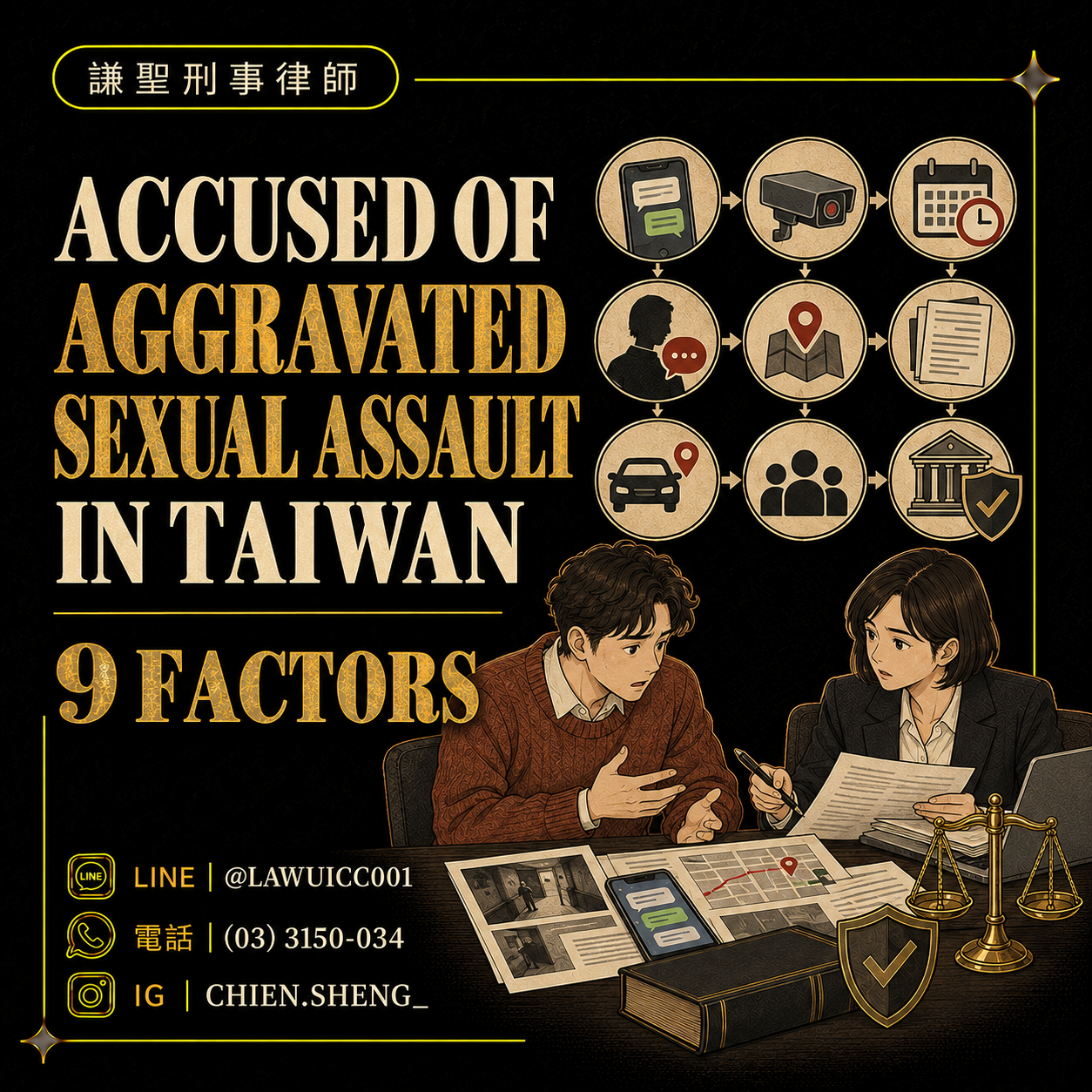
💡This guide explains the applicable provisions and the steps a defendant or family member can take. It uses “aggravated sexual assault” to describe the Article 222 offense commonly called 加重強制性交罪. Other sexual offenses have different requirements and should not be treated as interchangeable.
1. Understanding the Basic Offense and the Meaning of Intercourse
Article 221 concerns sexual intercourse carried out through violence, coercion, intimidation, hypnosis, or another method contrary to the other person’s will. Its prescribed punishment is imprisonment for three to ten years. Article 222 builds on that offense and adds specified aggravating circumstances. web.law.ntpc.gov.tw
The legal definition of intercourse is broader than penile-vaginal intercourse. Article 10 includes specified sexual penetration or contact involving sexual organs, the anus, or the mouth, as well as specified acts involving other body parts or objects. Oral or anal acts can therefore fall within the intercourse definition; they are not automatically classified as indecent assault. web.law.ntpc.gov.tw
Identifying the actual alleged act is essential. A police notice using a general description such as “sexual offense” may not explain whether investigators are examining intercourse, indecent assault, exploitation of incapacity, or conduct involving a minor.
🚨For the initial consultation, write down what investigators have said, which provision appears on the notice, and what conduct is alleged. Keep the notice itself. Counsel can then separate questions about the physical act, the method used, the other person’s will, and the defendant’s state of mind.
2. Prison Sentences, Attempts, and Limitation Periods
The standard prescribed punishment under Article 222 is fixed-term imprisonment of at least seven years. The provision itself does not prescribe life imprisonment. Attempted offenses are also punishable. mojlaw.moj.gov.tw
Under Article 33, the ordinary upper limit for fixed-term imprisonment is fifteen years, with a twenty-year limit where a statutory increase applies. Multiple offenses, separate sentencing rules, or additional offenses involving serious consequences require a separate analysis. A headline stating “seven years to life” therefore does not accurately describe Article 222 alone. web.law.ntpc.gov.tw
Whether conduct is an attempt or a completed offense depends on the proven acts and the statutory definition, rather than simply whether a particular medical finding exists.Do not assume that a first offense, an apology, or a settlement removes the minimum sentence. A sentence below the ordinary minimum needs a legally applicable basis for reduction. Counsel should identify that basis and explain its consequences before discussing likely outcomes.
Limitation periods also require care. Article 80 generally places offenses with a maximum punishment of ten years or more within a thirty-year prosecution period. For specified sexual offenses against someone under twenty, time before the victim turns twenty is excluded from the calculation. Older incidents may involve transitional rules, interruptions, or other issues. web.law.ntpc.gov.tw
➠Record the alleged incident date accurately. A limitation analysis should use the law applicable to the incident and the procedural history, rather than a generic statement that every case expires after twenty years.
3. The Nine Aggravating Circumstances
Article 222 lists nine circumstances. The following is a summary, not a substitute for examining each statutory element. mojlaw.moj.gov.tw
3.1 Two or More People Acting Jointly
The offense is committed jointly by at least two people.
3.2 A Victim Under Fourteen
The offense is committed against a person younger than fourteen.
3.3 A Victim with a Specified Disability or Mental Impairment
The victim has a mental or physical disability or another mental impairment.
3.4 Use of Drugs or Medicinal Substances
The offense is committed using a drug or medicinal substance.
3.5 Cruel Treatment of the Victim
The perpetrator subjects the victim to cruel treatment.
3.6 Exploiting the Operation of Public Transport
The perpetrator takes advantage of driving transport serving the public or unspecified passengers.
3.7 Intrusion into or Concealment Inside Specified Premises
The offense involves entering a residence or occupied building or vessel unlawfully, or hiding inside it.
3.8 Carrying a Dangerous Weapon
The perpetrator carries a dangerous weapon when committing the offense.
3.9 Recording or Distributing Material Involving the Victim
The circumstance involves photographing, recording, filming, distributing, or broadcasting the specified material.
4. Questions to Examine Before Accepting an Aggravating Allegation
A useful defense review separates the allegation into specific factual questions. The following are practical review points; their answers must be assessed against the applicable law and evidence.For a group allegation, identify who was present, what each person actually did, and what communications show about their understanding. A group photograph, shared address, or friendship does not describe each participant’s conduct.
For an allegation involving age, obtain reliable information about the person’s age at the time and examine what the defendant knew. Article 227 separately criminalizes specified sexual acts with minors. An assertion of agreement does not automatically make sexual activity with a minor lawful. mojlaw.moj.gov.tw
For an allegation involving disability, do not equate a diagnosis with an inability to make every sexual decision. Examine the person’s circumstances and the conduct alleged. Article 225 separately addresses exploitation of a person who cannot or does not know how to resist because of specified conditions. mojlaw.moj.gov.tw
⚠️Where substances are involved, prepare a timeline of drinks, medication, alleged administration, symptoms, and any testing. The important questions include who supplied the substance, what it was, and how it relates to the alleged conduct. Avoid treating every incident involving alcohol as proof of drug-assisted assault.For a premises allegation, preserve invitations, access messages, entry records, and information about the location. Permission to enter and later concealment are different factual questions. An initially authorized visit does not, by itself, establish that the visitor hid inside.
For a weapon allegation, identify the item, its characteristics, and evidence placing it with the defendant during the alleged offense. For an image allegation, examine the original file, creation time, participants, and distribution history. Do not circulate intimate material to explain the case.This issue-by-issue approach helps counsel distinguish established facts from assumptions and identify which records should be obtained promptly.
5. Accused of Aggravated Sexual Assault in Taiwan: First Steps
5.1 Confirm the Notice and Your Procedural Status
Check whether the document is a police attendance notice, a prosecutor’s summons, or a court notice. Record the issuing office, case number, stated allegation, and attendance date.Tell counsel whether you have already been questioned and whether you signed a statement. Bring every relevant notice rather than describing it from memory. Different documents can indicate different stages of the same proceedings.
5.2 Preserve Complete Records
Save relevant conversations, call records, travel information, receipts, booking details, and location records. Preserve original files and devices where possible. A screenshot without its surrounding messages may leave important context unexplained.
➠Some information is held by third parties, such as building managers, transport providers, or businesses with cameras. Give counsel the location and approximate time so that a lawful preservation or investigation request can be considered before records disappear.
5.3 Prepare an Accurate Timeline
Separate what you personally remember from information learned later. Include arrival and departure times, who was present, communications before and after the incident, and any uncertainty.
➠If you cannot remember an event, say so. Do not convert an estimate into a precise time merely to make the account look complete. A clear explanation of uncertainty is more useful than an invented detail.
5.4 Understand Your Questioning Rights
Article 95 provides rights concerning notice of the suspected offense, silence, selection of defense counsel, and requests to investigate favorable evidence. web.law.ntpc.gov.tw
➠Discuss these rights before substantive questioning when possible. Read the written record carefully before signing and request corrections where it does not accurately reflect your answers. Explain translation or comprehension difficulties promptly.
5.5 Avoid Interference with Evidence or Witnesses
Do not delete messages, ask others to coordinate accounts, or pressure the complainant to withdraw the allegation. If settlement discussions are appropriate, counsel can assess a lawful and respectful channel.Family members can help collect existing documents and arrange legal representation. They should distinguish information they personally know from assumptions about what happened.
6. What Evidence Matters in a Sexual Offense Case?
Evidence should be examined for what it actually establishes. A record may support one element of an allegation while leaving another unresolved.
Medical findings, biological samples, and DNA results may be relevant to contact, injury, or identity. Their interpretation depends on the examination, collection method, timing, and surrounding evidence. A biological finding does not automatically answer every question about consent or the alleged aggravating circumstance.
💡Digital evidence may include messages, original photographs, recordings, device data, and communications with other people. Counsel should examine completeness, authenticity, timestamps, and whether a record refers to the incident being investigated.Witness evidence also needs careful separation. A witness who observed an event offers different information from someone who later heard an account. Both may be relevant, but the source and scope of each person’s knowledge should remain clear.
A prior relationship, earlier consensual intimacy, or willingness to meet does not establish agreement to the particular act alleged. Likewise, a person’s clothing or social behavior should not replace an assessment of the actual events.
📝The defense should identify material contradictions, missing context, or alternative explanations through evidence. It should not depend on stereotypes about how a person “must” behave after an assault.Prepare a list connecting each disputed issue to the available material. For example, transport records may help establish arrival time, while a conversation may explain why a meeting occurred. This makes an evidence request more precise than simply asking investigators to “check everything.”
7. From Police Investigation to Trial and Appeal
7.1 Police and Prosecutorial Investigation
Police may collect statements, obtain records, and refer the case to a prosecutor. The prosecutor evaluates the evidence and decides the appropriate disposition.
Defense counsel can explain the client’s position, submit supporting material, and request investigation of specific evidence. Requests should identify why the material matters and, where known, who holds it.Access to the complete prosecution file during an investigation is not automatically equivalent to access during trial. Counsel must use the disclosure and access procedures available at the particular stage.
7.2 Detention Proceedings
A serious allegation does not automatically mean detention. Article 101 requires the applicable suspicion, risk, and necessity conditions. web.law.ntpc.gov.tw
Counsel can examine the asserted grounds, including alleged flight risk or risk of evidence interference, and present relevant circumstances. Stable accommodation or employment may be useful information, but neither guarantees release.Keep detention documents separate from documents addressing guilt. A detention decision concerns custody during proceedings; it is not a final criminal judgment.
7.3 Court Proceedings
After indictment, the defense should review the charges and available file materials, identify disputed elements, and prepare appropriate evidence requests.
Questions about admissibility, witness examination, expert interpretation, and the legal classification of the acts may arise. The appropriate approach depends on the records and the court’s procedural directions.A defense may dispute the entire allegation, a particular aggravating factor, or sentencing issues. Those positions should follow the evidence and the client’s instructions.
7.4 Appeals and Extraordinary Remedies
Article 349 generally provides a twenty-day appeal period calculated from service of the judgment. Save the envelope and service information and ask counsel to calculate the applicable deadline promptly. web.law.ntpc.gov.tw
An appeal should identify concrete problems in the judgment, such as a disputed inference, an omitted evidentiary issue, or an incorrect legal application. Extraordinary remedies, including retrial, require their own statutory grounds; they are not automatic extensions of an ordinary appeal.
8. Settlement, Sentencing, and Civil Compensation
8.1 Settlement Does Not Automatically End Prosecution
Article 222 is not an offense whose prosecution ends simply because the complainant withdraws a complaint. A private agreement therefore should not be presented as a guarantee that the criminal proceedings will stop.
➠Where appropriate, compensation and efforts to address harm can be relevant to sentencing. Their weight depends on the circumstances. A settlement must be voluntary and should not involve pressure, threats, or conditions aimed at changing truthful evidence.
8.2 A Suspended Sentence Requires Separate Eligibility
Article 74 generally requires a sentence of no more than two years’ imprisonment, detention, or a fine, together with the applicable prior-conviction conditions and a judicial assessment that suspension is appropriate. web.law.ntpc.gov.tw
➠Given the ordinary seven-year minimum under Article 222, a suspended sentence cannot realistically be promised just because the defendant has no prior conviction. Counsel must first examine whether any lawful reductions apply and what sentence could result.
8.3 Compensation Is Assessed Individually
Civil liability can involve treatment expenses, lost income, other proven losses, and compensation for non-financial harm. Article 195 provides a basis for compensation for specified infringements of personal interests even without financial loss. mojlaw.moj.gov.tw
➠There is no universal compensation tariff for these cases. The proven harm, its consequences, causation, and applicable liability rules matter. Where several people allegedly participated, responsibility must also be assessed under the rules governing joint wrongdoing.Keep receipts, payment records, written agreements, and correspondence concerning compensation. A proposed payment should be reviewed for its civil and criminal implications before it is made.
9. Frequently Asked Questions
9.1 What should I do if I am accused of aggravated sexual assault in Taiwan?
Confirm the allegation and attendance date, preserve complete records, and consult defense counsel. Discuss questioning rights and prepare a factual timeline. Do not guess, delete material, or seek coordinated accounts from other people.
9.2 Does the charge automatically mean a life sentence?
No. Article 222 itself prescribes fixed-term imprisonment of at least seven years. Other offenses and sentencing rules require separate review.
9.3 Can oral or anal acts count as intercourse?
Yes. Conduct meeting Article 10’s definition can qualify. The legal classification depends on the act, not solely on whether penile-vaginal intercourse occurred.
9.4 Is being present enough to establish joint participation?
Presence should be distinguished from participation. Counsel needs to examine the alleged actions, communications, and relevant state of mind rather than treating everyone at a location identically.
9.5 Does a minor’s apparent agreement eliminate liability?
No. Article 227 separately regulates sexual acts involving minors. Age, capacity, the alleged methods, and the applicable provision must all be examined.
9.6 Can family members negotiate directly with the complainant?
Direct contact may create misunderstandings or concerns about pressure. Have counsel assess whether discussions are appropriate and how to respect the complainant’s wishes and any applicable restrictions.
9.7 Can I clarify a statement I already signed?
Counsel can assess how to submit a clarification or request further investigation. Explain precisely what was incomplete or inaccurate and why. A later account should be supported where possible, rather than replacing inconvenient details without explanation.
9.8 Will a past acquittal in a similar case predict my result?
No. The evidence and legal issues differ between cases. Prior examples can illustrate a method of analysis, but they do not establish the likely outcome of another allegation.
10. How Chien Sheng Law Firm Can Assist
Chien Sheng Law Firm can assess the allegation, the applicable provision, available records, and the procedural stage. Assistance may include consultation before questioning, attendance during questioning, evidence requests, detention-related representation, trial preparation, and evaluation of appeal grounds.
👨🏻⚖️For a first consultation, prepare the notices, any signed statements available to you, a factual timeline, complete relevant conversations, and a list of records held by third parties. State the nearest deadline at the beginning of the discussion.You can review the firm’s criminal defense services and sexual autonomy case examples. These linked pages are in Chinese. Individual case outcomes do not guarantee the same result for another client.
To discuss an existing notice or pending proceeding, visit the Chien Sheng Law Firm website and use its consultation information.
※ For the statutory wording, consult the Ministry of Justice’s Criminal Code Article 222 and Civil Code Article 195.
📢【24-Hour Free Legal Consultation】
🏛 Taipei Office: 6F., No. 64, Kangding Rd., Wanhua Dist., Taipei City|02-2388-8962
🏛 Taoyuan Office: 17F., No. 95, Xinpu 6th St., Taoyuan Dist., Taoyuan City|(03)3150-034
🏛 Kaohsiung Office: 3F., No. 687, Mingcheng 3rd Rd., Gushan Dist., Kaohsiung City
Contact Us on LINE for a Free Consultation: @lawuicc001
IG: chien.sheng_
FB: Chien Sheng International Law Firm
💳 We Accept Cash, Credit Cards, and Bank Transfers