
- 1. 1. Accused of Being a Money Mule: Must You Plead Guilty?
- 2. 2. Case Summary: A Cash Collector, an Alias and a Photo Identification
- 3. 3. Photo Identification: What Should a Lawyer Check?
- 4. 4. Shared Aliases and Missing Fingerprints: What Do They Mean?
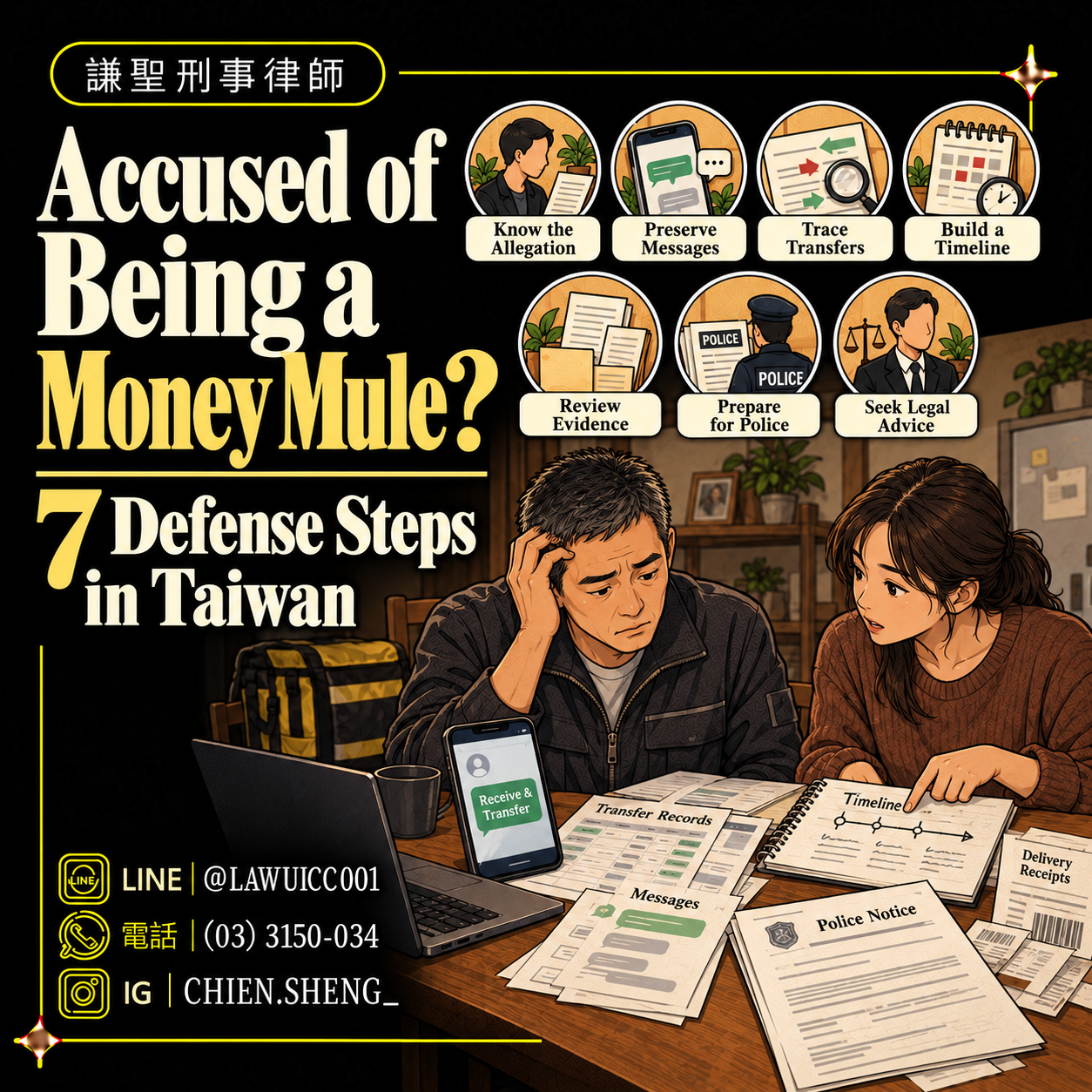
- 5. 5. Seven Practical Steps After Receiving a Police Notice or Summons
-
6.
6. Frequently Asked Questions
- 6.1. Q1. Accused of Being a Money Mule: Is a Victim’s Identification Enough to Convict?
- 6.2. Q2. Can I Be Convicted Without Fingerprints or Surveillance Footage?
- 6.3. Q3. I Collected Cash for a Job. Does That Automatically Make Me a Fraud Accomplice?
- 6.4. Q4. Does an Acquittal Mean the Case Is Finally Over?
- 6.5. Q5. Should I Admit Guilt to Obtain a Lighter Sentence?
- 7. 7. How Chien Sheng International Law Firm Can Assist
- 8. 📢【24-Hour Free Legal Consultation】
Accused of Being a Money Mule? You do not have to admit a crime simply because a victim identifies you as the person who collected cash. In Taiwan, the prosecution must prove the charged offense, including the defendant’s identity, participation and the required criminal intent. Reviewing identification procedures and supporting evidence may reveal important defense issues.
💡This article examines the evidentiary questions raised by a case summary supplied for publication. The source identifies the case as Taiwan Tainan District Court, 114年度金訴字第522號, and reports an acquittal. Chien Sheng International Law Firm did not handle this case. The judgment text and subsequent appeal status have not been independently verified; the discussion below therefore distinguishes the supplied account from verified legal principles.
1. Accused of Being a Money Mule: Must You Plead Guilty?
No. Being investigated, charged or identified by a witness does not remove your right to defend yourself.
Article 154 of Taiwan’s Code of Criminal Procedure protects the presumption of innocence and requires criminal facts to be established through evidence. Article 301 requires an acquittal when the defendant’s crime cannot be proved. law.moj.gov.tw
⚠️Two questions must be kept separate:
- Was the defendant actually the person who collected the money?
- If so, did the defendant possess the knowledge and intent required for the alleged offense?
➠A mistaken-identity defense differs from a defense that the defendant collected money while genuinely believing the task was legitimate employment. The appropriate strategy depends on the evidence.Do not confess to conduct you did not commit, and do not invent an explanation for conduct you did commit.
2. Case Summary: A Cash Collector, an Alias and a Photo Identification
According to the supplied summary, prosecutors accused a defendant of collecting several hundred thousand New Taiwan dollars from a fraud victim while using an assumed name and a fabricated work identification document.
The victim reportedly identified the defendant from photographs during the police investigation. At trial, however, the victim could no longer confidently identify the defendant because considerable time had passed.
➠The summary also describes concerns about connecting a shared alias to a particular individual and a missing receipt that could not undergo fingerprint examination.The reported result was an acquittal. These circumstances illustrate questions a defense lawyer should investigate. They do not establish that every similar identification is unreliable or that missing fingerprints automatically require an acquittal.
3. Photo Identification: What Should a Lawyer Check?
An eyewitness’s account deserves careful consideration, but identifying an unfamiliar person can be affected by viewing conditions and the identification procedure.
Taiwan’s official prosecutorial guidance requires investigators to obtain the witness’s description before identification, avoid materially different appearances among people presented for selection, explain that the actual suspect may be absent, and avoid suggestive arrangements. mojlaw.moj.gov.tw
👨🏻⚖️Important review points include:
- How long did the witness see the collector, and under what lighting?
- What description did the witness provide before seeing photographs?
- Did the suspect’s photograph stand out from the others?
- Was the witness told that the perpetrator might not be included?
- Did investigators give verbal or nonverbal cues?
- Were the procedure and the witness’s initial response recorded?
- Did later identifications follow repeated exposure to the same photograph?
Official photo-identification guidance describes a minimum of six persons’ photographs for each suspect. The applicable agency protocol and its version should be checked against the actual procedure. tpc.moj.gov.tw
➠A witness becoming less certain over time does not, by itself, prove that an earlier identification was false. Counsel should examine the original circumstances, confidence expressed at the time and other evidence.
➠A procedural defect also does not automatically make the evidence inadmissible. Admissibility concerns whether the court may use the evidence; evidential weight concerns how convincing it is. Both require legal analysis.
▫️An assumed name needs a reliable connection to the defendant
An alias appearing on a receipt or in a chat may be relevant, but investigators still need to establish who used it during the charged transaction.
➟Counsel can compare account access, messages, work instructions, surveillance footage, device records and witness descriptions. A name allegedly shared by several people requires particular care.
▫️Forensic evidence is helpful but not mandatory in every prosecution
Fingerprints, DNA or recovered documents may connect a person to an object or location. Their absence can leave an evidentiary gap, but a conviction may still rest on other reliable evidence.
➟If a receipt is missing, useful questions include whether photographs or copies exist, whether its handwriting or contents can be examined, and whether independent evidence establishes the collector’s identity.
▫️Reasonable doubt must arise from the evidence
The defense should identify concrete gaps or inconsistencies. A purely speculative alternative does not necessarily create reasonable doubt.
➟Conversely, suspicion cannot replace proof simply because fraud occurred and somebody collected the money.
5. Seven Practical Steps After Receiving a Police Notice or Summons
- Confirm your procedural status. Ask whether you are being questioned as a witness, suspect or defendant, and verify the notice through the agency’s official contact details.
- Consult counsel before substantive questioning. Article 95 provides protections including the right to remain silent, retain defense counsel and request investigation of favorable evidence. law.moj.gov.tw
- Preserve complete communications. Keep recruitment advertisements, original chats, voice messages, payment instructions and account information.
- Build a factual timeline. Record where you were, whom you contacted and what you understood at each stage. Separate personal recollection from information learned afterward.
- Identify time-sensitive evidence. Tell counsel about surveillance footage, transport records, work attendance, location data and potential witnesses before records disappear.
- Read the interview record before signing. Request corrections to inaccurate wording and avoid guessing about matters you do not remember.
- Avoid interfering with witnesses or evidence. Do not pressure the complainant, coordinate accounts with other suspects, delete messages or alter records.
⚠️Preserving favorable evidence supports your defense; the prosecution retains the burden of proving the offense.
6. Frequently Asked Questions
Q1. Accused of Being a Money Mule: Is a Victim’s Identification Enough to Convict?
An identification can be important evidence, but its reliability and relationship to the remaining evidence must be assessed. It is neither automatically conclusive nor automatically insufficient.
Q2. Can I Be Convicted Without Fingerprints or Surveillance Footage?
Yes, if other admissible and reliable evidence proves the offense to the required standard. Missing forensic evidence must be considered in the context of the complete case.
Q3. I Collected Cash for a Job. Does That Automatically Make Me a Fraud Accomplice?
No. The actual conduct, communications, working arrangements and required criminal intent must be examined.
However, not personally delivering the fraudulent pitch does not automatically exclude liability for knowing participation.
Q4. Does an Acquittal Mean the Case Is Finally Over?
Not necessarily. A first-instance acquittal may be appealed where legally permitted. Finality depends on the applicable appeal rules and subsequent proceedings.
Q5. Should I Admit Guilt to Obtain a Lighter Sentence?
That decision requires an assessment of the facts, evidence and applicable law. Truthful admission and compensation may matter in some cases, but a person should not make a false confession to secure an assumed procedural benefit.
7. How Chien Sheng International Law Firm Can Assist
Chien Sheng International Law Firm can assess identification evidence, review alleged participation, organize communications and financial records, and assist with police interviews, prosecutorial questioning and court defense.
Where identity or criminal intent is disputed, the defense should address those issues directly. Where the evidence supports responsibility, counsel can assess legally available mitigation and compensation options.
👨🏻⚖️Explore our practice areas and lawyer team. When seeking advice, prepare your notice or summons, indictment if available, full communications and a factual timeline.
This article provides general legal information about Taiwan. The illustrative case was not handled by this firm. Outcomes depend on the individual evidence and applicable law; no acquittal, non-prosecution decision or sentence reduction is guaranteed.
📢【24-Hour Free Legal Consultation】
🏛 Taipei Office: 6F., No. 64, Kangding Rd., Wanhua Dist., Taipei City|02-2388-8962
🏛 Taoyuan Office: 17F., No. 95, Xinpu 6th St., Taoyuan Dist., Taoyuan City|(03)3150-034
🏛 Kaohsiung Office: 3F., No. 687, Mingcheng 3rd Rd., Gushan Dist., Kaohsiung City
Contact Us on LINE for a Free Consultation: @lawuicc001
IG: chien.sheng_
FB: Chien Sheng International Law Firm
💳 We Accept Cash, Credit Cards, and Bank Transfers.