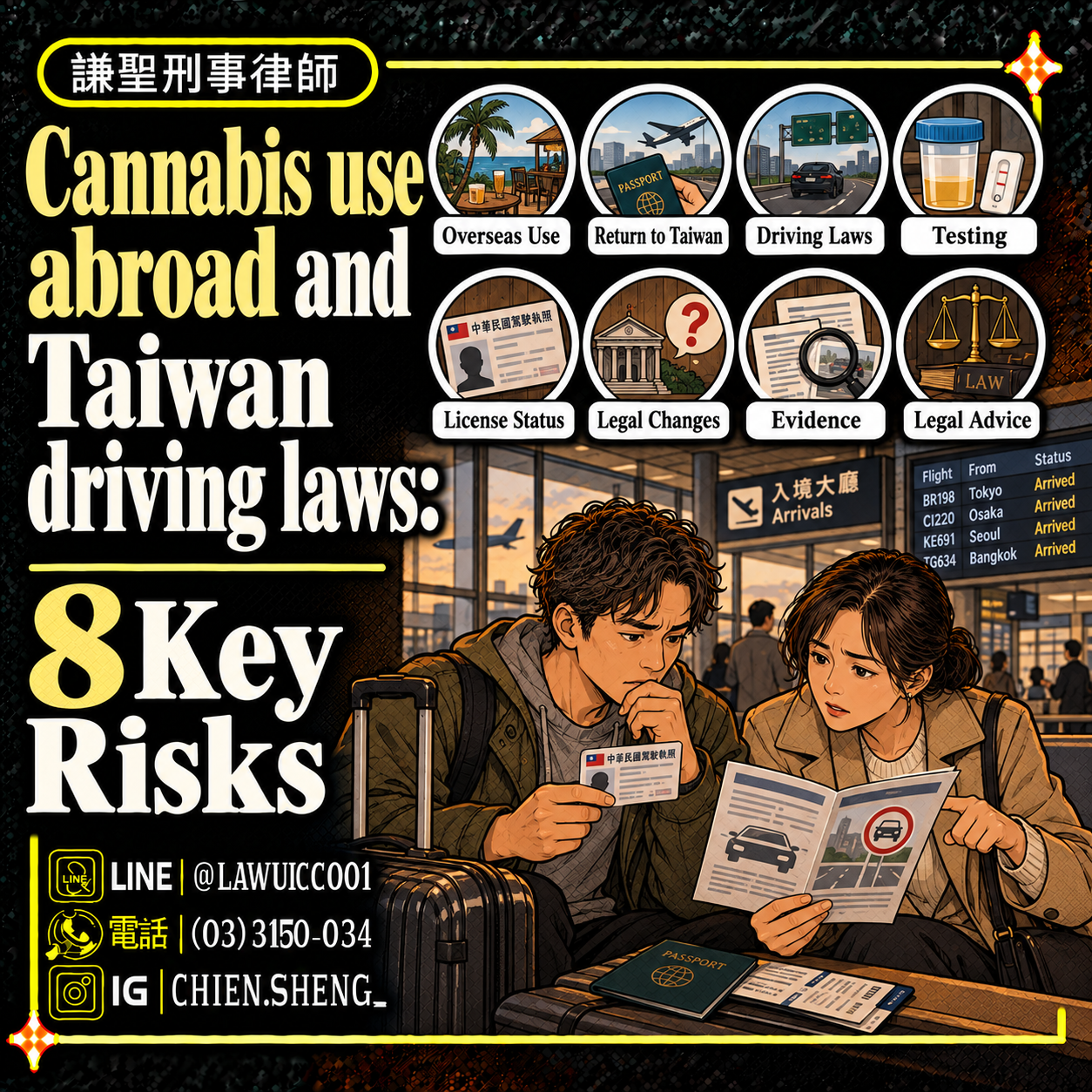
- 1. 1. Cannabis use abroad and Taiwan driving laws: Check the effective date first
- 2. 2. Is cannabis consumed overseas automatically a Taiwan drug offense?
- 3. 3. Can driving after returning create criminal liability?
- 4. 4. Administrative penalties are separate from criminal prosecution
- 5. 5. What about people who have not driven?
- 6. 6. What should you do during a stop or testing procedure?
- 7. 7. How can a license or traffic decision be challenged?
- 8. 8. How Chien Sheng International Law Firm can help
-
9.
Frequently Asked Questions
- 9.1. Q1: Cannabis use abroad and Taiwan driving laws: Can legal overseas use still affect my license?
- 9.2. Q2: If I brought no cannabis back, can I ignore a drug-driving allegation?
- 9.3. Q3: If I felt completely sober, can a concentration-based charge still arise?
- 9.4. Q4: Are the August 2026 amendments already fully effective?
- 9.5. Q5: Does one positive screen automatically prove every offense?
- 9.6. Q6: Can I wait for the prosecutor’s decision before challenging a traffic adjudication?
- 10. Official References📑
- 11. 📢【24-Hour Free Legal Consultation】
Cannabis use abroad and Taiwan driving laws can overlap even when consumption was lawful at the destination. Returning without cannabis does not automatically eliminate the legal risks of driving in Taiwan afterward.
However, a positive result does not mean every criminal charge or licensing consequence follows automatically. Overseas consumption, driving in Taiwan, administrative penalties and driver eligibility involve separate legal questions.
💡There is also an important update: the relevant traffic amendments were promulgated on August 17, 2026. The official database reviewed on October 27, 2026 still identifies their commencement date as awaiting an Executive Yuan order. They should not be described either as merely an initial proposal or as already fully operational. law.moj.gov.tw
1. Cannabis use abroad and Taiwan driving laws: Check the effective date first
News reports may describe a policy announcement, a draft, a passed amendment or an effective rule. Those stages are different.
The August amendments strengthen drug-driving penalties and introduce preventive license revocation following police confirmation of drug use. Their commencement must be checked separately from their promulgation. ly.gov.tw
🚨For an individual case, identify:
- The date of the alleged conduct.
- The version of each applicable provision.
- Any commencement order and transitional rules.
- The legal basis stated in the notice or decision.
Earlier reports distinguishing proposed consequences for different drug categories should not replace the wording ultimately enacted.
🔎Why this matters to travelers
A headline suggesting that overseas cannabis use automatically causes license revocation oversimplifies both the law’s implementation status and the facts that an authority must establish.The relevant question is what effective rule applies to the particular conduct and administrative decision.
2. Is cannabis consumed overseas automatically a Taiwan drug offense?
Cannabis remains a Category 2 drug under Taiwan’s Narcotics Hazard Prevention Act. Permission to use it in another jurisdiction does not change its classification in Taiwan. law.moj.gov.tw
Nevertheless, Taiwan’s authority to punish conduct abroad must be examined.
Article 5(8) of the Criminal Code provides extraterritorial application for drug offenses but excludes specified offenses involving use and possession of drugs, seeds and drug-use equipment from that particular rule. law.moj.gov.tw
➠That exception should not be rewritten as a universal guarantee covering every overseas situation. Counsel must check where the relevant conduct occurred and whether another applicable jurisdictional basis or separate offense exists.
🔎Consumption, possession and importation are different
A claim that consumption occurred lawfully overseas does not answer whether someone also brought a controlled product into Taiwan.Likewise, a later allegation of drug driving concerns conduct in Taiwan. It cannot be dismissed solely by proving where the cannabis was consumed.
➠Preserve genuine travel and other relevant records. Do not invent a location or timeline to fit a legal argument.
3. Can driving after returning create criminal liability?
Potentially. Article 185-3 of the Criminal Code includes two distinct drug-related routes:
- Specified drugs or metabolites in urine or blood reach announced substance and concentration criteria.
- Other evidence establishes drug use resulting in inability to drive safely. law.moj.gov.tw
➠These routes should not be confused. Feeling normal or showing no obvious erratic driving does not necessarily defeat a charge based on an applicable statutory concentration threshold.
➠The official urine-confirmation schedule includes the cannabis metabolite delta-9-tetrahydrocannabinol-9-carboxylic acid at 15 ng/mL. This is a specified urine criterion, not a universal standard for every sample or roadside device. law.moj.gov.tw
🔎What needs to be checked?
The alleged driving, substance, specimen, laboratory method, concentration, collection time and applicable announcement all matter.
A roadside screening result is not itself a court judgment. Equally, describing a finding as “residual” does not automatically make it legally irrelevant.Do not rely on an internet waiting period as a guarantee of safe or lawful driving. If there is uncertainty about fitness to drive, arrange alternative transport.
4. Administrative penalties are separate from criminal prosecution
The pre-amendment Article 35 framework provides substantial consequences for qualifying drug-driving violations.
💡Its basic ranges include:
- Motorcycle drivers: NT$15,000–90,000.
- Car drivers: NT$30,000–120,000.
- Vehicle impoundment and a license suspension of one to two years.
Aggravating circumstances, repeat violations and refusal can produce different consequences, including revocation. These basic ranges are not a complete penalty calculation. law.moj.gov.tw
The August 2026 amendments provide a stronger framework, including revocation rather than the previous basic suspension approach for drug driving. As explained above, the revised provisions must not be presented as operative before their commencement is established. law.moj.gov.tw
🔎Suspension and revocation are different
Suspension temporarily restricts the license for a prescribed period. Revocation removes the license and may require requalification, subject to the applicable restrictions.Paying a fine does not, by itself, restore driving privileges. Always confirm the actual license status before driving.
5. What about people who have not driven?
This is the preventive licensing issue raised by the reforms.
The promulgated Article 35 includes a provision for license revocation after police confirmation of use of specified drugs and related controlled substances. Its wording is not limited to a driver being caught driving at that moment. law.moj.gov.tw
➠That does not justify announcing that every traveler with a positive result will automatically lose a license today. Commencement, the scope of the effective rule, the evidence and the required administrative process remain essential.
➠The Ministry of Transportation and Communications has also published plans concerning treatment, education and license eligibility. An announced implementation target is not proof that every supporting rule has entered into force. motc.gov.tw
★For anyone facing a non-driving licensing action, request the actual legal basis. Do not assume it is identical to a traffic ticket for driving under the influence.
6. What should you do during a stop or testing procedure?
Stop safely. Do not flee, threaten officers or physically obstruct the procedure.
Ask calmly:
- Is this a traffic test, criminal investigation or another procedure?
- What authorizes the test?
- What sample is being collected?
- What documents and records will be provided?
- What are the legal consequences of refusal?
➠Refusal is not a reliable way to avoid legal consequences. Traffic-test refusal may itself carry serious sanctions under the applicable law.
➠A roadside saliva test, a urine examination and a blood test are not interchangeable. Their purposes, authority, procedures and evidential significance need separate review.
🔎Keep the explanation accurate
If relevant, explain overseas travel, medication and medical history truthfully. Do not guess dates or sign an inaccurate account merely to finish quickly.Request an interpreter if you cannot understand the questions or documents. A lawyer can help distinguish factual statements from legal conclusions.
7. How can a license or traffic decision be challenged?
First identify what document you received. A police notice, traffic adjudication, licensing decision and criminal summons are not the same.
For traffic adjudications covered by Article 87 of the Road Traffic Management and Penalty Act, the law provides a direct administrative-court route. An action seeking revocation must generally be filed within 30 days after service of the adjudication. law.moj.gov.tw
➠Do not assume a standard administrative appeal is required first. Other licensing decisions may follow a different route, so check the decision and its remedy instructions.
Documents to preserve📝
Keep:
- The notice, adjudication or licensing decision and service records.
- Screening and laboratory reports.
- Sampling and specimen-identification records.
- Relevant travel and medical documents.
- Available recordings and witness details.
- Criminal-case documents and upcoming dates.
➠Do not wait for the criminal case to finish before checking an administrative deadline. A non-prosecution decision or acquittal also does not automatically resolve every licensing issue.
➠If immediate enforcement threatens your livelihood, ask counsel whether interim relief is available. Filing a challenge should not be assumed to suspend the decision automatically.
8. How Chien Sheng International Law Firm can help
These cases require coordinated review of criminal jurisdiction, driving allegations, testing evidence and licensing rules.
Counsel can help identify the effective legal provisions, examine sampling and laboratory records, organize the timeline and assess the appropriate response to each proceeding.When contacting Chien Sheng International Law Firm, provide the incident date, return date, documents received and nearest deadline. Visit the firm’s contact page to arrange a consultation.
➠The purpose is to build arguments supported by the facts and law. No lawyer should guarantee that overseas legality will defeat a charge or preserve a license.
Frequently Asked Questions
Q1: Cannabis use abroad and Taiwan driving laws: Can legal overseas use still affect my license?
Potentially, particularly if you drive after returning. A licensing action still requires an applicable effective rule, supporting facts and the appropriate procedure.
Q2: If I brought no cannabis back, can I ignore a drug-driving allegation?
No. Importation and driving after return are separate issues. The latter requires assessment under Taiwan’s driving-related rules.
Q3: If I felt completely sober, can a concentration-based charge still arise?
Potentially. The statutory concentration route is distinct from the alternative route based on evidence of inability to drive safely.
Q4: Are the August 2026 amendments already fully effective?
The official database reviewed for this article still marks their commencement as awaiting an Executive Yuan order. Check for subsequent commencement orders before relying on any penalty summary.
Q5: Does one positive screen automatically prove every offense?
No. The allegation, sample, applicable test criteria and other evidence must be examined. Screening and confirmed laboratory findings should not be treated as identical.
Q6: Can I wait for the prosecutor’s decision before challenging a traffic adjudication?
That may cause you to miss a separate deadline. Have the administrative and criminal timelines checked independently.
※ This article provides general legal information based on official materials reviewed on October 27, 2026. It does not establish a safe waiting period after cannabis use or predict any individual case outcome. Check subsequent amendments and commencement orders before acting.
Official References📑
- Narcotics Hazard Prevention Act, Article 2
- Criminal Code, Article 5
- Criminal Code, Article 185-3
- Road Traffic Management and Penalty Act: Text and commencement notices
- Road Traffic Management and Penalty Act, Article 87
- Legislative Yuan: Summary of the 2026 traffic amendments
📢【24-Hour Free Legal Consultation】
🏛 Taipei Office: 6F., No. 64, Kangding Rd., Wanhua Dist., Taipei City|02-2388-8962
🏛 Taoyuan Office: 17F., No. 95, Xinpu 6th St., Taoyuan Dist., Taoyuan City|(03)3150-034
🏛 Kaohsiung Office: 3F., No. 687, Mingcheng 3rd Rd., Gushan Dist., Kaohsiung City
Contact Us on LINE for a Free Consultation: @lawuicc001
IG: chien.sheng_
FB: Chien Sheng International Law Firm
💳 We Accept Cash, Credit Cards, and Bank Transfers.