
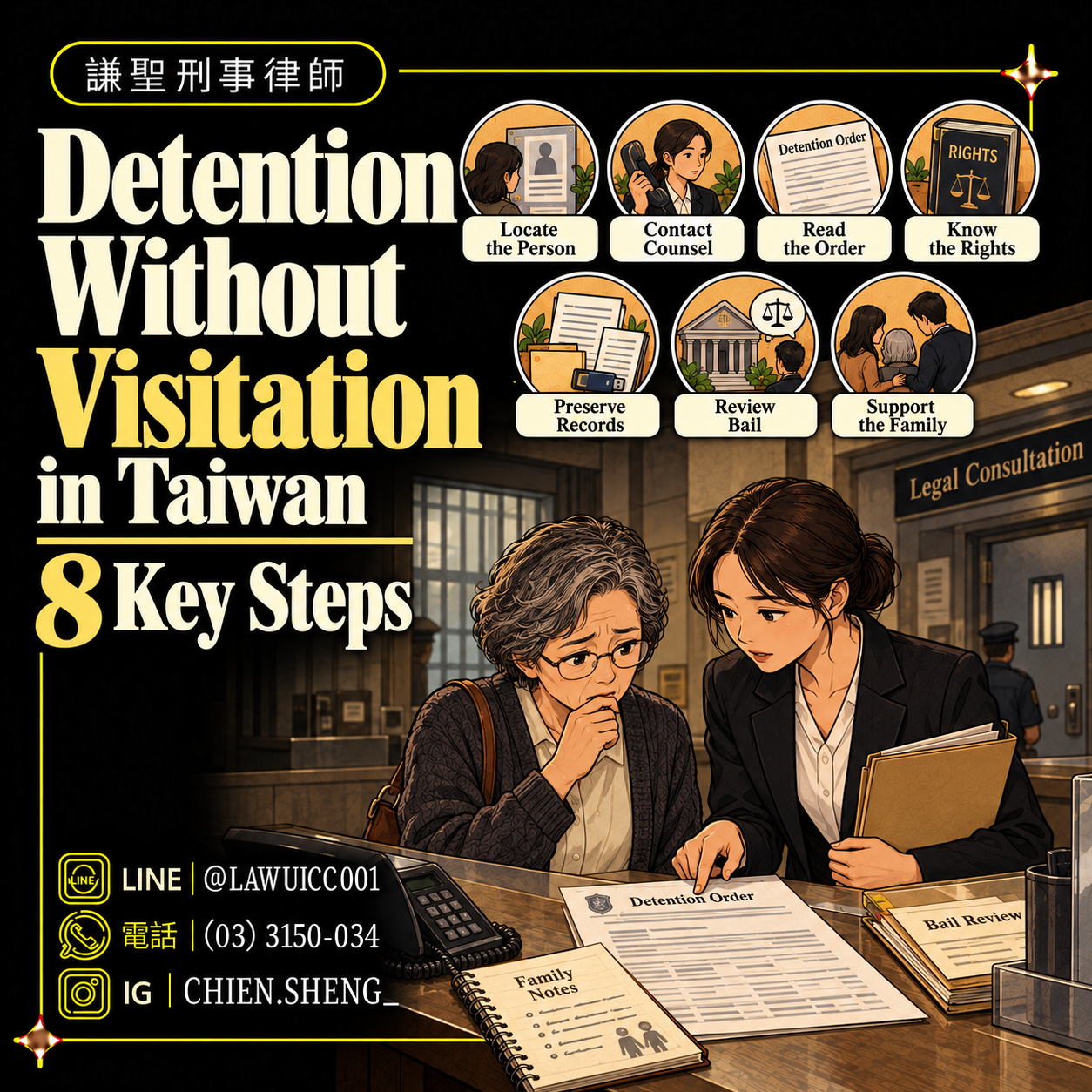
- 1. 1. Detention Without Visitation in Taiwan: What Does It Mean?
- 2. 2. What Should Family Members Do First?
- 3. 3. Can a Lawyer Visit When Family Visits Are Prohibited?
- 4. 4. Can a Detained Defendant Apply for Bail?
- 5. 5. How Can Detention or a Bail Refusal Be Challenged?
- 6. 6. How Long Can Detention Last?
- 7. 7. What Changes for Foreign Nationals and Residents of Hong Kong, Macau or Mainland China?
-
8.
8. Frequently Asked Questions
- 8.1. Q1. Detention Without Visitation in Taiwan: Can the Family Still Hire a Lawyer?
- 8.2. Q2. Does Being Detained Mean the Defendant Is Guilty?
- 8.3. Q3. Will Paying a Large Deposit Guarantee Release?
- 8.4. Q4. Can We Contact Witnesses to Explain What Happened?
- 8.5. Q5. Can Someone Leave Taiwan Immediately After Getting Bail?
- 8.6. Q6. What Should We Avoid While the Defendant Is Detained?
- 9. 👨🏻⚖️ Legal Assistance from Chien Sheng International Law Firm
- 10. 📢【24-Hour Free Legal Consultation】
Detention Without Visitation in Taiwan does not mean your family member has been convicted, and it does not ordinarily prevent access to defense counsel. If someone you know is in custody, first confirm their location, procedural status and the reasons for detention. A lawyer can then assess access, release options and any urgent challenge to the decision.
1. Detention Without Visitation in Taiwan: What Does It Mean?
Court-ordered detention, or 羈押, restricts a defendant’s liberty during criminal proceedings. It is different from an arrest, police questioning, immigration detention or serving a prison sentence.
Under Article 101 of Taiwan’s Code of Criminal Procedure, a judge must assess strong suspicion of an offense, a statutory detention ground and the necessity of detention. Relevant risks include absconding, destroying or altering evidence, and colluding with accomplices or witnesses. A serious charge alone does not automatically justify detention. law.moj.gov.tw
💡Certain listed offenses also have provisions addressing a concrete risk of repeatedly committing the same offense. The applicable requirements must still be established.
A restriction commonly called 禁見 can limit visits, correspondence and the exchange of objects. Article 105 governs these measures and requires that legitimate defense rights remain protected. law.moj.gov.tw
➠The actual order matters: family contact may be restricted while lawyer access remains available. Ending contact restrictions and obtaining release are separate objectives.
2. What Should Family Members Do First?
👨🏻⚖️Confirm the following through the responsible agency’s official contact details:
- The detainee’s full name, date of birth and identification or passport number.
- The police unit, prosecutors’ office, court and detention facility involved.
- The case number and alleged offenses.
- Whether the person is arrested, awaiting a detention hearing or already detained by court order.
- Whether visitation or communication restrictions have been imposed.
- When the decision was served and which remedies it specifies.
- Any urgent illness, medication needs, pregnancy or language difficulties.
➠Do not wait until every document is available before seeking counsel. Provide what you have and explain what remains unknown.
If there are immediate health concerns, notify the responsible agency or facility promptly and provide medical information. Legal consultation should not delay a request for necessary medical attention.
Relatives specified in Article 27, including a spouse and qualifying family members, may independently retain defense counsel for a defendant or suspect. A friend or employer wishing to help should confirm the proper appointment procedure with counsel. law.moj.gov.tw
3. Can a Lawyer Visit When Family Visits Are Prohibited?
Generally, yes. Article 34 allows defense counsel to meet a detained defendant and exchange correspondence. Restrictions require evidence supporting concerns that counsel may destroy, fabricate or alter evidence, or collude with accomplices or witnesses. law.moj.gov.tw
A lawyer can use a lawful meeting to discuss the case, understand the defendant’s account, identify medical or interpretation needs and prepare a defense.
⚠️Family members should understand the limits:
- Counsel represents the defendant and must protect confidentiality.
- Information shared with relatives depends on the defendant’s authorization and applicable duties.
- Lawyer visits cannot be used to pass prohibited messages or coordinate accounts.
- Money and daily necessities must follow the specific facility’s rules and the operative order.
➠Do not assume that a visitation restriction prohibits every permitted deposit or delivery. Equally, do not assume that a permitted delivery allows hidden notes or other communications.
4. Can a Detained Defendant Apply for Bail?
Yes. Article 110 permits the defendant, qualifying persons entitled to act as an assistant, or defense counsel to apply to the court for suspension of detention on bail. The prosecutor may also seek this during the investigation. law.moj.gov.tw
Bail is not simply a question of how much money the family can provide. The application must address why less restrictive measures can adequately manage the risks identified by the court.
🔎Useful materials may include:
- A verifiable residence in Taiwan.
- Employment, enrollment, family responsibilities and medical records.
- A reliable guarantor and supporting information.
- A workable reporting and attendance plan.
- Willingness to comply with residence or travel restrictions.
- Evidence that relevant devices, records or witness accounts have already been secured.
- A concrete plan to avoid contact with witnesses, complainants and alleged accomplices.
For a defendant from overseas, lawful residence, local ties and a realistic ability to remain available may be particularly relevant.
Article 114 provides specified circumstances in which a qualifying bail application must not be rejected. These include certain lower-penalty offenses, subject to exceptions, pregnancy of at least five months, less than two months after childbirth, and illness that would clearly be difficult to cure without treatment outside custody. law.moj.gov.tw
➠Counsel should check the exact requirements. These provisions do not eliminate the need to complete the lawful release process.
5. How Can Detention or a Bail Refusal Be Challenged?
The correct procedure depends on who made the decision and whether it is a court ruling or another specified disposition.
▫️An appeal against a court ruling
Where an interlocutory appeal, or 抗告, is available, Article 406 generally provides ten days from service of the ruling, unless a special provision applies. law.moj.gov.tw
▫️An application to revoke or modify a specified disposition
Article 416 provides a separate procedure for specified dispositions by a presiding judge, commissioned or delegated judge, or prosecutor. It covers matters including detention, bail and certain contact restrictions. Its ten-day period runs from the disposition, or from service where the disposition is served. law.moj.gov.tw
▫️A fresh application based on changed circumstances
Newly secured evidence, completed witness questioning, improved residence arrangements or changed medical needs may support reconsideration of continued detention.These procedures are not interchangeable. Preserve the ruling, disposition and service information so counsel can identify the correct remedy and deadline. Filing a challenge does not itself guarantee release or lift contact restrictions.
6. How Long Can Detention Last?
Article 108 generally limits the initial detention period to two months during investigation and three months during trial.
Where continued detention is necessary, an extension requires the prescribed judicial procedure. During investigation, an extension is generally limited to two months and may be granted once. During trial, each extension is generally limited to two months; applicable limits on the number of extensions depend on the offense and procedural stage.
Indictment does not necessarily result in release. Counsel should check when the files and evidence reach the trial court, the detention start date, extension decisions and their legal effectiveness.Expiry can trigger statutory release consequences, but Article 108 also contains specific provisions concerning alternatives and continued detention. Do not calculate a guaranteed release date from the arrest date alone. law.moj.gov.tw
➠Continued detention and continued restrictions on family contact should each be reviewed against their own legal basis and current necessity.
7. What Changes for Foreign Nationals and Residents of Hong Kong, Macau or Mainland China?
💡People arrested in Taiwan must address the applicable Taiwanese criminal procedure. However, foreign nationality and the legal statuses of Hong Kong, Macau and Mainland China residents should not be treated as identical.
▫️Interpretation and understanding
Article 99 requires interpretation where a person has a language barrier, with written questioning or responses available when necessary. law.moj.gov.tw
A person who speaks some Mandarin should still tell counsel or the questioning authority when they cannot understand the questions, legal terminology or interpretation. Review the interview record carefully and request correction of inaccuracies.
▫️Overseas contacts and representation
Counsel can help identify an appropriate foreign representative office or other lawful assistance channel where available. Contact arrangements depend on nationality, legal status and the applicable framework; ordinary consular arrangements should not be assumed to apply uniformly.
Such assistance does not replace defense counsel or determine whether the court grants release.
▫️Immigration and travel restrictions
Criminal detention, restrictions on leaving Taiwan, residence status and immigration detention are separate matters. Release on bail does not automatically authorize departure or resolve an expired residence permit.Prepare passport, entry, residence, work and enrollment records. Counsel should assess how criminal proceedings and immigration issues interact.
8. Frequently Asked Questions
Q1. Detention Without Visitation in Taiwan: Can the Family Still Hire a Lawyer?
Yes. Qualifying relatives may independently retain defense counsel under Article 27. Family visitation restrictions do not ordinarily remove the defendant’s access to counsel.
Q2. Does Being Detained Mean the Defendant Is Guilty?
No. Detention is a procedural measure. The criminal allegations still require examination through the applicable proceedings.
Q3. Will Paying a Large Deposit Guarantee Release?
No. The court must assess whether release conditions adequately address the relevant risks. Money alone may not resolve concerns about flight or interference with evidence.
Q4. Can We Contact Witnesses to Explain What Happened?
Do not contact them to coordinate accounts or influence evidence. Consult counsel before any proposed approach; even well-intentioned contact may create additional concerns.
Q5. Can Someone Leave Taiwan Immediately After Getting Bail?
Not necessarily. Travel restrictions, bail conditions and immigration requirements may remain in force. Check the operative orders before making arrangements.
Q6. What Should We Avoid While the Defendant Is Detained?
Do not delete or alter records, pass hidden messages, pressure witnesses or pay anyone claiming to guarantee release through personal connections. Preserve original evidence and use official communication channels.
👨🏻⚖️ Legal Assistance from Chien Sheng International Law Firm
Chien Sheng International Law Firm can assist with lawyer visits, detention hearings, bail applications, challenges to detention and contact restrictions, and subsequent criminal defense.For defendants from overseas, the team can also assess interpretation needs, appointment arrangements and the interaction between criminal proceedings and residence or travel issues.
🚨Prepare the detention decision, notices, identification documents, medical information and available evidence. Explore our practice areas and lawyer team to learn more.
This article provides general information about Taiwanese law. Available remedies and outcomes depend on the individual facts, operative orders and procedural stage. No release, removal of restrictions, acquittal or immigration outcome is guaranteed.
📢【24-Hour Free Legal Consultation】
🏛 Taipei Office: 6F., No. 64, Kangding Rd., Wanhua Dist., Taipei City|02-2388-8962
🏛 Taoyuan Office: 17F., No. 95, Xinpu 6th St., Taoyuan Dist., Taoyuan City|(03)3150-034
🏛 Kaohsiung Office: 3F., No. 687, Mingcheng 3rd Rd., Gushan Dist., Kaohsiung City
Contact Us on LINE for a Free Consultation: @lawuicc001
IG: chien.sheng_
FB: Chien Sheng International Law Firm
💳 We Accept Cash, Credit Cards, and Bank Transfers.