
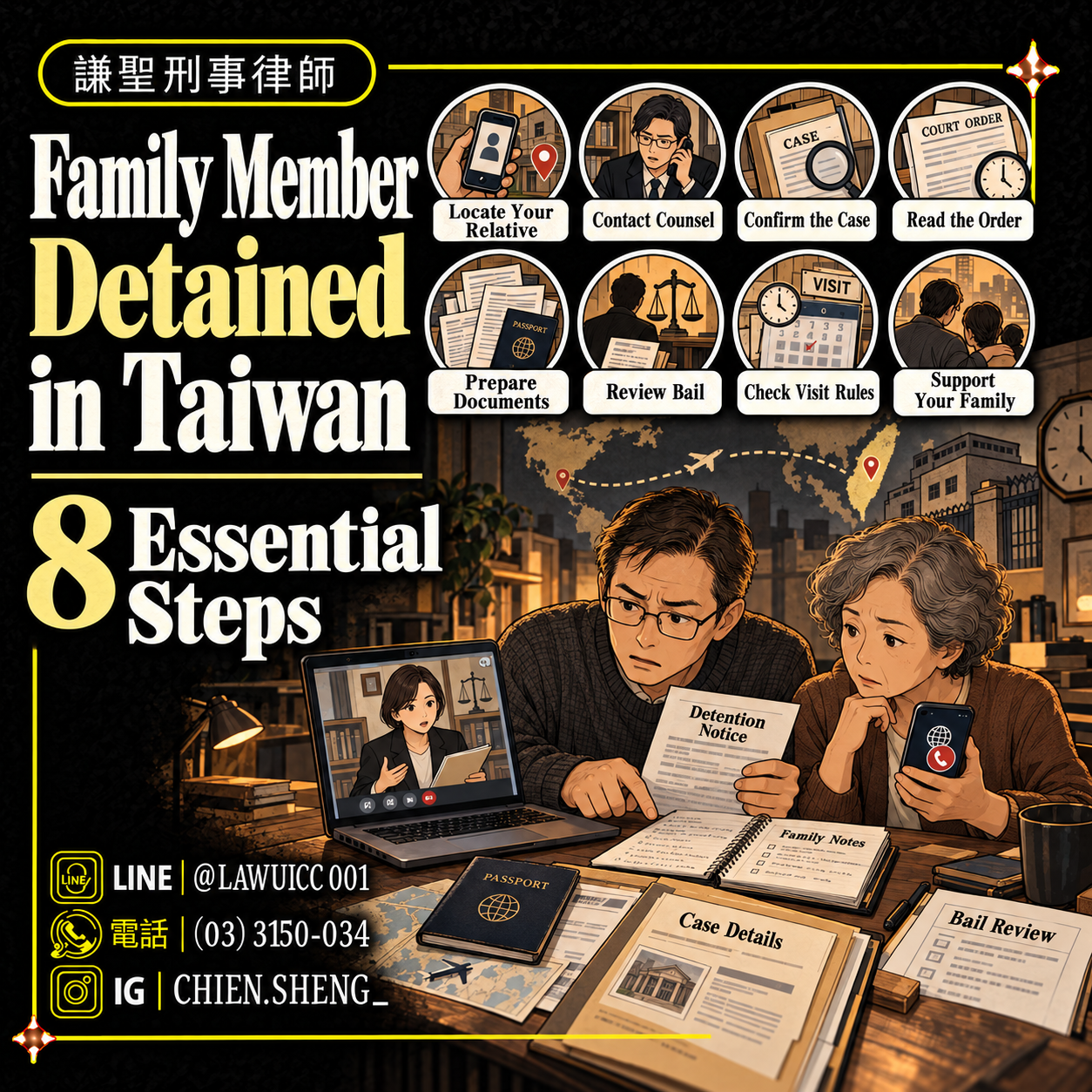
- 1. 1. Family Member Detained in Taiwan: What to Do First
- 2. 2. Understand Arrest, Court-Ordered Detention, and Contact Restrictions
- 3. 3. Protect Communication, Interpretation, and Family Support
- 4. 4. Assess Release on Bail and Other Detention Remedies
- 5. 5. Prepare Evidence That Helps Explain the Case
- 6. 6. Understand the Charges and What a Favorable Outcome Means
- 7. 7. Review Exit Restrictions and Immigration Separately
-
8.
8. Frequently Asked Questions
- 8.1. What should I do if I have a family member detained in Taiwan?
- 8.2. Can relatives overseas appoint a lawyer?
- 8.3. Does foreign nationality make detention inevitable?
- 8.4. Can a lawyer visit someone whose family visits are restricted?
- 8.5. Can we pay bail before the court approves release?
- 8.6. Can the person fly home after release?
- 8.7. Will a suspended sentence prevent deportation?
- 8.8. How much will representation cost?
- 8.9. Does the family need to come to Taiwan immediately?
- 8.10. How can Chien Sheng Law Firm assist?
- 8.11. Arrange a Case Assessment👨🏻⚖️
- 9. 📢【24-Hour Free Legal Consultation】
A family member detained in Taiwan needs prompt legal assistance, but your first task is to establish where they are, which authority is handling the case, and whether a court has actually ordered detention. An arrest, a prosecutor’s application for detention, and a detention order are different stages.
For families in Hong Kong, Macau, mainland China, Malaysia, and elsewhere, distance can make every update harder to understand. Start with verified information, preserve relevant documents, and ask a Taiwan criminal defense lawyer to identify the next hearing or deadline.
💡This guide explains access to counsel, interpretation, release applications, family communication, and immigration consequences. It also outlines examples from Chien Sheng Law Firm’s case materials. Those outcomes illustrate possible defense approaches; they do not predict the result of another case.
1. Family Member Detained in Taiwan: What to Do First
▫️Confirm the person’s location and legal status
Ask for the police station, prosecutor’s office, court, or detention center handling the matter. Obtain the officer’s or case clerk’s name, the case number if available, and copies of any summons, detention ruling, or notice.
Record the person’s full name, date of birth, passport or travel document number, nationality or relevant residence status, and preferred language. Names may appear differently in Chinese records and overseas documents, so provide both spellings where possible.
➠If the first information came from an unfamiliar caller, verify it through an independently located official contact. A request for urgent payment is not itself proof that the caller represents a court or detention center.
▫️Arrange representation without waiting to travel
Article 27 of Taiwan’s Code of Criminal Procedure allows defendants and suspects under police investigation to appoint defense counsel. It also permits specified relatives and other qualifying family members to appoint counsel independently. law.moj.gov.tw
An overseas family can begin by sending identification, relationship documents, and the available case papers. The lawyer should confirm who can sign, what appointment documents are needed, and how they must be submitted.
➠Ask which services are included: police questioning, a detention hearing, detention visits, investigation defense, trial representation, or a separate immigration matter. These are different tasks and may have different fee arrangements.
▫️Identify immediate health and language needs
Tell counsel about medication, allergies, medical conditions, disability, mental health concerns, and any language difficulties. Send existing medical documents rather than relying only on a verbal description.
➠A relative’s inability to communicate in Mandarin should be addressed before substantive questioning. Understanding ordinary conversation does not necessarily mean understanding a legal question or written statement.
2. Understand Arrest, Court-Ordered Detention, and Contact Restrictions
▫️Arrest does not automatically mean continued detention
A person may first be arrested or brought in for questioning. A prosecutor may then apply to a court for detention. The court decides whether the legal requirements are met.Under Article 101, detention requires a substantial criminal suspicion, a statutory ground such as flight or evidence-interference risk, and necessity. For the serious-offense ground specified in that article, the prescribed sentence alone does not complete the analysis.
➟Foreign nationality is not an automatic detention ground. Actual travel circumstances, local accommodation, ability to leave, and other evidence may nevertheless be relevant to a court’s assessment. law.moj.gov.tw
▫️Detention is not a conviction
A detention ruling addresses custody during criminal proceedings. It does not decide guilt, guarantee a later prison sentence, or prevent a defendant from contesting the allegations.
➟Families should obtain the written reasons. An argument about flight risk may require a different response from an argument about contacting witnesses or altering records.
▫️Contact restrictions are a separate issue
An order restricting visits and correspondence is often described as detention without visitation. It can affect family contact, but it should not be confused with an unrestricted ban on access to legal advice.
➟Under Article 34, defense counsel has a statutory right to meet a detained client and exchange correspondence, subject to the limited restrictions prescribed by law. Counsel should check the order and applicable procedures rather than assume every form of communication is permitted. law.moj.gov.tw
▫️Check the detention period
Article 108 ordinarily sets an initial limit of two months during investigation and three months during trial. Extensions, stage-specific limits, and exceptional continuation provisions must be considered.
➟Do not treat those figures as a guaranteed release date. Ask counsel to identify the current period, any extension ruling, and the next review point. law.moj.gov.tw
3. Protect Communication, Interpretation, and Family Support
▪️Request interpretation when needed
Article 99 requires interpretation for a defendant who cannot communicate in the language used in questioning. Families should identify the precise language needed, including a dialect where relevant. law.moj.gov.tw
Mandarin, Cantonese, English, and Malay are not interchangeable. Counsel can raise an interpretation problem, clarify misunderstandings, and ask that difficulties be recorded.An English-speaking lawyer can assist with consultations, but that does not automatically replace the interpreter required for official proceedings. Bringing an additional interpreter to a detention visit may also require advance arrangements and approval.
▪️Check statements before signing
The person should tell the interviewer and counsel if they do not understand a question or believe an answer has been recorded inaccurately. They should not guess at facts or agree merely to finish the interview.
Families can help by supplying original conversations, travel records, and documents that clarify dates or events. They should not prepare a fabricated account or ask witnesses to coordinate their statements.
A lawyer can update an authorized family contact about procedural developments and practical needs. However, representation is owed to the client, and confidentiality may limit disclosure of some information.
Paying the legal fees does not automatically entitle a family member to every statement, document, or private discussion. Agree on the communication arrangements at the start of the engagement.
▪️Ask about permitted visits, correspondence, and medical support
Family contact depends on the actual restriction order and detention center procedures. Counsel is an important channel, but ordinary detention should not be described as automatic isolation from all relatives.
Before arranging travel, mailing items, or depositing money, confirm the facility’s identification, booking, payment, and item rules. Overseas transfer arrangements should be verified directly.Where there is a health concern, provide medical information and ask counsel to raise it with the appropriate authority. Do not assume medicines sent by family will automatically be accepted.
4. Assess Release on Bail and Other Detention Remedies
▫️Match the application to the procedural stage
Before detention is ordered, counsel may argue that custody is unnecessary and propose lawful alternatives. After an order, counsel may assess an appeal, revocation of detention, or suspension of detention on bail.These remedies serve different purposes. An appeal challenges a ruling; a later release application can address changed circumstances or a workable alternative to continued custody.
Article 110 permits applications to the court for suspension of detention on bail. Permission is a judicial decision, not something purchased simply by paying a lawyer or offering money. law.moj.gov.tw
▫️Address the specific concern
A release proposal may include verifiable accommodation in Taiwan, reliable local contacts, arrangements to attend hearings, and relevant employment or study documents.If the concern is interference with evidence, counsel should examine what evidence has already been secured and whether concrete risks remain. Having a stable address does not answer every allegation of witness interference.
★Overseas family ties may provide useful background, but they do not automatically eliminate flight risk. A persuasive proposal explains how the person will remain available to Taiwan’s proceedings.
▫️Distinguish a surety from a cash deposit
Under Article 111, a written guarantee has requirements concerning the guarantor. The article also allows a cash deposit by the applicant or a permitted third party in place of the written guarantee.
An overseas relative’s willingness to help therefore does not automatically make that person an eligible surety. Counsel should confirm the court-approved arrangement, deposit method, and identity requirements. law.moj.gov.tw
▫️Do not assume release permits departure
A released defendant may remain subject to residence restrictions, exit restrictions, or other conditions. Bail does not end the case, and a booked flight does not establish permission to leave.Before purchasing tickets, verify the written release conditions and any separate travel restriction. The relevant authority must approve any required change.
▫️Check appeal deadlines promptly
Article 406 generally provides a ten-day period for an appeal against a ruling, calculated from service unless a special rule applies.
Keep the ruling and service information. Counsel should calculate the applicable deadline; families should not use the date they first heard about the case as a substitute. law.moj.gov.tw
5. Prepare Evidence That Helps Explain the Case
5.1 Build a factual chronology
Start with recruitment, travel, arrival, accommodation, work instructions, account activity, and arrest. Identify which events the person witnessed and which were reported by someone else.
For a suspicious job offer, preserve the advertisement, recruiter profile, complete conversations, payment terms, and instructions. If documents or a personal phone were taken away, record when, by whom, and what supporting evidence exists.
5.2 Preserve originals and context
Useful materials may include airline records, hotel bookings, bank statements, receipts, employment documents, school records, and messages about the alleged conduct.Retain original files and complete conversations where available. A cropped screenshot can omit information needed to understand who sent a message and when.
Avoid deleting accounts, editing conversations, or resetting a device that may contain relevant evidence. Discuss necessary security measures with counsel so that account protection and evidence preservation can be handled together.
5.3 Separate identity from participation
An account registered to someone, a parcel carried by them, or their presence at a location may be relevant. Each still requires analysis of conduct, knowledge, and the applicable offense.
Likewise, limited participation does not automatically mean innocence. Counsel must distinguish a factual defense from arguments about the person’s role, sentencing, or whether continued detention is necessary.
5.4 Prepare documents for their actual purpose
A work certificate may help explain travel or personal circumstances. A school record may show ongoing study. Medical evidence may support treatment needs.
An overseas police-clearance certificate is not automatically conclusive proof that Taiwan’s sentencing requirements are met. Documents may need translation, authentication, or additional verification.Ask counsel which records are needed before ordering expensive certified copies. Immigration, release, and sentencing applications may require different materials.
6. Understand the Charges and What a Favorable Outcome Means
6.1 Fraud and money laundering allegations
Cases can involve cash collection, withdrawals, bank accounts, recruitment, or transfers. The relevant charge depends on the conduct, evidence, and law applicable to the offense date.A person recruited for apparently legitimate work may have important evidence about their knowledge and instructions. Being deceived during recruitment does not, by itself, resolve every later act.
An acquittal or non-prosecution defense and a sentencing application are different approaches. Counsel should explain which the evidence supports.
6.2 Drug allegations
Under Article 4 of the Narcotics Hazard Prevention Act, manufacturing, transporting, and selling drugs carry different penalties depending on the drug category. Category One offenses can carry death or life imprisonment; Category Two offenses can carry life imprisonment or at least ten years.
The starting sentences for Category Three and Four offenses are different. It is therefore inaccurate to assign one sentencing range to every drug-transport case. law.moj.gov.tw
➠The substance, quantity, alleged knowledge, and role require examination. Release on bail remains a separate question from guilt and sentencing.
6.3 Allegations involving officials or intimate images
For obstruction-related allegations, counsel must check the alleged victim’s legal status and whether the relevant official-duty elements are met. A conflict with medical staff is not automatically obstruction of a public officer.
➠Sexual-assault and intimate-image allegations require careful review of communications and other evidence. A relationship, cultural difference, or later non-prosecution decision should not automatically be described as proof that a complaint was deliberately false.
6.4 Case examples from Chien Sheng’s materials
▪️Hong Kong recruitment case: A young person came to Taiwan for work and became involved in collecting cash. The defense addressed the person’s role, admissions, compensation, and settlement, ultimately obtaining a suspended sentence. That result was a sentencing outcome, not an acquittal.
▪️Malaysian student’s account-related case: The firm’s materials describe a three-month sentence with a two-year suspension and no judicial expulsion order. The important distinction is that avoiding a court’s expulsion order does not establish that every immigration permission remains valid.
➠Other case materials describe release on bail in drug-transport and cash-collection cases, and non-prosecution in allegations involving an Indonesian academic’s account. These examples illustrate different procedural results rather than a single promise that a person can immediately return home.
6.5 Keep outcome labels accurate
Release concerns custody. Non-prosecution is a prosecutor’s disposition. An acquittal is a court judgment. A suspended sentence follows a conviction while postponing execution of the sentence.
➠Article 74 allows a suspended sentence when the sentence, prior-record requirements, and judicial assessment satisfy the statute. Nationality alone does not exclude the possibility, but settlement or first-offender status does not guarantee it. law.moj.gov.tw
7. Review Exit Restrictions and Immigration Separately
Judicial expulsion is one mechanism
Article 95 of the Criminal Code permits expulsion of a foreign national sentenced to imprisonment or a more severe penalty after execution of the sentence or pardon.Its wording is discretionary. It should not be summarized as automatic deportation after every criminal case. law.moj.gov.tw
Administrative removal is a separate mechanism
Immigration authorities have powers under separate legislation. A court’s decision not to order expulsion does not automatically prevent cancellation of permission, administrative removal, or future entry consequences.
Similarly, a suspended sentence does not automatically preserve a residence permit. Counsel should review criminal and immigration documents together. law.moj.gov.tw
Status matters for Hong Kong, Macau, and mainland residents
Taiwan has distinct legislation governing Hong Kong and Macau residents and mainland-area people. Their legal status should not be grouped indiscriminately with Malaysian nationals or other foreign nationals. law.moj.gov.tw
Provide the person’s actual travel document, entry permission, residence documents, and relevant status information. A place of birth alone may not settle which framework applies.
Ask practical questions before planning return travel
Confirm whether there is an exit restriction, whether residence permission remains valid, whether any removal notice has been issued, and whether permission is required to leave.Also distinguish an order requiring departure from a criminal order preventing departure. The correct next step depends on the issuing authority and current documents.
🔎Further reference: Taiwan’s Immigration Act.
8. Frequently Asked Questions
What should I do if I have a family member detained in Taiwan?
➥Confirm their location and the authority handling the case, obtain available documents, and arrange a criminal defense lawyer. Tell counsel about urgent health issues and language needs.
Can relatives overseas appoint a lawyer?
➥Article 27 permits specified relatives and qualifying family members to appoint counsel independently. The firm should check your relationship and required appointment documents before submitting them.
Does foreign nationality make detention inevitable?
➥No. The court must apply the statutory requirements to the individual case. Nationality does not replace evidence of a detention ground and necessity.
Can a lawyer visit someone whose family visits are restricted?
➥Defense counsel’s access is governed separately under Article 34. Counsel should check the order and any lawful limitation, then arrange the visit.
Can we pay bail before the court approves release?
➥Offering money does not itself authorize release. Follow the court’s approved process and verify payment instructions through official channels.
Can the person fly home after release?
➥Only if departure is lawful under all current orders and permissions. Check exit restrictions and release conditions before booking travel.
Will a suspended sentence prevent deportation?
➥Not necessarily. Judicial expulsion, administrative removal, and residence permission are separate issues that require individual review.
How much will representation cost?
➥Request a written scope and quotation identifying the stages covered, visits, travel, interpretation, and any separate immigration work. Confirm payment methods and any installment arrangement directly.
Does the family need to come to Taiwan immediately?
➥Not always. Counsel can first assess what can be handled remotely. A visit may be useful later, but should be planned around actual facility rules and legal requirements.
How can Chien Sheng Law Firm assist?
➥The firm can assess detention reasons, arrange legal visits, prepare defense and release applications, and help organize evidence. Ask about the lawyer assigned, language support, likely next steps, and the scope of immigration assistance.
Arrange a Case Assessment👨🏻⚖️
Contact Chien Sheng Law Firm with the person’s identity details, current location, available notices, case number, and preferred language. One family contact can organize documents and updates while the legal team checks the procedure.
⚠️Review our criminal defense services and firm information through the official website. These linked pages are in Chinese.
The immediate goal is to establish the facts, protect access to counsel, and prepare for the next decision with accurate information.
📢【24-Hour Free Legal Consultation】
🏛 Taipei Office: 6F., No. 64, Kangding Rd., Wanhua Dist., Taipei City|02-2388-8962
🏛 Taoyuan Office: 17F., No. 95, Xinpu 6th St., Taoyuan Dist., Taoyuan City|(03)3150-034
🏛 Kaohsiung Office: 3F., No. 687, Mingcheng 3rd Rd., Gushan Dist., Kaohsiung City
Contact Us on LINE for a Free Consultation: @lawuicc001
IG: chien.sheng_
FB: Chien Sheng International Law Firm
💳 We Accept Cash, Credit Cards, and Bank Transfers.