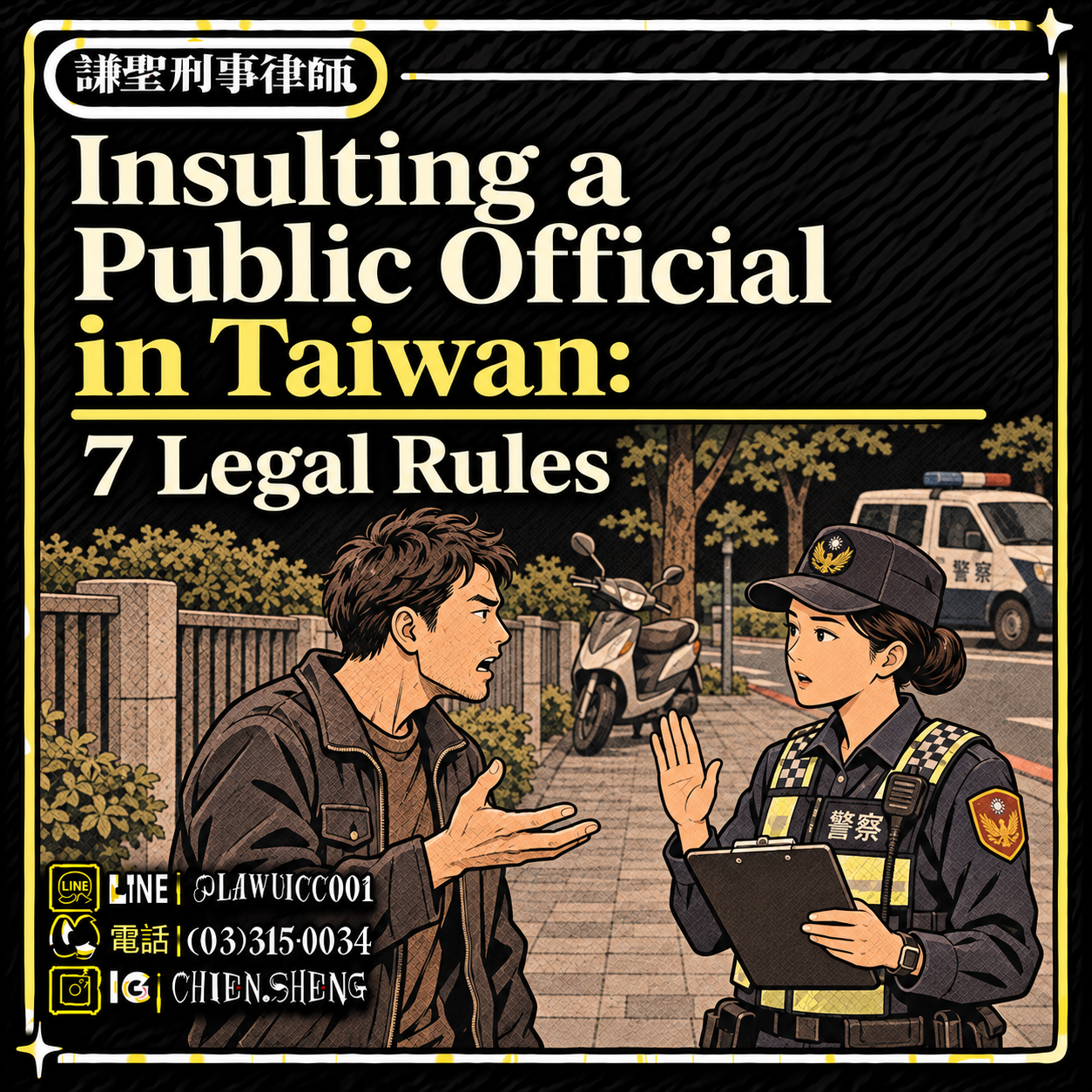
- 1. 1. Insulting a Public Official in Taiwan: What the Constitutional Court Changed
- 2. 2. Angry Words and a Purpose to Obstruct Are Different Questions
- 3. 3. The Effect on Official Duties Requires a Separate Assessment
- 4. 4. Warnings Matter, but They Do Not Decide Every Case
- 5. 5. Public Insult and Settlement Follow Different Rules
- 6. 6. Preserve Evidence and Understand Your Interview Rights
-
7.
7. Build the Defense Around the Encounter and the Evidence
- 7.1. ▫️Identify the official duty and its legal basis
- 7.2. ▫️Reconstruct the complete exchange
- 7.3. ▫️Evaluate additional conduct separately
- 7.4. ▫️Choose a strategy that reflects the evidence
- 7.5. ▫️Hypothetical example: A brief complaint during ticketing
- 7.6. ▫️Hypothetical example: Repeated shouting during enforcement
-
8.
Frequently Asked Questions
- 8.1. Q1. Is Insulting a Public Official in Taiwan always a criminal offense?
- 8.2. Q2. Can I criticize a police officer or government agency?
- 8.3. Q3. Does the absence of a warning guarantee dismissal?
- 8.4. Q4. Will apologizing or reaching a settlement automatically end the case?
- 8.5. Q5. What should I bring to a lawyer consultation?
- 9. How Chien Sheng International Law Firm Can Help
- 10. Official Legal References📑
- 11. 📢【24-Hour Free Legal Consultation】
Insulting a Public Official in Taiwan does not automatically lead to a conviction simply because an officer hears offensive words. Following Constitutional Court Judgment 113-Hsien-Pan-5, prosecutors must examine the purpose behind the conduct and whether it was sufficient to interfere with lawful official duties.
An argument during a traffic stop, an angry complaint about enforcement, and sustained abuse intended to disrupt an operation require different legal assessments. Understanding these distinctions is important when preparing for police questioning or responding to a criminal charge.
🚨This guide explains seven key rules, the evidence worth preserving, and how Chien Sheng International Law Firm can assist with a criminal defense.
1. Insulting a Public Official in Taiwan: What the Constitutional Court Changed
On May 24, 2024, the Constitutional Court issued two distinct rulings concerning Criminal Code Article 140:
- The offense involving an on-site insult directed at an official performing lawful duties remains valid within a narrowed scope.
- The separate offense of publicly insulting official duties became invalid immediately.
➥For the surviving offense, the conduct must involve both a subjective purpose to obstruct official duties and an objective capacity to affect their execution. The judgment therefore did more than explain how courts should assess offensive language: it also invalidated part of the provision. judicial.gov.tw
Article 140 provides for imprisonment of up to one year, short-term detention, or a fine of up to NT$100,000. Its statutory wording must be read together with the constitutional ruling. Quoting the provision without explaining that ruling can give readers an inaccurate impression of what remains punishable. law.moj.gov.tw
The practical starting point is to identify the exact accusation. Is the case about an insult directed at a particular official, criticism of government work, or additional conduct beyond speech?
2. Angry Words and a Purpose to Obstruct Are Different Questions
A defense should examine why the words were spoken, rather than treating offensive language as conclusive evidence of criminal intent.
Someone may complain about an officer’s attitude, question the legal basis for enforcement, or react emotionally to an unexpected penalty. Counsel should examine the surrounding conversation, the speaker’s actions, and what the official was doing at that moment.
💡Useful questions include:
- Was the person requesting an explanation or trying to prevent a specific task?
- Was the remark brief, repeated, or accompanied by other conduct?
- What happened immediately before and after the disputed words?
- Does the complete recording support the account in the police report?
➥Saying “I was angry” does not settle the issue. Equally, selecting an insulting sentence from a longer exchange does not explain the entire encounter.
An effective defense connects the explanation to recordings, timing, and observable behavior. For example, evidence that a person continued following directions while expressing frustration may deserve examination alongside the disputed language.
3. The Effect on Official Duties Requires a Separate Assessment
The relevant question is whether the conduct was clearly capable, in context, of interfering with official instructions, communication, or performance. An official’s personal displeasure does not by itself establish this requirement. judicial.gov.tw
Counsel should identify the particular task allegedly affected and examine the claimed interference.
🔎Practical questions include:
- Which official activity was underway?
- Were instructions prevented from being communicated or followed?
- How long did the exchange last?
- Was any delay attributable to the disputed conduct or to another event?
- What do the recording and operational timeline show?
➥The fact that an officer eventually completed the task does not, by itself, resolve the charge. Conversely, an officer’s decision to pause and respond does not automatically establish the required interference.
This is why a complete timeline can be more useful than a brief video clip or a general description of someone as “uncooperative.”
4. Warnings Matter, but They Do Not Decide Every Case
Whether an official asked the speaker to stop, and how the speaker responded, can be important evidence.
The Constitutional Court explained that stopping after intervention does not permit an automatic finding of guilt. Continuing despite intervention may support an inference about the speaker’s purpose, but the effect on official duties must still be assessed. judicial.gov.tw
👨🏻⚖️A defense should preserve the exact warning, its timing, and the subsequent exchange:
- Did the person stop immediately?
- Did the person continue speaking while complying with directions?
- Did the conduct become more intense?
- Were several people speaking simultaneously?
- What interference allegedly followed?
➥Neither “there was no warning, so the arrest must be unlawful” nor “the person continued after a warning, so guilt is established” is a reliable shortcut.
Any challenge to an arrest should also distinguish the substantive offense from the legal requirements for taking someone into custody. Whether a crime occurred and whether an arrest was lawful require related but separate analysis.
5. Public Insult and Settlement Follow Different Rules
If Article 140 is not established, an ordinary public-insult charge under Article 309 does not automatically follow.
Judgment 113-Hsien-Pan-3 requires courts to assess the expression in context, including whether it exceeds what people can reasonably tolerate and how reputation should be balanced against freedom of expression. Negative or vulgar wording alone does not settle that assessment. judicial.gov.tw
🚨Counsel should therefore examine:
- The alleged words and their surrounding conversation.
- Whether the expression was public.
- Whether an identifiable individual was targeted.
- Whether the remarks concerned public affairs.
- The alleged impact on the person’s reputation.
➥Public insult is a complaint-dependent offense under Article 314. Where applicable, the complainant may withdraw the complaint before the conclusion of first-instance oral argument. A settlement should clearly address whether a complaint will be withdrawn and when. law.moj.gov.tw
Article 140 is not complaint-dependent. An apology or settlement therefore does not automatically terminate that charge. Its possible relevance to the handling of the case should be assessed separately.
6. Preserve Evidence and Understand Your Interview Rights
If you receive a police notice or are taken to a police station, first identify the suspected offense and the incident under investigation.
👨🏻⚖️Preserve the following materials:
- Full original recordings, rather than only edited excerpts.
- The locations and approximate recording times of nearby CCTV cameras.
- Notices, citations, summonses, and available custody documents.
- Relevant messages and witness contact details.
- A chronological account written while memories are fresh.
➥Keep original files. Avoid deleting messages, altering recordings, or coordinating accounts with other witnesses. Counsel can assess how to request preservation or investigation of official recordings.
Article 95 of the Code of Criminal Procedure provides rights including being informed of the suspected offenses, remaining silent, retaining defense counsel, and requesting investigation of favorable evidence. law.moj.gov.tw
Before signing an interview record, review whether it accurately reflects your answers. Ask for errors or missing explanations to be corrected. If you do not remember something, say so rather than guessing.
A defense lawyer can also help separate factual admissions from legal conclusions. A person may acknowledge using certain words while disputing that every element of the charged offense is satisfied.
For additional information about criminal proceedings, visit the firm’s criminal law information section.
7. Build the Defense Around the Encounter and the Evidence
A practical defense should connect each disputed legal element to particular evidence.
▫️Identify the official duty and its legal basis
Disagreement with enforcement does not itself establish that the duty was unlawful. Counsel should examine the official’s authority, the relevant procedure, and what actually occurred.
➥An objection should identify a specific legal or factual issue instead of relying solely on the speaker’s dissatisfaction.
▫️Reconstruct the complete exchange
Arrange the words, actions, warnings, responses, and alleged interference in chronological order.
➥Compare the police report with available recordings and witness accounts. If the accounts differ, identify the precise discrepancy and explain why it matters.
▫️Evaluate additional conduct separately
Speech, physical contact, threats, and physical obstruction may require different legal assessments. A freedom-of-expression argument should not be assumed to resolve every allegation arising from the encounter.
▫️Choose a strategy that reflects the evidence
Depending on the record, counsel may focus on contesting criminal liability, requesting further investigation, challenging a procedural issue, or presenting mitigation.
➥The appropriate approach follows from the evidence and the client’s informed instructions.
▫️Hypothetical example: A brief complaint during ticketing
A driver makes an offensive remark after receiving a traffic citation and then follows the officer’s directions.
➥Counsel should examine whether the exchange supports a purpose to obstruct and whether the remark was capable of affecting an ongoing task. The timing matters, but receiving the ticket does not conclusively establish that every official duty had ended.
▫️Hypothetical example: Repeated shouting during enforcement
A person repeatedly shouts at officials while an operation is underway, despite requests to stop.Counsel should identify what allegedly interfered with the operation. Was it the speech, physical blocking, several people shouting together, or another event?
➥These examples illustrate questions to investigate. They are not predictions of acquittal or conviction.
Frequently Asked Questions
Q1. Is Insulting a Public Official in Taiwan always a criminal offense?
No. Offensive words alone do not establish the surviving Article 140 offense. The purpose of the conduct, its capacity to interfere with lawful duties, and the surrounding circumstances must be examined.
Q2. Can I criticize a police officer or government agency?
Criticism of public power receives constitutional protection. Whether a particular expression creates separate criminal liability depends on its context and the requirements of the applicable offense.
Q3. Does the absence of a warning guarantee dismissal?
No. Warnings and responses are relevant evidence, but the case still requires an assessment of all applicable elements. The absence of a warning does not automatically determine either guilt or the legality of an arrest.
Q4. Will apologizing or reaching a settlement automatically end the case?
No. Article 140 is not complaint-dependent. A separate Article 309 allegation requires its own procedural assessment, including whether a valid complaint withdrawal is available.
Q5. What should I bring to a lawyer consultation?
Bring the police notice or summons, available charging documents, recordings, witness details, and a clear timeline. Explain unfavorable facts as well as favorable ones so the advice reflects the complete incident.
How Chien Sheng International Law Firm Can Help
Chien Sheng International Law Firm can assist with reviewing the alleged conduct, identifying missing evidence, preparing for questioning, and presenting arguments about criminal liability and procedure.
👨🏻⚖️If you or a family member faces an allegation arising from an encounter with officials, preserve the original materials and contact Chien Sheng International Law Firm to discuss the documents, procedural stage, and available defense options.
Legal information reviewed on November 25, 2026. This article provides general information about Taiwanese law and does not replace advice based on the complete case record. No particular prosecutorial or judicial outcome is guaranteed.
Official Legal References📑
- Judicial Yuan: Summary of Constitutional Court Judgment 113-Hsien-Pan-5
- Criminal Code Article 140
- Judicial Yuan: Summary of Constitutional Court Judgment 113-Hsien-Pan-3
- Criminal Code Article 309
- Criminal Code Article 314
- Code of Criminal Procedure Article 95
- Code of Criminal Procedure Article 238
📢【24-Hour Free Legal Consultation】
🏛 Taipei Office: 6F., No. 64, Kangding Rd., Wanhua Dist., Taipei City|02-2388-8962
🏛 Taoyuan Office: 17F., No. 95, Xinpu 6th St., Taoyuan Dist., Taoyuan City|(03)3150-034
🏛 Kaohsiung Office: 3F., No. 687, Mingcheng 3rd Rd., Gushan Dist., Kaohsiung City
Contact Us on LINE for a Free Consultation: @lawuicc001
IG: chien.sheng_
FB: Chien Sheng International Law Firm
💳 We Accept Cash, Credit Cards, and Bank Transfers.