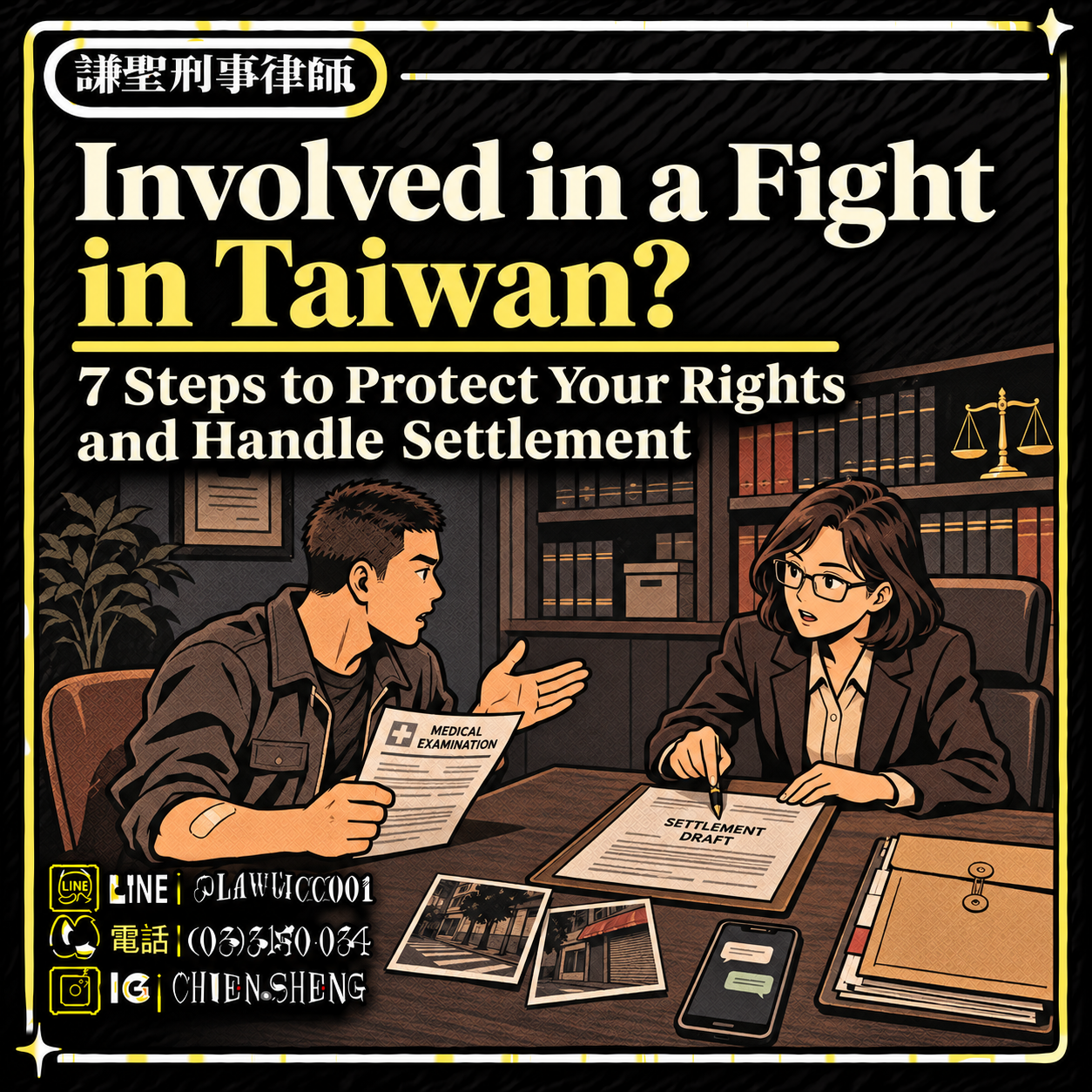
- 1. 1. Involved in a Fight in Taiwan? Identify the Possible Charges
- 2. 2. Assess Self-Defense Without Assuming That Every Counterattack Is Unlawful
- 3. 3. Protect Your Safety and Preserve Evidence
- 4. 4. Understand the Criminal Complaint Deadline
- 5. 5. Prepare Carefully for Police Questioning
- 6. 6. Separate Settlement From Withdrawal of a Complaint
- 7. 7. Evaluate Civil Compensation Separately
-
8.
Frequently Asked Questions
- 8.1. Q1. Involved in a Fight in Taiwan? Can both sides face charges?
- 8.2. Q2. Is it automatically self-defense if the other person hit first?
- 8.3. Q3. Can I withdraw my complaint after receiving a first-instance judgment?
- 8.4. Q4. Will paying compensation prevent a criminal conviction?
- 8.5. Q5. Can I face liability if I did not punch anyone?
- 9. How Chien Sheng International Law Firm Can Assist
- 10. Official Legal References🔍
- 11. 📢【24-Hour Free Legal Consultation】
Involved in a Fight in Taiwan? Your next steps should be to get to safety, obtain medical care, preserve evidence and understand your legal position before giving a detailed statement. A physical confrontation can lead to injury charges, public-order offenses and civil compensation claims. Being injured does not automatically excuse your own conduct, and being accused does not establish guilt.
Two common assumptions can cause problems: “They hit me first, so anything I did was self-defense,” and “We settled, so the criminal case must be over.” Neither is a reliable statement of Taiwanese law.
📢 This guide from Chien Sheng International Law Firm explains the rules on bodily injury, group violence, self-defense, criminal complaints and settlement.
1. Involved in a Fight in Taiwan? Identify the Possible Charges
▫️Ordinary bodily injury under Article 277
Article 277, paragraph 1 of Taiwan’s Criminal Code punishes intentionally injuring another person’s body or health. The maximum penalty is five years’ imprisonment, detention or a fine of NT$500,000.
If an intentional injury causes death or serious injury, paragraph 2 provides substantially heavier penalties. Whether those aggravated consequences apply depends on the evidence and applicable legal requirements.law.moj.gov.tw
➠In a confrontation where both sides use violence, each person’s conduct must be assessed separately. Both may potentially be complainants and suspects. Their injuries, intentions and responsibility do not automatically cancel each other out.
▫️Group violence under Article 150
Article 150 addresses three or more people gathering in a public place or a place accessible to the public and using violence or threats. It distinguishes between:
- People present who lend support: up to one year’s imprisonment, detention or a fine of NT$100,000.
- Ringleaders and direct perpetrators: six months to five years’ imprisonment.
Specified aggravating circumstances include carrying weapons or other dangerous items with the intention of using them, or causing danger to the public or traffic. The court may increase the punishment by up to one-half.law.moj.gov.tw
➠Three people merely standing nearby do not automatically satisfy the offense. Investigators must examine participation, intent, location and the actual conduct. A bystander, a person trying to separate the parties and someone encouraging violence may have very different legal positions.
2. Assess Self-Defense Without Assuming That Every Counterattack Is Unlawful
Article 23 of the Criminal Code permits conduct undertaken to defend your own or another person’s rights against a present unlawful attack. Excessive defensive conduct may result in a reduced or remitted punishment.law.moj.gov.tw
💡The practical questions include:
- Was an unlawful attack occurring or immediately impending?
- Were you acting to stop that attack?
- Was your response necessary in the circumstances?
- Did you continue using force after the danger ended?
▫️Hitting back does not automatically defeat self-defense
A defensive response can involve force. It is inaccurate to say that only blocking or retreating can qualify, or that throwing a punch necessarily turns the incident into mutual combat.
However, a response intended to punish, retaliate or continue a fight is different from force used to stop an ongoing attack. Taiwanese court decisions distinguish necessary defensive counteraction from reciprocal attacks motivated by an intention to injure.judgment.judicial.gov.tw
If the other person stops attacking and the danger has ended, chasing and striking them may be treated as retaliation.
The assessment should consider the sequence of events, weapons, number of attackers, physical disparity and available responses. It is not simply a comparison of who suffered the worse injury.
For safety, disengage and seek help when possible. Legally, however, the existence of an opportunity to move away should not be presented as an automatic rule that eliminates every claim of self-defense.
3. Protect Your Safety and Preserve Evidence
▫️Get help and obtain medical treatment
Move to a safe location and call the police. If urgent medical assistance is needed, call emergency services.Seek treatment promptly and explain your symptoms and the incident accurately. Ask for relevant medical documentation and retain receipts.
A medical certificate can document injuries and treatment. It does not, by itself, prove who caused every injury or establish the entire sequence of events.
▫️Preserve complete recordings
Identify nearby cameras and save original dashcam or phone footage. Record camera locations and ask investigators to obtain footage promptly, because recordings may be overwritten.
Preserve the lead-up and aftermath as well as the physical contact. A short clip may omit an initial attack, an attempt to intervene or the moment someone withdrew.
▫️Keep supporting records
Useful materials may include:
- Photographs of injuries and the scene.
- Witness names and contact details.
- Original messages and relevant call records.
- Damaged clothing or property.
- Medical expenses and documented work absence.
- Police notices and case reference information.
Do not edit recordings, fabricate documents or coordinate accounts with other participants.
4. Understand the Criminal Complaint Deadline
Ordinary bodily injury under Article 277, paragraph 1 generally requires a criminal complaint, subject to statutory exceptions. Other offenses arising from the same confrontation may not require one.law.moj.gov.tw
▫️The six-month period is not always measured from the incident
Under Article 237 of the Code of Criminal Procedure, the complaint period generally runs for six months from when the person entitled to complain learns the offender’s identity.
That may coincide with the incident, but it should not automatically be described as “six months after the fight.”law.moj.gov.tw
A complaint can generally be made to the police or prosecutor. Clearly identify the conduct you want investigated and provide available evidence. Do not assume that obtaining medical treatment or making a general report necessarily resolves every complaint requirement.
▫️Do not let negotiations consume the deadline
Settlement discussions should not be assumed to suspend the complaint period. If negotiations remain unresolved, obtain advice before the deadline expires.
Also distinguish ordinary injury from injury causing death or serious injury, group violence and other offenses. Their procedural requirements may differ.
5. Prepare Carefully for Police Questioning
Before attending, confirm whether you are being questioned as a suspect, complainant, witness or in another capacity. In a reciprocal confrontation, your role may require particular care.
A suspect has rights including silence and the appointment of defense counsel. A lawyer can generally attend questioning within the applicable legal framework and help identify evidence or procedural issues.
👨🏻⚖️Prepare a factual timeline covering:
- What happened before physical contact.
- Who was present and where each person stood.
- The sequence of attacks, defensive actions and attempts to leave.
- When the confrontation ended.
- What happened afterward.
Do not guess about matters you cannot remember. Distinguish what you personally saw from what someone later told you.
Before signing a statement, read it carefully or request that it be read to you. Check whether it accurately records your account, especially descriptions such as “attacked,” “blocked,” “restrained” or “helped.” Request corrections where the wording changes your meaning.
Legal assistance should help you give an accurate account and exercise your rights, rather than construct a version inconsistent with the evidence.
6. Separate Settlement From Withdrawal of a Complaint
Settlement can resolve compensation and reduce conflict. It can also be relevant to prosecutorial or sentencing decisions. Its effect depends on the offense and the procedural stage.
▫️Signing an agreement does not automatically withdraw a complaint
For a complaint-dependent offense, Article 238 permits withdrawal before the conclusion of oral argument in the first-instance trial. A person who withdraws the complaint cannot file it again.
A private settlement agreement and a procedural withdrawal are different acts. Confirm whether withdrawal has actually been submitted and whether it is legally effective.law.moj.gov.tw
A valid withdrawal may result in non-prosecution during investigation or a judgment of non-acceptance after prosecution, depending on the procedural position. This is not the same as an acquittal on the merits.
Article 150 is not dependent on the victim maintaining a complaint. Settling an ordinary injury claim therefore does not automatically terminate a related public-order prosecution.
▫️Address payment and withdrawal together
A settlement should clearly state:
- Which incident, parties and claims it covers.
- The amount, payment dates and method.
- Whether payment is immediate or by installments.
- Any agreement concerning complaint withdrawal.
- The consequences of missed payments.
- Whether further civil claims remain.
Withdrawal cannot simply be reversed if payment later fails. Consider payment security and enforceability before agreeing to withdraw, while also observing the statutory withdrawal deadline.
7. Evaluate Civil Compensation Separately
Criminal proceedings and civil liability are related but distinct. A settlement of one issue may leave others unresolved.
Under the Civil Code, unlawful injury may give rise to compensation for proven losses. Depending on the circumstances, recoverable items can include medical expenses, lost earnings, reduced earning capacity, increased care needs and non-pecuniary harm. Each item requires an appropriate factual and legal basis.law.moj.gov.tw
➠There is no universal settlement price for a bruise, fracture or hospital stay. Assess the evidence, causation, treatment needs and responsibility instead of relying on an online compensation figure.
If settlement cannot be reached, the case still requires an assessment of the evidence. A lawyer may examine whether charges are supported, whether self-defense applies, what conduct is attributable to each person and which sentencing factors are relevant.
➠Payment does not purchase an acquittal, and declining an unsupported demand does not establish guilt.
Frequently Asked Questions
Q1. Involved in a Fight in Taiwan? Can both sides face charges?
Yes. Each person’s conduct is assessed separately. Both sides may potentially face injury allegations, while the evidence may support different conclusions about their intentions, defensive actions and responsibility.
Q2. Is it automatically self-defense if the other person hit first?
No. The first attack matters, but the purpose, necessity and timing of your response also matter. Force used to stop an ongoing attack differs from retaliation after the danger has ended.
Q3. Can I withdraw my complaint after receiving a first-instance judgment?
For complaint-dependent offenses, the ordinary statutory deadline is before oral argument concludes in the first-instance trial. Waiting until after judgment is generally too late to obtain that procedural effect.
Q4. Will paying compensation prevent a criminal conviction?
Not necessarily. A valid complaint withdrawal may resolve an ordinary injury prosecution, but payment alone does not guarantee withdrawal or terminate offenses prosecuted independently of a complaint.
Q5. Can I face liability if I did not punch anyone?
Possibly. Encouraging violence or otherwise participating may create liability, depending on the offense and evidence. Mere presence, observation or an attempt to stop the confrontation should not automatically be treated as criminal support.
How Chien Sheng International Law Firm Can Assist
Physical confrontation cases require an accurate reconstruction of what each person did. Chien Sheng International Law Firm can assist with:
- Reviewing injury and public-order allegations.
- Assessing self-defense and individual participation.
- Organizing recordings, medical records and witness evidence.
- Providing assistance during police questioning and prosecution.
- Negotiating compensation and reviewing withdrawal arrangements.
- Handling related criminal proceedings and civil disputes.
For further reading, see the firm’s guide to group violence and Article 150. Service information is available through the Chien Sheng International Law Firm website.
Preserving a complete record early helps ensure that responsibility is assessed on evidence rather than assumptions. Outcomes depend on the facts, applicable law and procedural position.
※ This article provides general information about Taiwanese law, reviewed on November 24, 2026. It does not replace advice on a specific case.
Official Legal References🔍
- Criminal Code, Article 23: Self-defense
- Criminal Code, Article 150: Group violence and threats
- Criminal Code, Article 277: Bodily injury
- Criminal Code, Article 287: Complaint requirements
- Code of Criminal Procedure, Article 237: Complaint period
- Code of Criminal Procedure, Article 238: Comp
📢【24-Hour Free Legal Consultation】
🏛 Taipei Office: 6F., No. 64, Kangding Rd., Wanhua Dist., Taipei City|02-2388-8962
🏛 Taoyuan Office: 17F., No. 95, Xinpu 6th St., Taoyuan Dist., Taoyuan City|(03)3150-034
🏛 Kaohsiung Office: 3F., No. 687, Mingcheng 3rd Rd., Gushan Dist., Kaohsiung City
Contact Us on LINE for a Free Consultation: @lawuicc001
IG: chien.sheng_
FB: Chien Sheng International Law Firm
💳 We Accept Cash, Credit Cards, and Bank Transfers.