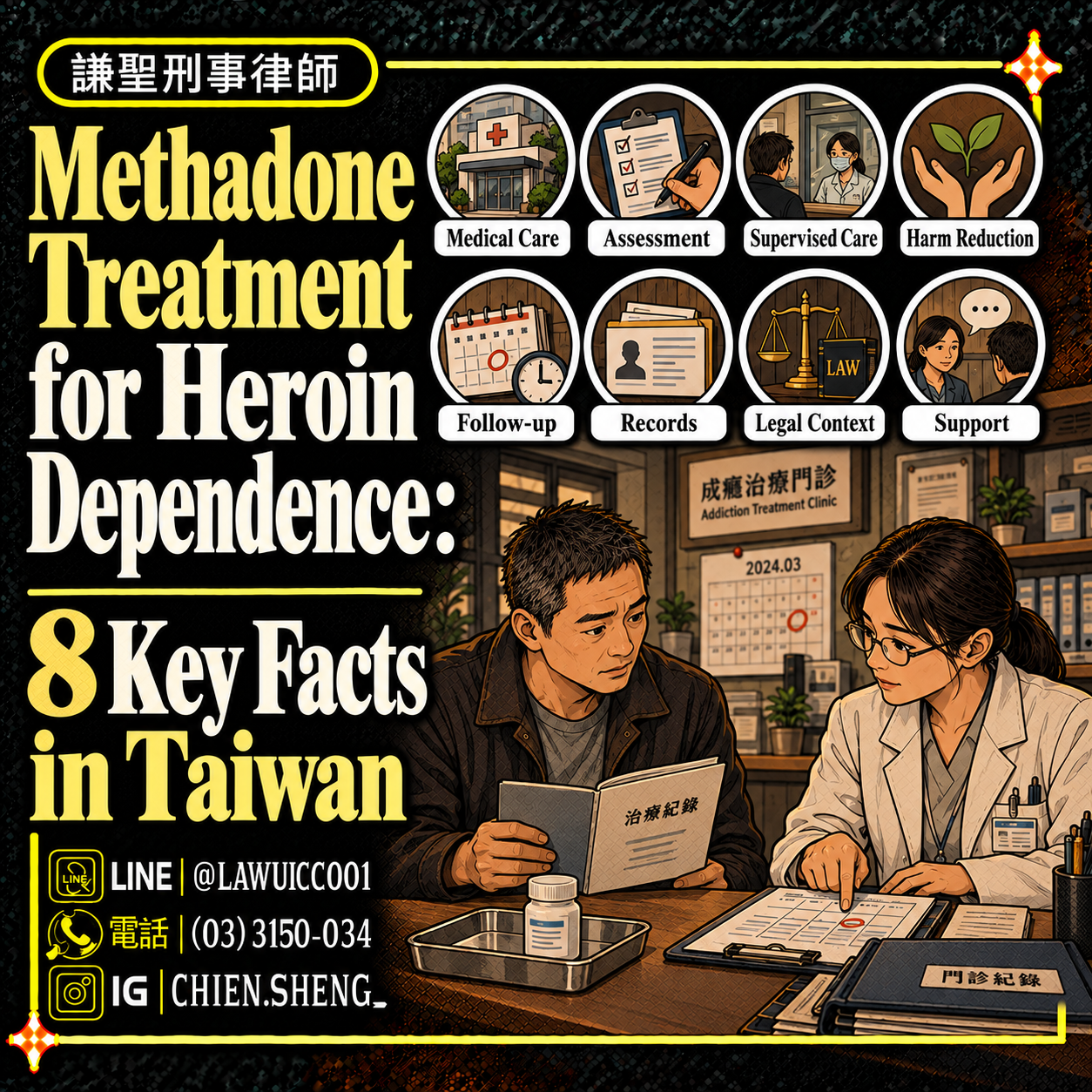
- 1. 1. How methadone treatment for heroin dependence works
- 2. 2. Methadone and heroin have different legal classifications
- 3. 3. Harm reduction supports treatment without legalizing heroin
- 4. 4. Treatment has benefits, but medication safety still matters
- 5. 5. Taiwan already has an established treatment and subsidy system
- 6. 6. Voluntary treatment and criminal immunity are different questions
- 7. 7. Deferred prosecution with treatment carries additional obligations
- 8. 8. Medical treatment does not authorize unrelated possession or supply
-
9.
Frequently asked questions
- 9.1. Q1. Is methadone treatment for heroin dependence legal in Taiwan?
- 9.2. Q2. Does entering treatment mean I cannot be prosecuted for past heroin use?
- 9.3. Q3. Will I have to stay on the medication for life?
- 9.4. Q4. What if I use heroin or another substance during treatment?
- 9.5. Q5. Can I arrange treatment in another city or receive financial assistance?
- 10. How to begin treatment and prepare for legal advice
- 11. How Chien Sheng International Law Firm can assist👨🏻⚖️
- 12. 📢【24-Hour Free Legal Consultation】
Methadone treatment for heroin dependence is a medically supervised approach to reducing withdrawal symptoms, cravings, and the harms associated with illicit opioid use. In Taiwan, it is provided through regulated treatment services. It does not legalize heroin or automatically remove criminal liability for other drug-related conduct.
💡Confusion often arises because methadone is itself an opioid. The important distinction is between authorized medical treatment and unlawful acquisition, use, or supply—not simply whether a substance has opioid effects.
Chien Sheng International Law Firm explains the medical principles, harm reduction goals, and legal issues patients and families should understand.
1. How methadone treatment for heroin dependence works
Methadone is a synthetic opioid medication. When prescribed for opioid use disorder, its longer action can help control withdrawal symptoms and cravings, reducing the repeated cycle of seeking and using illicit heroin.
The clinician assesses the patient’s opioid use, health conditions, other medications, and response to treatment. The aim is a stable, effective regimen that supports recovery, rather than intoxication.Treatment may also involve mental health care, counseling, infectious disease services, social support, and monitoring. These services can address needs beyond withdrawal alone. irp.nida.nih.gov
➠Medication is not a guarantee that someone will immediately stop all illicit drug use. Treatment plans require follow-up and may need adjustment. Patients should discuss difficulties openly with the clinical team rather than change the medication themselves.
2. Methadone and heroin have different legal classifications
Heroin is a Category 1 narcotic under Taiwan’s Narcotics Hazard Prevention Act. Article 10 prescribes imprisonment of six months to five years for unlawful use of Category 1 narcotics, although treatment-related procedures and statutory exceptions must also be considered. law.moj.gov.tw
Methadone is not heroin. However, it would also be inaccurate to say that methadone is outside Taiwan’s narcotics legislation.It appears in the Category 2 narcotics schedule and is separately regulated as a Schedule 2 controlled medicine. These classifications operate alongside the legal framework for medical use. law.moj.gov.tw
👨🏻⚖️Why a scheduled substance can be used in treatment
Being listed as a controlled substance does not mean every medical administration is a criminal act. Authorized prescribing, dispensing, and administration are governed by medical and controlled-drug rules.
➠Patients should obtain treatment through authorized services and follow their instructions. Buying methadone privately, sharing medication, or diverting it to someone else is not equivalent to receiving supervised care and may create separate legal risks.
The legal boundary therefore depends on authorization, source, purpose, and actual conduct. Classification alone cannot answer every question.
3. Harm reduction supports treatment without legalizing heroin
Harm reduction seeks to prevent avoidable illness, overdose, and other harms while helping people access care. It does not require pretending that illicit drug use is harmless.Taiwan’s Ministry of Health and Welfare describes maintenance medication, clean needle services, and education, testing, and referral as complementary parts of its harm reduction approach.
Reducing illicit heroin use and injecting can reduce exposure to unsafe supplies and shared equipment. Patients can also gain access to HIV and hepatitis testing, treatment, and other health services. mohw.gov.tw
🔎What the evidence supports
The World Health Organization recognizes opioid agonist maintenance treatment as an effective intervention that can reduce non-medical opioid use, mortality, and infectious disease transmission, while improving treatment retention. who.int
A Cochrane review comparing methadone maintenance with approaches that did not use opioid replacement medication found improved retention and reduced heroin use. That review did not establish statistically significant differences in mortality or criminal activity within its included trials.
This is a limitation of that particular evidence comparison, not proof that treatment has no mortality benefit. Research findings should be described with their scope and limitations intact. Cochrane
➠Medication treatment does not solve every social or criminal justice problem. Its benefits also do not remove the need for safe prescribing, monitoring, and continuity of care.
4. Treatment has benefits, but medication safety still matters
Methadone can cause side effects such as constipation, nausea, sweating, dizziness, and drowsiness. Serious risks include respiratory depression and, in some circumstances, heart rhythm problems.Risk can increase when methadone is combined with alcohol, heroin, benzodiazepines, sleeping medicines, or other substances that depress breathing. Patients should tell every treating clinician about their medications and substance use.
Do not take an extra dose because a dose was missed or seems ineffective. Contact the treatment provider for instructions. Marked difficulty waking, slow breathing, or collapse requires urgent medical attention. 衛生福利部疾病管制署
💡Physical dependence is not the same as uncontrolled addiction
Long-term opioid medication can produce physical dependence, meaning withdrawal may occur if it is stopped abruptly or reduced too quickly. This does not, by itself, mean that properly supervised treatment is failing or that one uncontrolled addiction has simply replaced another.
Some patients benefit from long-term maintenance. Others may eventually discuss a gradual reduction with their clinician. Treatment duration should reflect clinical needs and relapse risk, rather than pressure to stop as quickly as possible. NHS
➠Avoid driving or operating machinery if you feel sedated or impaired, and ask the treatment team about fitness to drive. A prescription is not permission to drive unsafely.
5. Taiwan already has an established treatment and subsidy system
Methadone services are not a recent legalization measure. Taiwan has provided opioid maintenance treatment within its harm reduction and addiction care system for many years.The Ministry of Health and Welfare maintains a list of designated substance use treatment institutions and methadone dispensing sites. Approved cross-region arrangements may help eligible patients maintain treatment when work or residence changes. mohw.gov.tw
Patients should arrange any transfer with their provider. They should not assume they can collect medication from any clinic without prior coordination.
Financial assistance in 2026📝
The ministry’s 2026 addiction treatment subsidy program runs from January 1 through December 31, 2026. It includes support for specified maintenance medication and dispensing services, subject to the applicable program rules.
Other treatment costs may depend on eligibility, the service provided, and available funding. The existence of a subsidy does not mean every patient receives every service free of charge. 802.mnd.gov.tw
➠Ask the institution to confirm the required documents, current coverage, and any remaining payment before starting treatment.
6. Voluntary treatment and criminal immunity are different questions
Starting medical care does not automatically cancel an existing investigation. The timing and statutory requirements matter.
Article 21 of the Narcotics Hazard Prevention Act addresses people who voluntarily seek treatment from a designated institution before their drug-use offense has been discovered. The institution is exempted from referring the treatment seeker to the court or prosecutors.
The provision also directs non-prosecution, or the relevant juvenile non-hearing disposition, where a qualifying person is discovered during that treatment. This latter protection is limited to one occasion. law.moj.gov.tw
💡Why the timeline matters
A person who begins treatment only after the offense has already been discovered cannot assume that Article 21 applies. Relevant dates may include the treatment request, police discovery, sampling, and other investigative steps.
Do not delay needed medical care while trying to resolve these legal questions. Instead, preserve the records and obtain a separate assessment of the criminal procedure.Bring treatment enrollment documents, medical records, sampling notices, and police or prosecutor correspondence to counsel. A careful timeline is more useful than a general statement that you are already receiving medication.
7. Deferred prosecution with treatment carries additional obligations
Voluntary medical enrollment is different from a prosecutor’s deferred prosecution disposition requiring completion of addiction treatment.
Under Article 24 of the Narcotics Hazard Prevention Act, treatment-related deferred prosecution operates within the criminal procedure. The prosecutor must consult the relevant medical institution before imposing the specified treatment condition. Enrollment alone does not guarantee approval.
➠If deferred prosecution is revoked, the prosecutor must continue the investigation or prosecute as the law provides. law.moj.gov.tw
📢Attendance and testing can affect the disposition
Taiwan’s treatment implementation and completion rules identify circumstances that may be treated as failure to complete treatment. These include:
- Missing scheduled replacement medication treatment for eight consecutive days or more without justification.
- Missing other designated treatment more than three times without justification.
- Certain violent or threatening conduct toward personnel.
- Specified positive drug test results during the relevant period.
➠The rules permit revocation in these circumstances; they do not mean every disputed result can be assessed without checking the substance detected, medical records, and procedural facts. law.moj.gov.tw
Report illness, hospitalization, scheduling problems, or medication issues promptly. Keep evidence of communications with the treatment institution and supervising authority.Do not confuse the eight-day rule with permission to skip treatment. Even a shorter interruption can require clinical reassessment, and the individual disposition may impose additional duties.
Receiving supervised medication does not make separately possessed heroin, methamphetamine, or other illicit substances lawful. Possession, transfer, sale, transportation, and manufacture involve their own legal questions.
Article 11 of the Narcotics Hazard Prevention Act distinguishes ordinary possession from specified higher-quantity possession. For Category 1 narcotics, the higher-quantity threshold is a pure net weight of 10 grams or more—not merely more than 10 grams.
The applicable provision carries one to seven years’ imprisonment and a possible fine of up to NT$1 million. Other conduct, including possession with intent to sell, may fall under different provisions. law.moj.gov.tw
▫️Weight and conduct must be checked separately
Pure net weight is not automatically the same as the total weight of a packet or mixture. Laboratory findings, the substance identified, and the alleged conduct must be examined before assessing exposure.
Treatment records may be relevant to the person’s history and appropriate response, but they do not automatically defeat evidence of a separate drug offense.
▫️Drug testing also requires careful interpretation
A report identifying prescribed methadone is not the same as a report identifying heroin use. Ask for the actual report rather than relying on the word “positive.”
Preserve prescriptions, administration records, the specimen collection date, and the specific laboratory findings. Where a result is disputed, the medical team can explain treatment-related findings while counsel addresses the procedural and legal issues.
📖 Related reading: Chien Sheng’s guide to medication-related urine test disputes and codeine explains why the substance detected and medical records matter. Different medications require their own interpretation.
Frequently asked questions
Q1. Is methadone treatment for heroin dependence legal in Taiwan?
Yes, when provided through the authorized medical and controlled-drug framework. Methadone’s Category 2 narcotics classification does not prohibit properly authorized treatment. Private purchase, diversion, or sharing is a different matter.
Q2. Does entering treatment mean I cannot be prosecuted for past heroin use?
No automatic exemption follows from enrollment alone. Article 21 has specific requirements, including seeking designated treatment before the offense is discovered. Existing investigations and other alleged offenses require separate assessment.
Q3. Will I have to stay on the medication for life?
Not necessarily. Some people benefit from prolonged maintenance, while others may eventually reduce treatment under medical supervision. Do not stop suddenly or change the plan without discussing it with the treating clinician.
Q4. What if I use heroin or another substance during treatment?
Tell the clinical team promptly so it can assess overdose risk and adjust support. Do not compensate by increasing or stopping medication yourself. If treatment is a deferred prosecution condition, additional drug use or a qualifying positive test may also affect that disposition.
Q5. Can I arrange treatment in another city or receive financial assistance?
Possibly. Taiwan has designated institutions, dispensing sites, approved cross-region services, and subsidy arrangements. Ask your current provider to confirm eligibility and coordinate continuity before changing sites or missing an appointment.
How to begin treatment and prepare for legal advice
Start with the Ministry of Health and Welfare’s designated treatment institution list. A clinician can assess whether methadone, another medication, or a different approach is appropriate.Patients and families can also contact their local drug abuse prevention center for referral and support. The ministry publishes the consultation number 0800-770-885. dep.mohw.gov.tw
💡If a criminal matter is already underway, prepare a separate set of documents for legal review:
- Police notices, prosecutor summonses, indictments, or court documents.
- Treatment enrollment and attendance records.
- Prescriptions and medication administration records.
- Complete laboratory reports and sampling information.
- Documents concerning previous drug cases and treatment-related dispositions.
Do not assume that medical attendance replaces a scheduled police interview or court appearance. Confirm both sets of obligations.
How Chien Sheng International Law Firm can assist👨🏻⚖️
Chien Sheng International Law Firm can help review drug-use allegations, treatment-related deferred prosecution, disputed test results, possession allegations, and other narcotics proceedings.The legal analysis should identify the alleged conduct, relevant dates, applicable classification, evidence, prior dispositions, and available procedural options. Medical professionals remain responsible for diagnosis, medication selection, dosage, and treatment changes.
For more information, visit the firm’s narcotics law resources or contact Chien Sheng International Law Firm with the relevant documents and any approaching deadline.
➠This article provides general medical-policy and legal information under Taiwan law, reviewed on October 29, 2026. It does not replace clinical care or individualized legal advice, and it does not guarantee a particular treatment or case outcome.
📢【24-Hour Free Legal Consultation】
🏛 Taipei Office: 6F., No. 64, Kangding Rd., Wanhua Dist., Taipei City|02-2388-8962
🏛 Taoyuan Office: 17F., No. 95, Xinpu 6th St., Taoyuan Dist., Taoyuan City|(03)3150-034
🏛 Kaohsiung Office: 3F., No. 687, Mingcheng 3rd Rd., Gushan Dist., Kaohsiung City
Contact Us on LINE for a Free Consultation: @lawuicc001
IG: chien.sheng_
FB: Chien Sheng International Law Firm
💳 We Accept Cash, Credit Cards, and Bank Transfers.