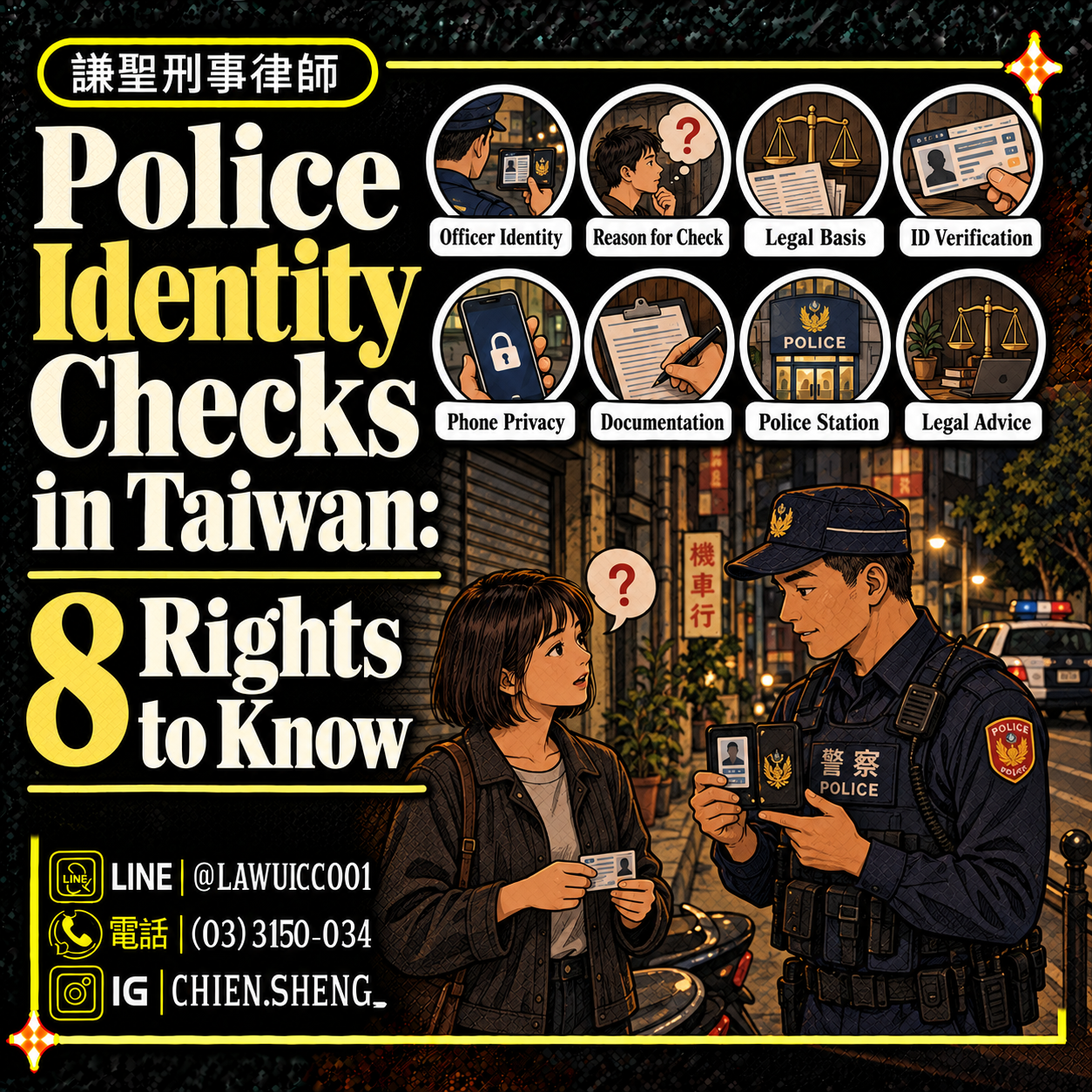
- 1. 1. When police identity checks in Taiwan are permitted
- 2. 2. Ask the officer to identify themselves and explain the reason
- 3. 3. You can generally record public police activity without obstructing it
- 4. 4. An identity check is not automatic permission to search your bag or phone
- 5. 5. Vehicle stops have additional rules
- 6. 6. You can state an objection and request a written record
- 7. 7. Being taken to a station for identity verification has limits
- 8. 8. If questioning concerns a criminal allegation, confirm your defense rights
- 9. 【What to preserve after the encounter】
-
10.
Frequently asked questions
- 10.1. Q1. Can I refuse police identity checks in Taiwan?
- 10.2. Q2. Can an officer take me to the station just because I forgot my ID?
- 10.3. Q3. Can police read my messages during a routine stop?
- 10.4. Q4. Does the three-hour limit cover every police encounter?
- 10.5. Q5. Can I record officers without asking permission?
- 11. How Chien Sheng International Law Firm can assist
- 12. 📢【24-Hour Free Legal Consultation】
Police identity checks in Taiwan must have a legal basis and remain within the scope of the power being exercised. If an officer stops you, stay calm, ask why you are being stopped, and clarify whether the encounter concerns identity verification, a traffic matter, or a criminal investigation.
Your practical priorities are to understand the procedure, record relevant details safely, express objections clearly, and avoid turning a legal disagreement into a physical confrontation.
👨🏻⚖️Chien Sheng International Law Firm explains the rules on identification, recording police activity, searches, station visits, and access to defense counsel.
1. When police identity checks in Taiwan are permitted
Article 6 of the Police Power Exercise Act allows identity verification in public places or places lawfully entered when specified conditions exist.
Examples include reasonable suspicion of criminal involvement, facts indicating knowledge of a committed or impending offense, and a need to prevent a concrete threat to life or physical safety.
💡The Act also addresses certain locations and designated public places, road sections, and checkpoints. Designation under Article 6 must be necessary for crime prevention or handling a major public safety or social order event and must be made by the responsible police chief. law.moj.gov.tw
A lawful check does not always mean the person stopped is suspected of an offense. For example, police may seek information from someone believed to know about a crime.
▫️Police powers are not unlimited
Judicial Yuan Interpretation No. 535 explains that police checks affect freedom of movement, property, and privacy. Their conditions, procedures, and remedies require a legal foundation, and their execution must respect proportionality. mojlaw.moj.gov.tw
A general reference to “routine checks” does not eliminate the need to identify an applicable legal basis. Conversely, saying “I have done nothing wrong” does not by itself resolve whether a particular check is lawful.
2. Ask the officer to identify themselves and explain the reason
Article 4 requires officers exercising police powers to identify themselves by wearing a uniform or presenting identification, and to explain the reason for the exercise of power.
The wording is important: a uniform and a separate identification document are not automatically both required in every situation. If a person in plain clothes claims to be an officer, ask to see official identification. law.moj.gov.tw
🚨You can calmly ask:
- “Which unit are you from?”
- “What is the reason for stopping me?”
- “Is this identity verification or questioning about a specific offense?”
Note the officer’s name, unit, visible identifying information, and patrol vehicle number where available.
▫️What if no reason is given?
Article 4 states that a person may refuse an exercise of power that does not comply with its identification and explanation requirements.
That provision does not make physical resistance a safe way to settle a dispute about compliance. State your concern, preserve what was said, and ask the officer to record your objection.If it is unclear whether you may leave, ask directly: “Am I free to leave? If not, what is the legal basis for keeping me here?”
3. You can generally record public police activity without obstructing it
Public recording can help establish what happened, including the reason given, the words exchanged, and any restriction on movement.
Official police guidance recognizes that recording officers performing duties in public to protect one’s rights is not prohibited merely because an officer has not consented. Recording must still account for the circumstances, proportionality, and other applicable legal restrictions. khhpd.npa.gov.tw
Record safely and preserve context📝
Keep a reasonable distance. Do not place a phone against an officer’s face, block movement, reach for equipment, or enter traffic to obtain footage.
A practical explanation is: “I am recording the encounter to preserve an accurate record, and I will not obstruct your work.”
Where safe, capture:
- The time, location, and surrounding conditions.
- The officer’s identifying details and stated reason.
- Any request to search belongings or move elsewhere.
- Your objections and the response.
- Any force, injury, or property damage.
➠Keep the original file and make a backup. Recording for evidence and publishing footage are different matters; uploading identifiable bystanders, private information, or misleadingly edited material can create separate issues.
➠Public recording rules do not automatically apply in the same way inside a police station, interview room, or other non-public setting. Ask about the applicable restrictions rather than assume an unrestricted right to film everywhere.
4. An identity check is not automatic permission to search your bag or phone
Article 7 permits specified measures for identity verification, including asking identifying questions and requiring identification documents.
Its safety-inspection provision requires clear facts indicating that a person carries an item capable of suicide, self-harm, or harming another person’s life or body. This is not a general authorization to search everything a person carries. law.moj.gov.tw
🔎Different powers require different grounds
A criminal search may rely on a warrant or another statutory basis. Its legality cannot be assessed solely by calling it an “identity check.”
Ask: “What is the legal basis and scope of this inspection?”
➠If you do not agree to a proposed consensual search, say so clearly and ask that your position be recorded. Lack of consent does not necessarily prevent a search supported by an independent lawful power.
Under Article 131-1 of the Code of Criminal Procedure, a search based on consent must be voluntary; the executing personnel must show identification and record the consent. law.moj.gov.tw
🔎Your phone’s contents require separate attention
Checking an identity document is different from browsing messages, photographs, location history, or financial applications.
Ask whether access to your phone is being requested voluntarily or under a compulsory legal measure, and what data is sought. Do not assume that handing over a device for one limited purpose authorizes unrestricted inspection.If a device is lawfully seized, do not physically wrestle it back or remotely erase its contents. Preserve your objection and ask counsel to examine the authority, scope, and records of the action.
Related reading: Chien Sheng’s explanation of police investigation methods, searches, and drug testing.
5. Vehicle stops have additional rules
Article 8 allows police to stop a vehicle where harm has occurred or an objective, reasonable assessment indicates a risk of harm. It authorizes specified measures, including checking identification, inspecting identifying vehicle features, and requiring an alcohol test.
The Article separately addresses ordering occupants out where unusual conduct creates reasonable suspicion of dangerous behavior, and inspecting a vehicle where facts support the relevant suspicion of crime. law.moj.gov.tw
A vehicle stop may also involve traffic legislation or criminal procedure. The correct legal basis depends on what officers are doing and why.
💡Respond without creating a road hazard
Pull over safely and avoid sudden movements or driving away while the stop is unresolved. Explain before reaching for a document or phone if the movement could be misunderstood.You may ask why you must leave the vehicle or why an inspection is required, while keeping the interaction calm and recording where safe.
Do not treat disagreement about the stop as a reason to refuse every safety instruction or test. Different traffic measures have their own requirements and consequences.
6. You can state an objection and request a written record
Article 29 allows the affected person or an interested party to state reasons and object during an exercise of police powers under the Act.
If officers consider the objection justified, they must immediately stop or correct the action. If they consider it unjustified, they may continue, but must record the reasons for the objection and provide that record when requested. law.moj.gov.tw
Make the objection specific🔍
For example:
“I object because I have not been told the reason for this check. Please record the reasons for my objection and provide me with the record.”
Or:
“I do not consent to the proposed search. Please explain its legal basis and record my position.”
The statutory right concerns a record of the objection; it does not depend on knowing a particular form’s official title.
An objection is not an automatic suspension🔍
Stating an objection does not necessarily end the encounter. Record the response and distinguish between disagreeing verbally and using force.
Whether an officer acted unlawfully and whether a person’s response was lawful require separate assessment. Pushing, threatening, or grabbing equipment can introduce additional legal issues.
7. Being taken to a station for identity verification has limits
An officer cannot automatically require a station visit simply because it would be more convenient.
➠Official Ministry of the Interior guidance explains that identity verification should generally occur at the scene. Taking a person to a police duty location under Article 7 requires the statutory condition that questioning and requests for identification clearly cannot establish identity. moi.gov.tw
▫️The three-hour period starts at the initial stop
For this specific identity-verification procedure, Article 7 sets a maximum of three hours measured from the stop—not from arrival at the station.
Police must immediately report to the responsible duty command center and notify the relative, friend, or lawyer designated by the person. The provision also limits the use of force during transport, stating that it may not be used absent resistance. law.moj.gov.tw
➠This is a maximum, not permission to keep everyone for three hours regardless of need.
▫️Ask which procedure applies
You can say:“Are you taking me to a duty location under Article 7 to verify my identity? Please note the time of the initial stop and notify the person I designate.”
If police rely on an arrest or another legal power, the applicable procedures and time limits may differ. The identity-check limit does not replace criminal arrest rules, and authorities cannot extend identity verification merely by changing its label.
8. If questioning concerns a criminal allegation, confirm your defense rights
A street encounter can develop into a criminal investigation. Ask whether you are now being questioned as a suspect and what offense is alleged.
▪️Article 95 of the Code of Criminal Procedure provides for notification of the suspected offenses and rights including silence, selection of defense counsel, and requesting investigation of favorable evidence.
▪️Article 245 generally permits counsel to attend questioning, take notes, and express opinions, subject to specified statutory restrictions that must be recorded. law.moj.gov.tw
💡Do not guess to end the interview
Separate what you know personally from what someone told you. If you do not understand a question or need records to answer accurately, say so.Ask for language assistance if you cannot understand the proceedings. Review the interview record carefully and request correction of inaccuracies before signing.
The Code also provides for official recording of questioning, subject to its stated exception. If the written account does not match what happened, tell counsel promptly so the available recordings and records can be assessed. law.moj.gov.tw
Requesting legal assistance is a procedural right. It does not establish guilt, and it should not be confused with obstructing an officer.
【What to preserve after the encounter】
As soon as practical, write a factual timeline. Keep observations separate from assumptions and include:
- When and where the stop began and ended.
- The reason given and the procedure described.
- Officer and vehicle identifiers.
- What was inspected, seized, or accessed.
- Whether you objected and requested a record.
- Where you were taken and whom police notified.
- Original recordings, witness details, and nearby camera locations.
- Medical documentation, photographs, receipts, and other evidence of loss.
Seek medical attention where needed. Ask counsel about timely preservation of police body-camera footage, surveillance, or other records that you cannot obtain yourself.
💡Complaints, administrative remedies, and compensation
Article 29 addresses administrative appeals and litigation for unlawful or improper exercises of power affecting rights. Article 30 separately addresses compensation where the requirements of the State Compensation Law are met. law.moj.gov.tw
The available remedy depends on the nature of the action, whether it has ended, the loss alleged, and procedural requirements. An internal complaint does not necessarily replace a formal legal remedy or preserve its deadline.
Frequently asked questions
Q1. Can I refuse police identity checks in Taiwan?
The answer depends on the legal basis and procedure. Article 4 permits refusal where officers fail to comply with its identification and explanation requirements. Where lawful grounds exist, refusal alone may not end the check. State objections calmly rather than use physical resistance.
Q2. Can an officer take me to the station just because I forgot my ID?
Not automatically under the identity-verification power. The issue is whether identity clearly cannot be established through the methods specified in Article 7, not merely whether a particular card is missing.
Q3. Can police read my messages during a routine stop?
Identity verification alone does not authorize unrestricted access to private messages. A data search needs an applicable legal basis, such as valid voluntary consent or another lawful search power, with the relevant requirements and scope assessed.
Q4. Does the three-hour limit cover every police encounter?
No. It applies to the specified Article 7 identity-verification procedure and runs from the initial stop. Arrest, criminal questioning, and other measures must be assessed under their own legal rules.
Q5. Can I record officers without asking permission?
In a public encounter, recording to protect your rights is generally permissible if it does not unlawfully interfere with duties or breach other applicable rules. Recording inside non-public premises or during other procedures may be restricted. Publication raises separate privacy issues.
How Chien Sheng International Law Firm can assist
Chien Sheng International Law Firm can review the basis for a stop, the scope of a search, station attendance, questioning records, and available remedies.
Where an encounter leads to a criminal allegation, counsel can help organize evidence, attend questioning, assess procedural disputes, and prepare the defense according to the actual case materials.Bring the full recording, official documents, timeline, and any injury or loss records. Contact Chien Sheng International Law Firm early if a police interview, prosecutor appearance, or other deadline is approaching.
➠This article provides general information under Taiwan law, reviewed on October 29, 2026. The legality of a particular encounter depends on its facts, evidence, and applicable powers. It is not individualized legal advice or a guarantee of a particular outcome.
📢【24-Hour Free Legal Consultation】
🏛 Taipei Office: 6F., No. 64, Kangding Rd., Wanhua Dist., Taipei City|02-2388-8962
🏛 Taoyuan Office: 17F., No. 95, Xinpu 6th St., Taoyuan Dist., Taoyuan City|(03)3150-034
🏛 Kaohsiung Office: 3F., No. 687, Mingcheng 3rd Rd., Gushan Dist., Kaohsiung City
Contact Us on LINE for a Free Consultation: @lawuicc001
IG: chien.sheng_
FB: Chien Sheng International Law Firm
💳 We Accept Cash, Credit Cards, and Bank Transfers.