
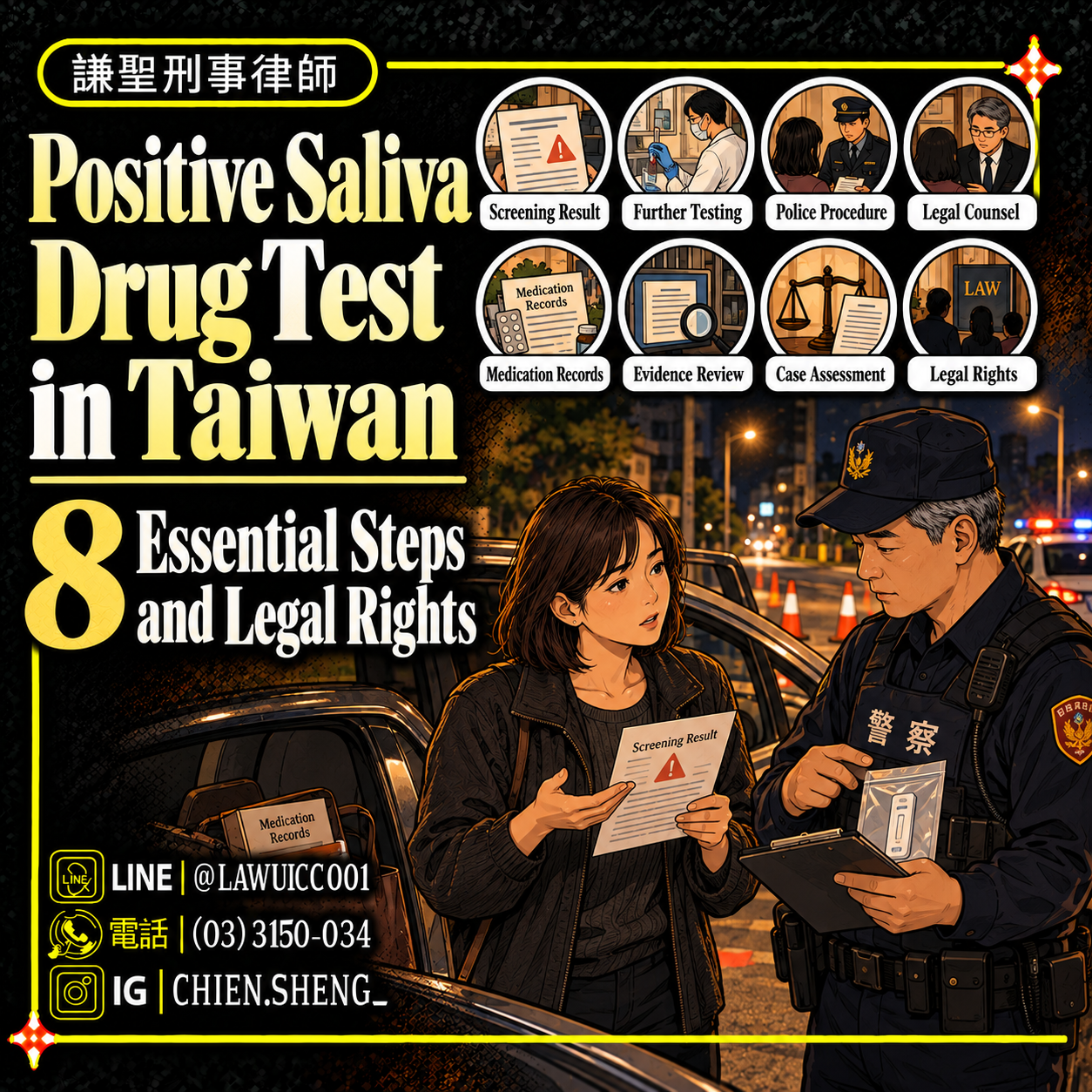
- 1. 1. Positive Saliva Drug Test in Taiwan: What Happens Next?
- 2. 2. Can You Refuse the Roadside Test?
- 3. 3. What Should Police Record During Screening?
- 4. 4. Will Police Collect Urine or Blood?
- 5. 5. How Does the Criminal Drug-Driving Standard Work?
- 6. 6. What Should You Do During Questioning?
- 7. 7. Which Documents Can Help a Defence Review?
- 8. 8. Can You Challenge the Traffic Penalty or Criminal Allegation?
-
9.
Frequently Asked Questions
- 9.1. Q1. Does a Positive Saliva Drug Test in Taiwan automatically mean I am guilty?
- 9.2. Q2. Can I refuse because I have not agreed to provide saliva?
- 9.3. Q3. Must police always obtain permission before urine collection?
- 9.4. Q4. If I was driving normally, can I still face prosecution?
- 9.5. Q5. Does a negative laboratory result automatically cancel the citation?
- 9.6. Q6. Can a lawyer guarantee that I will avoid prison?
- 10. How Chien Sheng International Law Firm Can Assist
- 11. Official Legal References📝
- 12. 📢【24-Hour Free Legal Consultation】
A Positive Saliva Drug Test in Taiwan can lead to immediate traffic enforcement and a separate criminal investigation. However, a roadside screening result is not a criminal conviction. The next steps depend on the applicable law, the testing procedure, laboratory findings and the circumstances of the driving incident.
👨🏻⚖️Chien Sheng International Law Firm explains eight issues drivers and families should understand: roadside screening, refusal penalties, urine or blood collection, criminal thresholds, interviews, evidence preservation and legal remedies.
1. Positive Saliva Drug Test in Taiwan: What Happens Next?
A positive roadside result may trigger a traffic citation, vehicle impoundment and licence-related consequences. Police may also investigate suspected drug driving and arrange further sample collection.
➠These are distinct procedures. A roadside test can support traffic enforcement without itself establishing every element of a criminal offence. Taiwan’s National Police Agency expressly distinguishes roadside traffic enforcement from subsequent investigation using urine testing. npa.gov.tw
Do not assume that you can continue driving after screening, or that being taken to a police station means a court has already found you guilty. Ask what procedure is being used and keep the documents you receive.
2. Can You Refuse the Roadside Test?
💡Do not rely on older advice suggesting that saliva screening is always voluntary and refusal has no consequences.
Taiwan introduced nationwide saliva-screening enforcement in November 2025. The traffic rules expressly address refusal, including advance explanation of its legal consequences.Under the rules in force reviewed for this article, a first refusal by a motor-vehicle driver can attract an NT$180,000 fine, licence revocation and other vehicle-related measures. Repeat offences can have heavier consequences. laws.gov.taipei
➠There is also an important timing issue: the official database lists August 2026 amendments containing tougher provisions whose commencement remains pending. A published amendment must not automatically be treated as the rule already applicable to an earlier incident. law.moj.gov.tw
Ask officers to explain the legal basis. If you dispute the procedure, preserve the relevant facts and obtain legal advice rather than assuming refusal will protect you from investigation.
3. What Should Police Record During Screening?
Article 19-4 of the traffic-enforcement rules requires continuous video recording throughout the saliva-screening procedure.Officers should explain the product expiry date, testing process, result interpretation and valid reading period. If a product problem or failure to follow the process causes an unsuccessful test, the reason should be explained before retesting.
➠The driver should be told the result and asked to sign the enforcement record. Refusal to sign must be recorded; it should not simply be confused with refusal to undergo testing. 桃園市政府交通事件裁決處
🚨A lawyer may examine the recording, device instructions, batch information, expiry date and recorded timing.Storage temperatures, waiting periods, rinsing requirements and test-repeat limits should be checked against the applicable procedure and product. They should not be presented as universal statutory requirements without verifying the source.
Likewise, the meaning of a visible line depends on the particular kit. A line appearing does not universally mean a positive result.
4. Will Police Collect Urine or Blood?
Further collection must have a lawful basis. Saliva screening, non-invasive urine collection and blood sampling are not interchangeable procedures.
Article 205-2 of the Code of Criminal Procedure permits non-consensual, non-invasive urine collection from an arrested or apprehended suspect under specified conditions, generally with prosecutorial permission. An urgent evidence-preservation exception permits collection first, followed by a request for permission within 24 hours. law.moj.gov.tw
A lawyer should therefore examine the arrest basis, collection circumstances, permission and timing. The absence of advance permission alone does not establish illegality if a lawful urgent exception applies.Blood collection requires separate examination of the relevant authority and authorisation, including Article 205-1 where applicable. It should not be described as an automatic substitute whenever a person cannot immediately urinate. law.moj.gov.tw
🚨If you have a medical condition, tell officers and healthcare staff. Keep records of what was explained, who collected the sample and when.
5. How Does the Criminal Drug-Driving Standard Work?
Article 185-3 of Taiwan’s Criminal Code provides two relevant routes:
- A specified substance or metabolite in urine or blood reaches an officially announced threshold.
- Other evidence establishes drug use resulting in an inability to drive safely.
For the threshold route, visibly abnormal driving is not a separate requirement written into that provision. However, prosecutors must still establish the applicable offence elements; a saliva result is not itself the required urine or blood concentration.
➠The basic offence carries up to three years’ imprisonment and a possible criminal fine of up to NT$300,000. Death, serious injury and qualifying repeat offences can attract substantially greater penalties. law.moj.gov.tw
➠The published urine schedule, for example, lists amphetamine at 500 ng/mL. Methamphetamine has an additional metabolite condition. The precise substance, testing method and applicable schedule must be checked. law.moj.gov.tw
Do not apply a urine threshold directly to saliva or assume all drugs share the same limit. A result below a listed threshold also does not automatically exclude the separate unsafe-driving route.
6. What Should You Do During Questioning?
First, establish whether you are being questioned as a witness or suspect and identify the alleged offence.A defendant has rights including remaining silent, choosing defence counsel and requesting investigation of favourable evidence. If you need interpretation, make that need clear before answering substantive questions. law.moj.gov.tw
➠Give accurate facts. Do not guess when you last took medication, drove or supplied a sample. Distinguish what you personally remember from what police later told you.Read the interview record carefully and request corrections before signing. Keep the distinction between admitting a factual action and accepting a legal conclusion.
⚠️Do not delete messages, alter files or coordinate accounts with others.
7. Which Documents Can Help a Defence Review?
Preserve, or ask counsel to seek through lawful procedures:
- The traffic citation and any formal penalty decision.
- Roadside testing and observation records.
- Dashcam footage and relevant timestamps.
- Sample-collection documents and authorisations.
- Laboratory reports, identification records and chain-of-custody information.
- Prescriptions, medicine packaging and medical records.
- Driving, screening and collection timelines.
Medication records may justify further investigation, but taking cold medicine does not automatically establish a false positive.
Similarly, a procedural defect does not automatically exclude evidence or produce an acquittal. Its significance depends on the governing law, the seriousness of the defect and the remaining evidence.
8. Can You Challenge the Traffic Penalty or Criminal Allegation?
A traffic citation, formal administrative decision and criminal case may require different responses.
Record service dates and consult a lawyer promptly about the correct objection or court procedure. A criminal non-prosecution decision does not necessarily remove every traffic consequence automatically.For the criminal case, counsel may examine whether the applicable threshold, driving conduct, mental element and lawful collection have been established. Depending on the evidence and eligibility, counsel may also assess deferred prosecution or sentencing options.
🔎No test defect, prescription or favourable case example guarantees dismissal.
Frequently Asked Questions
Q1. Does a Positive Saliva Drug Test in Taiwan automatically mean I am guilty?
No. It can trigger traffic enforcement and further investigation, but criminal liability requires proof under the applicable offence and evidence rules.
Q2. Can I refuse because I have not agreed to provide saliva?
Do not assume refusal is penalty-free. Current traffic rules provide refusal consequences. Whether the particular demand was lawful requires case-specific review.
Q3. Must police always obtain permission before urine collection?
Not in every case. Article 205-2 contains an urgent non-invasive collection exception with subsequent prosecutorial review, subject to its conditions.
Q4. If I was driving normally, can I still face prosecution?
Yes. The statutory concentration route differs from the route requiring evidence of an inability to drive safely.
Q5. Does a negative laboratory result automatically cancel the citation?
Not automatically. The administrative decision, testing records and grounds relied on must be reviewed separately.
Q6. Can a lawyer guarantee that I will avoid prison?
No. Counsel can assess evidence, procedural objections and eligible dispositions, but the outcome depends on the case.
How Chien Sheng International Law Firm Can Assist
The firm can review traffic notices, screening records, laboratory evidence and collection procedures, and assist with police interviews and subsequent proceedings.
When seeking advice, provide the incident date, vehicle type, testing sequence, notices received and upcoming deadlines. For English-speaking clients, confirm language support and appointment arrangements when booking.
📖Related reading:
- Saliva Screening and Criminal Drug-Driving Thresholds
- Traffic Penalties After Positive Screening Without Urine Testing
👨🏻⚖️The linked articles are in Chinese.
Contact Chien Sheng International Law Firm through LINE
Official Legal References📝
- Criminal Code Article 185-3
- Traffic Enforcement Rules, including Article 19-4
- Road Traffic Management and Penalty Act—check commencement status
- Code of Criminal Procedure Article 205-2
- Code of Criminal Procedure Article 205-1
This article reflects public legal materials checked on October 14, 2026. Applicable rules depend on the incident date and commencement provisions. It provides general information, not individual legal advice or an outcome guarantee.
📢【24-Hour Free Legal Consultation】
🏛 Taipei Office: 6F., No. 64, Kangding Rd., Wanhua Dist., Taipei City|02-2388-8962
🏛 Taoyuan Office: 17F., No. 95, Xinpu 6th St., Taoyuan Dist., Taoyuan City|(03)3150-034
🏛 Kaohsiung Office: 3F., No. 687, Mingcheng 3rd Rd., Gushan Dist., Kaohsiung City
Contact Us on LINE for a Free Consultation: @lawuicc001
IG: chien.sheng_
FB: Chien Sheng International Law Firm
💳 We Accept Cash, Credit Cards, and Bank Transfers.