
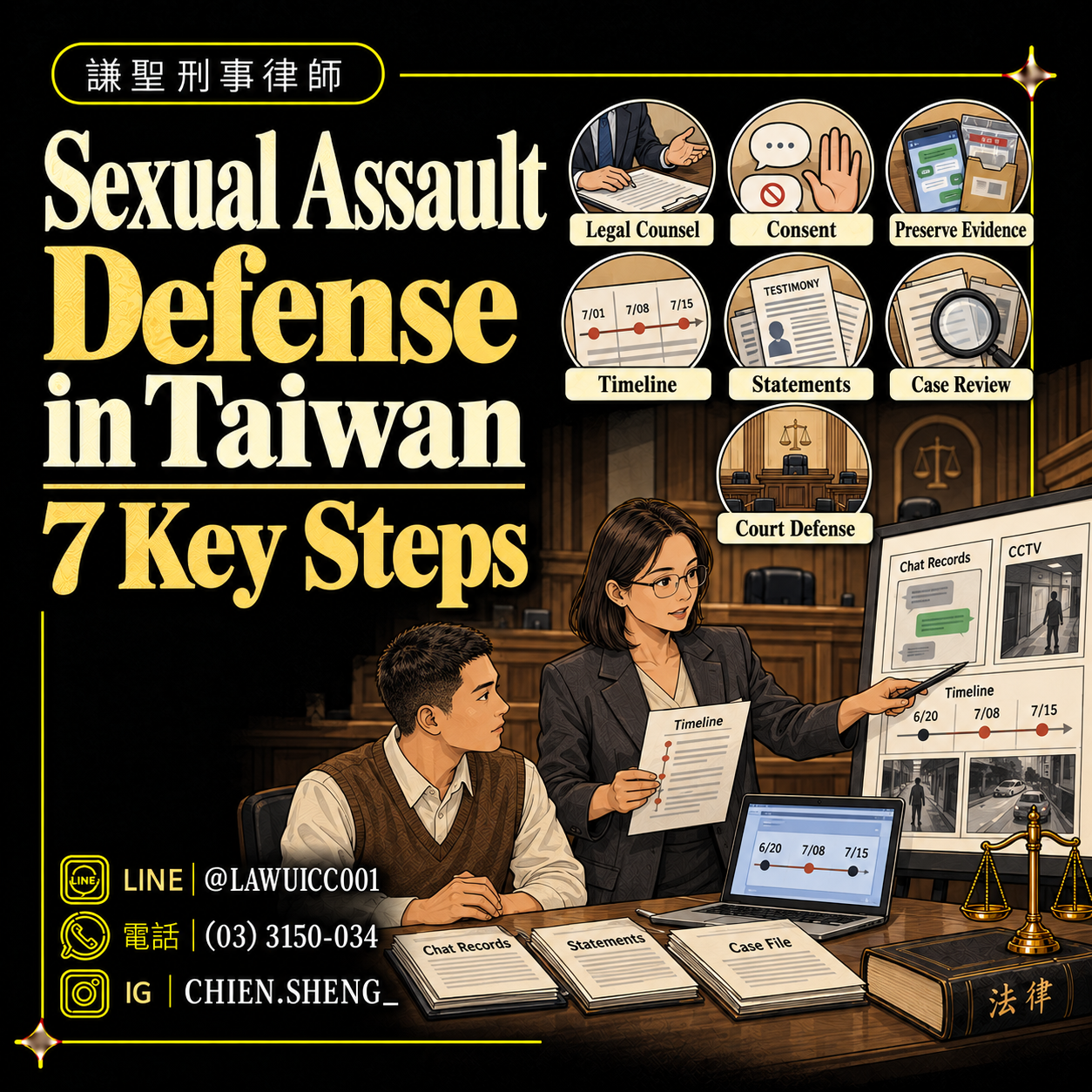
- 1. 1. Sexual Assault Defense in Taiwan: Understand the Charge
- 2. 2. Intoxication and Incapacity Require Separate Analysis
- 3. 3. Preserve Complete Evidence Before Records Disappear
- 4. 4. Evaluate Evidence Without Assuming a “Typical Victim”
- 5. 5. Prepare for Questioning and Cross-Examination
- 6. 6. Examine Expert Reports and Choose a Supported Strategy
-
7.
7. Frequently Asked Questions and Legal Assistance
- 7.1. Q1: What should I do first when seeking Sexual Assault Defense in Taiwan?
- 7.2. Q2: Do affectionate messages prove that the encounter was consensual?
- 7.3. Q3: Does delayed reporting make a complaint unreliable?
- 7.4. Q4: Can a case proceed without DNA or visible injuries?
- 7.5. Q5: Should I contact the complainant to explain or apologize?
- 8. 📢【24-Hour Free Legal Consultation】
Sexual Assault Defense in Taiwan begins with identifying the allegation, preserving evidence and understanding how consent is assessed. Being accused does not establish guilt, but neither a past relationship nor continued contact automatically proves consent.
📢Chiensheng International Law Firm explains seven practical issues involving rape allegations, impaired capacity, digital records and courtroom questioning.
1. Sexual Assault Defense in Taiwan: Understand the Charge
Article 221 of Taiwan’s Criminal Code addresses sexual intercourse accomplished through force, coercion, intimidation, hypnosis or other methods against another person’s will. The prescribed imprisonment is three to ten years; attempts are also punishable. law.moj.gov.tw
The inquiry concerns the particular encounter and the accused’s conduct and knowledge. A defense should identify what happened, what was communicated, and which elements the prosecution must establish.Consent to a date, entering a room, or earlier sexual activity does not automatically establish consent to the alleged act. A person may withdraw consent, and an existing romantic or marital relationship does not remove their sexual autonomy.
➠Other provisions may apply where the allegation concerns aggravated circumstances, indecent acts, age or abuse of authority. Counsel should check the specific charge before choosing a strategy.
2. Intoxication and Incapacity Require Separate Analysis
Article 225 addresses intercourse involving exploitation of circumstances in which a person cannot resist or does not know to resist because of specified impairments or comparable conditions. law.moj.gov.tw
Drinking alcohol does not by itself determine which offense applies. Relevant questions include the person’s actual condition, capacity, the other person’s awareness, and whether that condition was exploited.For example, where a person is unconscious or severely impaired, apparent passivity cannot simply be treated as agreement. Conversely, the fact that alcohol was consumed does not automatically prove incapacity or establish guilt.
➠A hypothetical example cannot substitute for reviewing medical records, witness accounts and the complete sequence of events. Counsel must distinguish alleged force from alleged exploitation of incapacity.
3. Preserve Complete Evidence Before Records Disappear
Evidence preservation should begin as soon as an allegation becomes known. Relevant material may include:
- Complete message histories, including attachments, voice messages and timestamps.
- Original photographs and recordings, with available metadata.
- Transport receipts, booking records and payment histories.
- CCTV footage and information about camera locations.
- Witness details and contemporaneous communications.
- Medical records obtained through lawful procedures.
➠Keep original material as well as working copies. Selected screenshots may omit context, and surveillance footage may be overwritten quickly. A lawyer can assess whether to request preservation or investigation through the appropriate authority.
🔎Do not delete unfavorable messages, alter files or ask another person to change their account. Do not access the complainant’s accounts without authorization or publish private material online.Create a timeline that separates personal recollection from documents and assumptions. If a date is uncertain, mark it as uncertain rather than supplying a guess.
4. Evaluate Evidence Without Assuming a “Typical Victim”
Physical findings, messages and witness accounts must be assessed for what they actually establish.DNA may help identify participants but does not, by itself, resolve consent. Medical findings may support or challenge aspects of an account, depending on their nature and timing. The absence of visible injury does not automatically establish voluntary participation.
Continued contact, delayed reporting or an apparently calm demeanor should not be treated as automatic proof that an allegation is false. Taiwan courts have cautioned against expecting a fixed pattern of reactions or a “perfect victim.” judgment.judicial.gov.tw
💡The same care applies to inconsistencies. A contradiction about a central event may be important, while a difference in peripheral detail may have a reasonable explanation.For example, footage placing a person elsewhere at the alleged time may require close examination. The defense should verify timestamps, coverage and the witness’s explanation before claiming the footage disproves the allegation.
5. Prepare for Questioning and Cross-Examination
Before a police interview, clarify your procedural status and consult counsel about your rights. Describe what you remember accurately, distinguish uncertainty from certainty, and review the record before signing.
🚨Courtroom cross-examination should test specific facts rather than seek humiliation. Useful areas may include:
- Whether the witness personally observed the event.
- The source and timing of a particular recollection.
- The meaning and context of a message.
- A material difference between earlier and later statements.
- Whether independent records support the proposed timeline.
Article 166-7 of the Code of Criminal Procedure requires specific questioning and restricts irrelevant, threatening, insulting and otherwise improper questions. law.moj.gov.tw
➠A lawyer should also assess applicable protective arrangements and how the defense can meaningfully challenge evidence within those procedures. Protective measures do not make testimony immune from scrutiny, and defense rights do not authorize harassment.
6. Examine Expert Reports and Choose a Supported Strategy
When medical or psychological opinions are relied on, counsel should examine the expert’s qualifications, source material, methods and the limits of the conclusion.
A report may address injuries or psychological symptoms without independently establishing every disputed fact, the perpetrator’s identity or the legal question of consent. Expert evidence must be connected to the issue it can reliably address.
Article 154 of the Code of Criminal Procedure establishes the presumption of innocence and requires criminal facts to be determined through evidence. law.moj.gov.tw
➠A defense may therefore address evidential gaps, reliability, admissibility or the legal classification of the conduct. Where responsibility is supported by the evidence, counsel may instead evaluate lawful sentencing submissions and compensation.Settlement does not automatically end prosecution or guarantee probation. The strategy must follow the evidence and applicable law, rather than a promised outcome.
7. Frequently Asked Questions and Legal Assistance
Q1: What should I do first when seeking Sexual Assault Defense in Taiwan?
Preserve complete records, confirm the notice and your procedural status, and consult a criminal lawyer before making detailed statements. Avoid attempting to negotiate a retraction privately.
Q2: Do affectionate messages prove that the encounter was consensual?
No. Messages may be relevant, but their timing and context matter. Earlier affection or later contact does not automatically establish consent at the alleged time.
Q3: Does delayed reporting make a complaint unreliable?
Not by itself. The court should assess the full circumstances rather than assume every person responds to sexual violence in the same way.
Q4: Can a case proceed without DNA or visible injuries?
Yes. Their absence does not automatically defeat the allegation. The court must evaluate the available testimony and other evidence.
Q5: Should I contact the complainant to explain or apologize?
Discuss any necessary communication with counsel first. Contact can create further disputes or be viewed as pressure, particularly where protective restrictions apply. Any lawful settlement discussions should use an appropriate channel.
👨🏻⚖️Chiensheng International Law Firm can review the allegation, organize evidence, assess interview records and prepare questions tied to the disputed facts. Consult our criminal defense services and lawyer profiles.
Bring the notice, interview records available to you, complete communications and a factual timeline to the consultation.
📝For the statutory framework, see Criminal Code Article 221, Criminal Code Article 225 and Code of Criminal Procedure Article 166-7.
This article provides general information about Taiwan law. The examples are hypothetical and do not predict a case outcome. Legal advice requires review of the applicable law, evidence and procedural stage.
📢【24-Hour Free Legal Consultation】
🏛 Taipei Office: 6F., No. 64, Kangding Rd., Wanhua Dist., Taipei City|02-2388-8962
🏛 Taoyuan Office: 17F., No. 95, Xinpu 6th St., Taoyuan Dist., Taoyuan City|(03)3150-034
🏛 Kaohsiung Office: 3F., No. 687, Mingcheng 3rd Rd., Gushan Dist., Kaohsiung City
Contact Us on LINE for a Free Consultation: @lawuicc001
IG: chien.sheng_
FB: Chien Sheng International Law Firm
💳 We Accept Cash, Credit Cards, and Bank Transfers.