
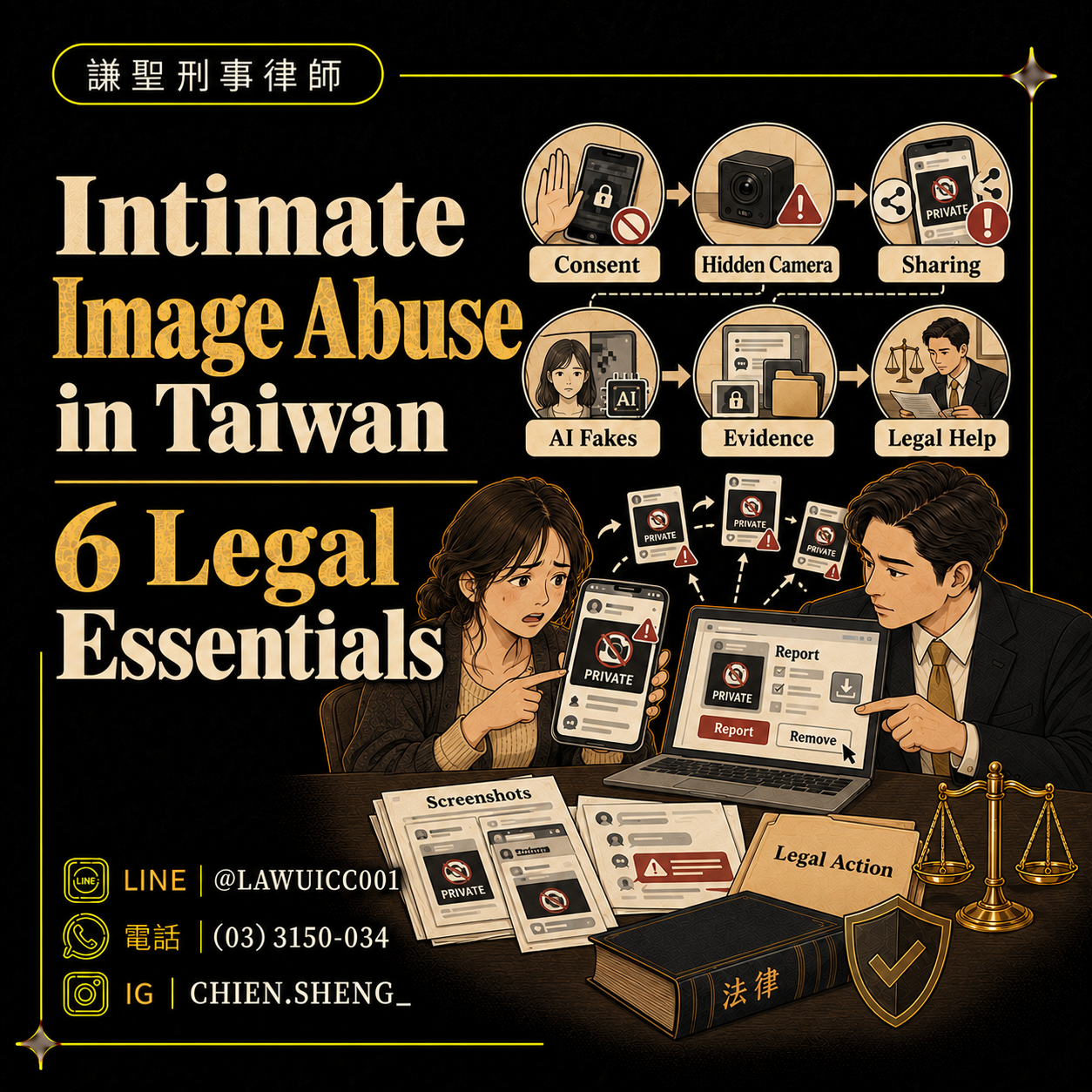
- 1. 1. Intimate Image Abuse in Taiwan: What Does the Law Cover?
- 2. 2. Secret Recording and Coercion: Articles 319-1 and 319-2
- 3. 3. Sharing Private Images and Creating Sexual Deepfakes
- 4. 4. What Victims Should Do: Evidence, Removal and Complaints
- 5. 5. Accused of Secret Filming or Sharing? Prepare Before Questioning
-
6.
6. Frequently Asked Questions
- 6.1. ▪️What should I do about Intimate Image Abuse in Taiwan if I do not know the uploader?
- 6.2. ▪️Can someone share a photo I originally agreed to take?
- 6.3. ▪️Can a sexual deepfake be criminal even though it is not real?
- 6.4. ▪️Does forwarding to one person avoid liability?
- 6.5. ▪️Will deleting an uploaded image end the case?
- 7. ▪️Legal Assistance from Chien Sheng International Law Firm
- 8. 📢【24-Hour Free Legal Consultation】
Intimate Image Abuse in Taiwan can involve secret recordings, unauthorized sharing or sexual deepfakes made with AI. Victims should preserve evidence, seek removal assistance and check complaint deadlines. Anyone accused should also obtain legal advice before responding to police. Chien Sheng International Law Firm explains the main offenses, practical next steps and distinctions that can affect criminal liability.
1. Intimate Image Abuse in Taiwan: What Does the Law Cover?
Taiwan added Chapter 28-1 of the Criminal Code to address sexual privacy and fabricated sexual images. The amendments were promulgated on February 8, 2023—not February 8, 2025—and the new chapter took effect on February 10, 2023. moj.gov.tw
💡Article 10 of the Criminal Code defines sexual images by their content. The definition includes sexual acts described in the Code, sexual organs or intimate body parts objectively capable of arousing sexual desire or shame, certain contact with those parts, and other sexually related conduct meeting that objective standard. law.moj.gov.tw
➥An image does not qualify simply because someone considers it embarrassing. Its content and context must satisfy the statutory definition. Likewise, nudity or an underwear image requires legal assessment rather than an automatic assumption about the applicable offense.Consent also has a scope. Agreeing to be photographed does not automatically authorize publication, forwarding, copying or sale.
2. Secret Recording and Coercion: Articles 319-1 and 319-2
Article 319-1 covers recording another person’s sexual images without consent and without justification. The basic offense carries up to three years’ imprisonment.
Providing premises, tools or equipment for profit to facilitate that recording can carry up to five years’ imprisonment, with an additional fine of up to NT$500,000. Recording with an intent to profit or make the images available to others is punishable under the same penalty provision.
➥Actual publication is therefore not always necessary for the more serious recording offense. An attempted offense requires conduct amounting to an attempt; having an intention alone is not enough. law.moj.gov.tw
▪️Recording against a person’s will
Article 319-2 addresses recording through violence, coercion, threats or other methods contrary to the person’s will, including forcing the person to record themselves.
The basic penalty is up to five years’ imprisonment, with a possible additional fine of NT$500,000. Profit-driven facilitation, or committing the recording offense with an intent to profit or share, can carry six months to five years’ imprisonment and a possible additional fine of NT$500,000.
🔎Both provisions expressly punish specified attempts. A lawyer should distinguish the recording act, the means used and any intended distribution. law.moj.gov.tw
3. Sharing Private Images and Creating Sexual Deepfakes
Article 319-3 covers unauthorized and unjustified reproduction, distribution, transmission, delivery, public display or otherwise making another person’s sexual images available for viewing.
Its basic penalty is up to five years’ imprisonment, with a possible additional fine of NT$500,000. More serious ranges apply when the images originated from the offenses above:
- Images obtained under Article 319-1: six months to five years, with a possible additional fine of NT$500,000.
- Images obtained under Article 319-2: one to seven years, with a possible additional fine of NT$700,000.
➙Acting for profit or selling the images increases the applicable penalty by up to one-half. Specified attempts are also punishable.A private message is not automatically exempt: delivery and transmission are among the acts covered. The circumstances and other statutory elements still matter. law.moj.gov.tw
AI-generated or manipulated sexual images
Article 319-4 applies to fabricating sexual images of another person using computer synthesis or other technology, with an intent to share or make them available for viewing, where the images are capable of causing harm.
Making qualifying images available to others is separately covered. The basic penalty includes imprisonment of up to five years, short-term imprisonment, or a fine of up to NT$500,000, which may also be imposed alongside imprisonment. Profit-driven conduct or selling such images can carry up to seven years’ imprisonment and an additional fine of up to NT$700,000.
➙Calling an image “fake” or “a joke” does not resolve liability. However, the prosecution must establish the relevant conduct, intent and capacity to cause harm; not every edited photograph meets these requirements. law.moj.gov.tw
Confiscation
Article 319-5 provides for confiscation of objects and items bearing the relevant sexual images regardless of ownership. It does not simply declare that every camera or device used in a case must be confiscated. Equipment may require assessment under other confiscation rules. law.moj.gov.tw
4. What Victims Should Do: Evidence, Removal and Complaints
Preserve evidence without increasing circulation
Record the website address, platform, uploader’s account, group name, posting time and threatening messages. Keep original communications and payment demands. Avoid publicly reposting the material to expose the uploader.Where minors are involved, seek police or professional guidance about evidence preservation rather than downloading or forwarding additional copies.
Request platform removal and official assistance
Report the content through the platform’s abuse-reporting system. Taiwan’s Ministry of Health and Welfare Sexual Image Processing Center also accepts complaints and helps notify platforms to restrict access or remove unlawful material. 衛生福利部|性影像處理中心
➙Removal assistance and a criminal complaint serve different purposes. Requesting a takedown does not replace reporting the offense, and no service can guarantee that every copy will disappear.
Check whether a complaint is required
Under Article 319-6, the basic offenses under Article 319-1 paragraph 1 and Article 319-3 paragraph 1, including their attempts, require a complaint. This rule does not apply to every offense in the chapter. law.moj.gov.tw
For complaint-dependent offenses, Article 237 of the Code of Criminal Procedure generally sets a six-month period from learning the offender’s identity. Do not assume that negotiating or asking a platform to remove content pauses that period. law.moj.gov.tw
Assess compensation and urgent protection
A lawyer can assess criminal complaints, civil damages and whether an appropriate interim court measure is available. A civil claim requires evidence of its legal basis and loss; a criminal report does not automatically produce compensation or a universal injunction.
➙If threats or immediate danger are involved, contact police promptly. Do not send additional images or money in response to promises that the existing material will be deleted.
5. Accused of Secret Filming or Sharing? Prepare Before Questioning
An accusation is not a conviction. Relevant questions may include:
- Does the material meet the statutory definition?
- Who recorded, created, uploaded or forwarded it?
- What consent existed, and what did it authorize?
- What evidence establishes the alleged intent?
- Is the image authentic, manipulated or incorrectly attributed?
- Was a legally required complaint filed in time?
Preserve relevant messages, devices and account information. Do not delete evidence, coordinate accounts with others or pressure the complainant.
👨🏻⚖️Counsel can review the allegation, explain procedural rights, identify evidence to request and accompany questioning. If an interpreter is needed, raise that need before questioning begins. Any settlement should be lawful and voluntary; it does not automatically terminate offenses that do not depend on a complaint.Cases involving children or adolescents may also engage separate child sexual exploitation legislation. Adult consent rules and penalties should not be assumed to apply unchanged.
6. Frequently Asked Questions
▪️What should I do about Intimate Image Abuse in Taiwan if I do not know the uploader?
Preserve account details, links and timestamps, report the incident and request removal assistance. An unknown uploader does not prevent you from seeking help; investigators may need platform or account records to identify them.
Consent to recording does not automatically include consent to distribution. The agreed scope and evidence must be examined.
▪️Can a sexual deepfake be criminal even though it is not real?
Yes. Article 319-4 specifically addresses fabricated sexual images when its statutory requirements are met.
▪️Does forwarding to one person avoid liability?
Not necessarily. Delivery or transmission can fall within the relevant provision even without a public post.
▪️Will deleting an uploaded image end the case?
No automatic rule provides that result. Removal can limit further harm, but the earlier conduct and evidence remain relevant. Discuss lawful removal and evidence preservation with counsel.
▪️Legal Assistance from Chien Sheng International Law Firm
Our team can assess allegations involving secret recordings, unauthorized sharing and fabricated sexual images. Depending on the case, assistance may include evidence organization, criminal complaints or defense, removal requests, civil claims and settlement advice.
📝Review our legal services and lawyer profiles, then prepare police notices, relevant messages, links and a timeline for consultation.
This article provides general information about Taiwan law. Liability, available remedies and case outcomes depend on the facts, evidence and applicable law. No particular result is guaranteed.
📢【24-Hour Free Legal Consultation】
🏛 Taipei Office: 6F., No. 64, Kangding Rd., Wanhua Dist., Taipei City|02-2388-8962
🏛 Taoyuan Office: 17F., No. 95, Xinpu 6th St., Taoyuan Dist., Taoyuan City|(03)3150-034
🏛 Kaohsiung Office: 3F., No. 687, Mingcheng 3rd Rd., Gushan Dist., Kaohsiung City
Contact Us on LINE for a Free Consultation: @lawuicc001
IG: chien.sheng_
FB: Chien Sheng International Law Firm
💳 We Accept Cash, Credit Cards, and Bank Transfers.