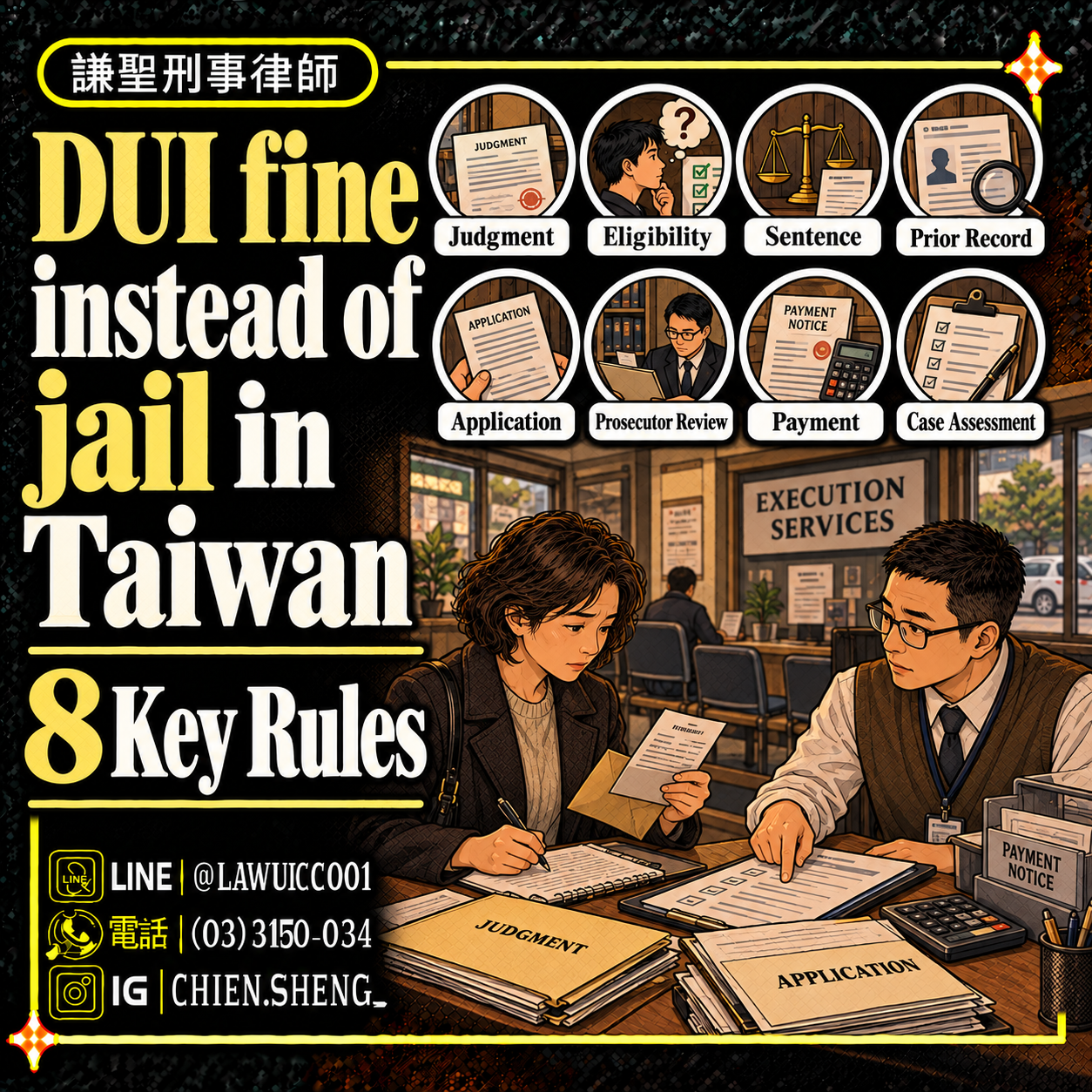
- 1. 1. DUI fine instead of jail in Taiwan: how Article 41 works
- 2. 2. Can a first-time offender avoid imprisonment?
- 3. 3. What changes if someone suffers serious injury or dies?
- 4. 4. Does a third DUI offense always mean prison?
- 5. 5. What evidence should a repeat offender prepare?
- 6. 6. What if the prosecutor refuses despite the judgment’s conversion wording?
- 7. 7. How much must be paid, and are installments possible?
- 8. 8. Can social labor be used if monetary conversion is refused?
-
9.
Frequently Asked Questions
- 9.1. ▪️Is a DUI fine instead of jail in Taiwan available for a third offense?
- 9.2. ▪️Does a six-month sentence guarantee that I can pay?
- 9.3. ▪️Do old DUI cases stop mattering after five years?
- 9.4. ▪️Will paying restore my driver’s license?
- 9.5. ▪️Can I ignore a reporting notice while a lawyer prepares an objection?
- 9.6. ▪️Can a lawyer promise that I will avoid prison?
- 10. How Chien Sheng International Law Firm Can Help
- 11. 📢【24-Hour Free Legal Consultation】
A DUI fine instead of jail in Taiwan may be available when the offense and sentence meet the legal requirements, but approval is not automatic. A first offense does not guarantee payment instead of imprisonment, and a third offense does not create an automatic statutory ban.
👨🏻⚖️The key is to separate sentencing from enforcement. The court decides the conviction, sentence and applicable conversion rate. After the judgment becomes final, the enforcement prosecutor assesses whether allowing conversion would undermine rehabilitation or maintenance of the legal order.This article addresses adult criminal proceedings involving alcohol-impaired driving. Injury, death, additional offenses and multiple-sentence cases require separate analysis.
1. DUI fine instead of jail in Taiwan: how Article 41 works
The Chinese term 易科罰金 refers to converting an eligible short custodial sentence into a monetary payment. It does not erase the conviction or turn the original sentence into a standalone fine.
Under Criminal Code Article 41, the usual requirements include:
- An offense carrying a statutory maximum of no more than five years.
- A sentence of six months or less, or detention.
- No applicable finding that monetary conversion would be inadequate for rehabilitation or maintaining the legal order. law.moj.gov.tw
Statutory maximum means the maximum punishment authorized for the offense. It is different from the sentence actually imposed.
➠A judgment stating a daily conversion rate therefore does not settle every enforcement issue. Keep the complete judgment and any enforcement notice, rather than relying on a short description of the outcome.
2. Can a first-time offender avoid imprisonment?
For the ordinary offense under Article 185-3(1), the maximum imprisonment is three years, with a possible additional criminal fine of up to NT$300,000.
Alcohol-related grounds include a breath concentration of at least 0.25 mg/L or a blood concentration of at least 0.05%. Other evidence establishing an inability to drive safely because of alcohol can also support the offense. law.moj.gov.tw
The statutory maximum therefore allows consideration of conversion if the actual sentence and other requirements qualify. First-offense status alone does not decide the result.Useful information includes the testing records, driving circumstances, accident evidence, prior record and any genuine treatment or prevention measures. A lawyer should examine how these facts affect both the criminal case and the later enforcement decision.
➠Neither a high reading nor the absence of an accident should be treated as answering every legal question.
3. What changes if someone suffers serious injury or dies?
Article 185-3(2) provides imprisonment of three to ten years for causing death and one to seven years for causing serious injury, with possible additional fines. Specified repeat-offense circumstances can carry higher penalties. law.moj.gov.tw
The ordinary serious-injury and death offenses exceed Article 41’s five-year statutory-maximum threshold. That is an independent obstacle to monetary conversion, even if sentence reductions are argued.
➠Do not assess these cases by simply checking whether the eventual sentence might fall below six months. The precise offense, causation and statutory penalty range matter.Other allegations, compensation claims and insurance issues also require separate assessment.
4. Does a third DUI offense always mean prison?
No automatic rule in Article 185-3 says that every third alcohol-driving offense must result in imprisonment without conversion.
💡The enforcement-policy history nevertheless matters:
- In 2013, Ministry of Justice guidance generally opposed conversion for three offenses within five years, while retaining individualized exceptions. moj.gov.tw
- A 2022 High Prosecutors Office directive identified three or more detected DUI offenses as a circumstance requiring scrutiny under Article 41.
- In 2023, the Judicial Yuan clarified that prosecutors must apply the statutory test and that their decisions remain subject to judicial review. judicial.gov.tw
➠The practical lesson is that an older offense is not necessarily irrelevant merely because it falls outside a five-year window. But counting incidents does not replace examining their legal status and the reasons for refusing conversion.
➠A prior administrative violation, criminal conviction and deferred-prosecution disposition should not be treated as interchangeable records without checking the documents.
5. What evidence should a repeat offender prepare?
An application should address why the proposed enforcement method can meet the legal purposes of punishment. General statements about needing a job or supporting a family may leave the central questions unanswered.
📑Consider preparing:
- A chronology of previous cases, outcomes and completed enforcement.
- The current judgment, testing records and accident information.
- Documented alcohol-use assessment, treatment or counseling.
- A practical transport plan that avoids driving after drinking.
- Work, caregiving and financial documents supporting specific factual claims.
➠Treatment should be genuine and accurately described. Attending one appointment does not establish that a problem has been resolved.
Similarly, explaining an incident is different from minimizing its danger. Documents should identify what happened, what has changed and how the proposed changes will be maintained.These materials support an individualized assessment; they do not create an entitlement or guarantee a favorable decision.
6. What if the prosecutor refuses despite the judgment’s conversion wording?
Article 484 of the Code of Criminal Procedure allows an eligible person to challenge an improper prosecutorial enforcement direction before the court that pronounced the judgment. law.moj.gov.tw
🔔This is an objection concerning enforcement, not a new appeal against the conviction.
Judicial Yuan Interpretation No. 245 explains that judicial relief may include requiring reconsideration and, where necessary, a ruling allowing conversion. 憲法法庭網站
➠An objection should identify the challenged direction, the factual or legal error, and supporting evidence. Possible issues include an incorrect criminal record, overlooked documents or reasons that do not address the statutory criteria.
➠A lawyer should also confirm reporting obligations and whether separate relief concerning execution is needed. Filing an objection should not be assumed to suspend an order automatically.
👨🏻⚖️Keep the written refusal or relevant enforcement record, the notice and proof of when documents were received.
7. How much must be paid, and are installments possible?
The statutory conversion rates are NT$1,000, NT$2,000 or NT$3,000 per day. The judgment specifies the applicable rate.
📝For illustration, if the enforcement office confirms 90 payable days:
- NT$1,000 per day produces NT$90,000.
- NT$2,000 per day produces NT$180,000.
- NT$3,000 per day produces NT$270,000.
➠This is arithmetic, not a quotation for every three-month sentence. Credits, previous enforcement and the official calculation must be checked.
If immediate payment is difficult, ask the enforcement office about an approved grace period or installment arrangement and submit financial evidence. Do not start paying a self-selected monthly amount without approval. tnc.moj.gov.tw
➠Also distinguish three obligations: payment converting a custodial sentence, a separate criminal fine imposed by the court, and administrative traffic penalties. Paying one does not necessarily discharge the others or restore a suspended or revoked license.
⚠️Use official payment instructions and retain receipts identifying the case and payment purpose.
It may be considered, but it is not an automatic fallback.
Article 41 permits qualifying sentences of six months or less, or detention, to be considered for social labor even where monetary-conversion requirements are not met. Health and rehabilitation or legal-order concerns can still prevent approval. law.moj.gov.tw
The two decisions must therefore be examined separately. Reasons for refusing payment may also be relevant to whether social labor is suitable.Prepare medical information, available hours, transport arrangements and previous compliance records. Follow the enforcement office’s application requirements; non-incarcerated applicants generally must attend personally.
If permission is granted, comply with the assigned work and deadline. Serious unjustified nonperformance or failure to finish within the prescribed period can lead to custodial enforcement. mojlaw.moj.gov.tw
➠Social labor is a method of executing punishment. It is not an acquittal and does not erase the conviction.
Frequently Asked Questions
▪️Is a DUI fine instead of jail in Taiwan available for a third offense?
It is not automatically excluded, but repeat offenses receive close scrutiny. The judgment, prior-case records and enforcement reasons must be examined together.
▪️Does a six-month sentence guarantee that I can pay?
No. The offense must qualify, and the enforcement-stage statutory assessment still matters.
▪️Do old DUI cases stop mattering after five years?
Do not assume so. The later guidance discussed above is not limited to the earlier five-year formulation. Check the actual records and applicable enforcement reasoning.
▪️Will paying restore my driver’s license?
Not automatically. Criminal execution and administrative licensing measures are separate.
▪️Can I ignore a reporting notice while a lawyer prepares an objection?
No. Confirm the required attendance and any separate execution-related application with counsel and the enforcement office.
▪️Can a lawyer promise that I will avoid prison?
No. Counsel can examine evidence, present sentencing and enforcement arguments, and assess available review procedures. The outcome depends on the law and case-specific findings.
How Chien Sheng International Law Firm Can Help
Early preparation helps connect each document to the issue it can actually prove. During investigation, counsel can examine driving and testing evidence. During trial, counsel can address the charge and sentencing. After final judgment, the focus shifts to execution, conversion applications and possible objections.
Chien Sheng International Law Firm can assist with reviewing judgments, preparing prior-case chronologies, organizing treatment and prevention evidence, and assessing enforcement remedies.
👨🏻⚖️Visit the Chien Sheng International Law Firm website for criminal-defense information, or arrange a consultation through the official LINE account. Bring police or prosecution notices, the full judgment, enforcement documents and available treatment records.
This article provides general information about Taiwanese law based on materials reviewed in October 2026. It does not guarantee conversion, social labor or avoidance of imprisonment. The applicable law, final judgment and individual enforcement decision must be reviewed.
Official Sources🔍
- Criminal Code Article 41: Conversion of custodial sentences
- Criminal Code Article 185-3: Impaired-driving offenses
- Ministry of Justice: 2013 repeat-DUI enforcement guidance
- Judicial Yuan: Clarification concerning repeat-DUI enforcement and judicial review
- Code of Criminal Procedure Article 484: Objections to enforcement directions
- Judicial Yuan Interpretation No. 245
📢【24-Hour Free Legal Consultation】
🏛 Taipei Office: 6F., No. 64, Kangding Rd., Wanhua Dist., Taipei City|02-2388-8962
🏛 Taoyuan Office: 17F., No. 95, Xinpu 6th St., Taoyuan Dist., Taoyuan City|(03)3150-034
🏛 Kaohsiung Office: 3F., No. 687, Mingcheng 3rd Rd., Gushan Dist., Kaohsiung City
Contact Us on LINE for a Free Consultation: @lawuicc001
IG: chien.sheng_
FB: Chien Sheng International Law Firm
💳 We Accept Cash, Credit Cards, and Bank Transfers.