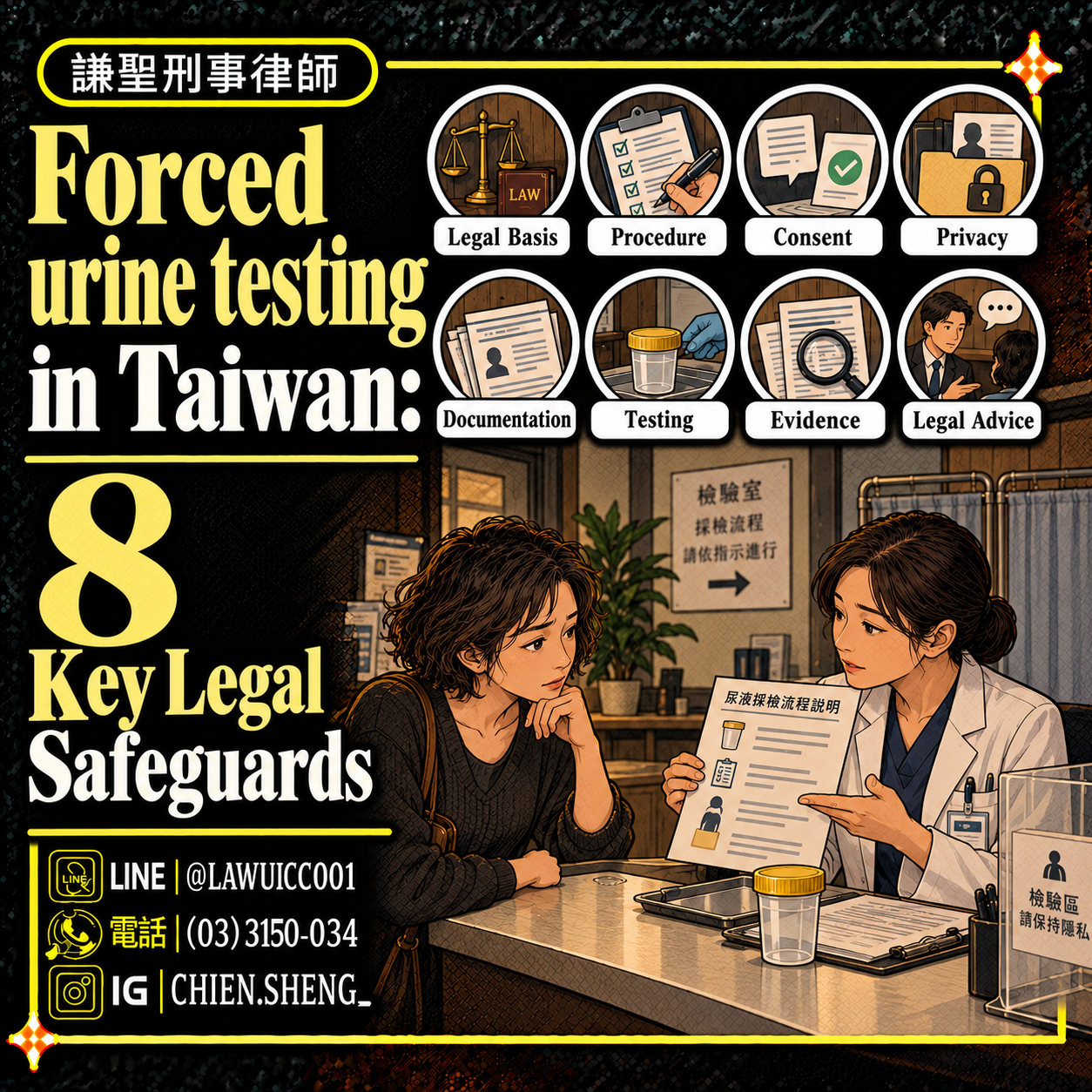
- 1. 1. Forced urine testing in Taiwan: What Article 205-2 permits
- 2. 2. Non-invasive collection is not permission for catheterization
- 3. 3. Can police keep someone until a sample is produced?
- 4. 4. Does refusal prove drug use?
- 5. 5. How can a collection measure be challenged?
- 6. 6. Will unlawfully obtained urine evidence be excluded?
- 7. 7. What should a suspect or family member preserve?
- 8. 8. How Chien Sheng International Law Firm can assist
-
9.
Frequently Asked Questions
- 9.1. Q1: Forced urine testing in Taiwan: Can police use a catheter if I refuse?
- 9.2. Q2: Is a prosecutor’s permission always required beforehand?
- 9.3. Q3: What if I cannot urinate because of a medical problem?
- 9.4. Q4: Can I challenge collection after it has happened?
- 9.5. Q5: Does a positive result guarantee conviction?
- 9.6. Q6: Does this guide also cover roadside saliva-test refusal?
- 10. Official References📝
- 11. 📢【24-Hour Free Legal Consultation】
Forced urine testing in Taiwan does not automatically allow police to use a catheter. In a criminal investigation, the authority to collect urine without consent under Article 205-2 of the Code of Criminal Procedure is limited to non-invasive collection and requires specific safeguards.
💡Refusing to provide a sample, being physically unable to urinate, and challenging an unlawful procedure are different situations. None should be treated as a shortcut to deciding guilt.This guide explains the statutory framework, the limits of compulsory collection, and the records a lawyer may need to review. It concerns criminal evidence collection; roadside testing, treatment supervision and other statutory testing schemes may involve different rules.
1. Forced urine testing in Taiwan: What Article 205-2 permits
Article 205-2 applies to suspects or defendants brought in under arrest or compulsory appearance. For urine collection, investigators must have substantial grounds to believe the sample can provide criminal evidence and that expert examination is necessary.
The usual route requires prosecutorial permission. An urgent exception allows immediate non-invasive collection when delay would prevent effective preservation of evidence. Investigators must then seek permission within 24 hours after collection; a prosecutor who finds approval inappropriate must revoke the measure within three days. law.moj.gov.tw
➠These requirements are more specific than simply suspecting drug use. Officers should be able to identify the legal route they are using.A voluntary visit to a police station does not, by itself, satisfy the arrest or compulsory-appearance condition in this provision. Another lawful basis would need separate examination.
🔎Consent and compulsory collection are different
Ask whether officers are requesting voluntary cooperation or exercising a compulsory power. A consent form and a prosecutor-authorized procedure should not be confused.A lawyer can assess the legal basis without advising anyone to physically obstruct officers or alter evidence.
2. Non-invasive collection is not permission for catheterization
The central distinction is between obtaining urine passed naturally and inserting equipment into the body to extract it.
Constitutional Court Judgment 111-Hsien-Pan-16 addressed the bodily rights, informational privacy and procedural safeguards involved in urine evidence. It interpreted the police collection provision as concerning non-invasive methods.
➠Accordingly, Article 205-2 should not be treated as an authorization to insert a urinary catheter merely because someone refuses or cannot urinate. mojlaw.moj.gov.tw
➠Nor should medication, forced drinking, physical pressure or other interventions be assumed lawful simply because investigators want a sample. Their legal basis, health implications and proportionality require separate scrutiny.
🔎Does taking someone to a hospital change the answer?
Not automatically. A medical setting does not turn an unsupported evidence-gathering measure into a lawful one.
Article 205-1 separately addresses bodily samples taken by an expert with judicial or prosecutorial permission. That provision should not be presented as an automatic workaround for refusal. The proposed procedure, authorization and necessity still require examination. law.moj.gov.tw
➠Medical treatment for a genuine health problem must also be distinguished from a procedure performed primarily to obtain criminal evidence.
3. Can police keep someone until a sample is produced?
A sampling authorization is not an unlimited detention order.Authorities must independently justify restrictions on liberty and comply with the applicable custody, questioning and transfer rules. They cannot assume that failure to obtain urine extends every deadline.
The authorization itself also matters. Article 205-3 requires a prosecutor-signed document identifying the case, person, examination, executing agency and execution period. In the prior-permission procedure, officers must show the authorization and identification. An expired authorization cannot be executed. web.law.ntpc.gov.tw
🔎What if the person genuinely cannot urinate?
Explain any pain, medical condition or other relevant difficulty accurately, and request that it be recorded. Seek medical attention when needed.
Ask officers to distinguish physical inability from deliberate refusal in their record. Note the timing of requests, waiting periods, symptoms and any medical assessment.Do not force excessive fluid intake or try to manipulate a sample. Both safety and the reliability of the evidence matter.
4. Does refusal prove drug use?
Refusal alone does not establish that a drug offense occurred. Investigators and courts must examine evidence supporting the elements of the alleged offense.
However, the privilege against self-incrimination should not be described as a blanket right to refuse every bodily sample. Rules governing statements and rules governing physical evidence are different.A person can ask for legal advice, question the authority for collection and preserve objections without assuming refusal ends the investigation.
🔎Other evidence may still be investigated
Depending on the case, investigators may examine seized substances, communications, witness accounts or other lawfully obtained material.
Hair, saliva and blood also involve distinct collection requirements and different evidential limitations. Inability to obtain urine does not create unrestricted authority to take another sample.
➠A laboratory result must be interpreted for the particular allegation. Evidence of exposure to a substance does not necessarily answer every question about timing, possession or driving impairment.
5. How can a collection measure be challenged?
The available remedy depends on how collection was authorized and carried out.
Article 205-4 specifically allows a person to ask the competent court to revoke an urgent collection measure taken under the latter part of Article 205-2(2). It sets a ten-day application period running from collection.
➠The court cannot dismiss that application merely because collection has already been completed. The resulting ruling is not appealable under that provision. web.law.ntpc.gov.tw
➠This is not a statement that every sampling dispute uses exactly the same application. A lawyer should identify the correct remedy, deadline and decision-maker for the procedure actually used.
🔎Do not wait for the laboratory report
A challenge deadline may arise before the test result becomes available. Preserve the collection date, permission documents and relevant notices immediately.
➠Ask counsel to review the grounds for urgency, the timing of prosecutorial review and whether the method stayed within the authorized scope.
6. Will unlawfully obtained urine evidence be excluded?
💡Not necessarily automatically.
Article 158-4 generally requires courts, unless another rule applies, to balance human-rights protection and the public interest when deciding the admissibility of evidence obtained by officials through unlawful procedure. law.moj.gov.tw
A defense lawyer should identify the particular defect and its significance, rather than assume that any irregularity guarantees exclusion or acquittal.
👨🏻⚖️It is also important to distinguish:
- Admissibility: whether the evidence may be used.
- Evidential weight: how reliably it supports the allegation.
- The final outcome: whether all the evidence proves the offense.
Even where collection was authorized, sample identification, handling and laboratory analysis may require review. Conversely, a collection dispute does not automatically resolve every other piece of evidence.
7. What should a suspect or family member preserve?
Create a factual timeline and keep available copies of:
- Arrest, compulsory-appearance or other procedural documents.
- The sampling authorization and related notices.
- Consent forms and collection records.
- Relevant medical records and medication information.
- Sample identifiers, collection times and laboratory reports.
- Details of witnesses and potentially available recordings.
- Records of objections, symptoms or requests for assistance.
Before signing, read whether the document records consent, receipt, the sample details or an admission. Ask for inaccurate wording to be corrected and for relevant explanations to be included.
If you need an interpreter, say so before giving a statement or signing a document you do not understand.Preserve original files. Do not edit records to fit an argument, delete relevant material or coordinate false accounts with others.
8. How Chien Sheng International Law Firm can assist
Counsel can review the basis for custody, prosecutorial authorization, emergency justification, collection method and available remedies.The review may also cover sample identification, laboratory findings and other evidence, so that a procedural objection connects to the actual issues in the case.
When contacting the firm, provide the collection date, current procedural stage, next deadline and documents already available. Visit the Chien Sheng International Law Firm contact page to arrange a consultation.
➠Legal representation cannot guarantee exclusion, non-prosecution or acquittal. Its role is to identify supported arguments and present them through the appropriate procedure.
Frequently Asked Questions
Q1: Forced urine testing in Taiwan: Can police use a catheter if I refuse?
Article 205-2’s non-invasive collection power does not itself authorize catheterization. Any proposed invasive procedure requires separate legal scrutiny.
Q2: Is a prosecutor’s permission always required beforehand?
Prior permission is the usual route under this provision, but a narrowly defined urgent exception allows collection first, followed by prosecutorial review within the statutory framework.
Q3: What if I cannot urinate because of a medical problem?
Explain the difficulty, request an accurate record and seek medical assessment if needed. Physical inability should not simply be recorded as deliberate refusal.
Q4: Can I challenge collection after it has happened?
Potentially. Article 205-4 provides a specific ten-day court remedy for the urgent collection route. Other situations require checking the applicable procedure.
Q5: Does a positive result guarantee conviction?
No. The offense, lawful use, timing, laboratory evidence and other circumstances must be assessed as relevant. A result is evidence, not a judgment.
Q6: Does this guide also cover roadside saliva-test refusal?
No. Road traffic enforcement can involve separate statutory duties and penalties. Do not assume the rules discussed here determine the consequences of refusing a roadside test.
※ This article provides general information about Taiwan law based on official materials reviewed on October 27, 2026. It does not replace advice on a specific case. The law applicable to an earlier collection and the appropriate remedy must be checked separately.
Official References📝
- Code of Criminal Procedure, Article 205-2
- Code of Criminal Procedure, Article 205-3
- Code of Criminal Procedure, Article 205-4
- Code of Criminal Procedure, Article 158-4
- Constitutional Court Judgment 111-Hsien-Pan-16
📢【24-Hour Free Legal Consultation】
🏛 Taipei Office: 6F., No. 64, Kangding Rd., Wanhua Dist., Taipei City|02-2388-8962
🏛 Taoyuan Office: 17F., No. 95, Xinpu 6th St., Taoyuan Dist., Taoyuan City|(03)3150-034
🏛 Kaohsiung Office: 3F., No. 687, Mingcheng 3rd Rd., Gushan Dist., Kaohsiung City
Contact Us on LINE for a Free Consultation: @lawuicc001
IG: chien.sheng_
FB: Chien Sheng International Law Firm
💳 We Accept Cash, Credit Cards, and Bank Transfers.