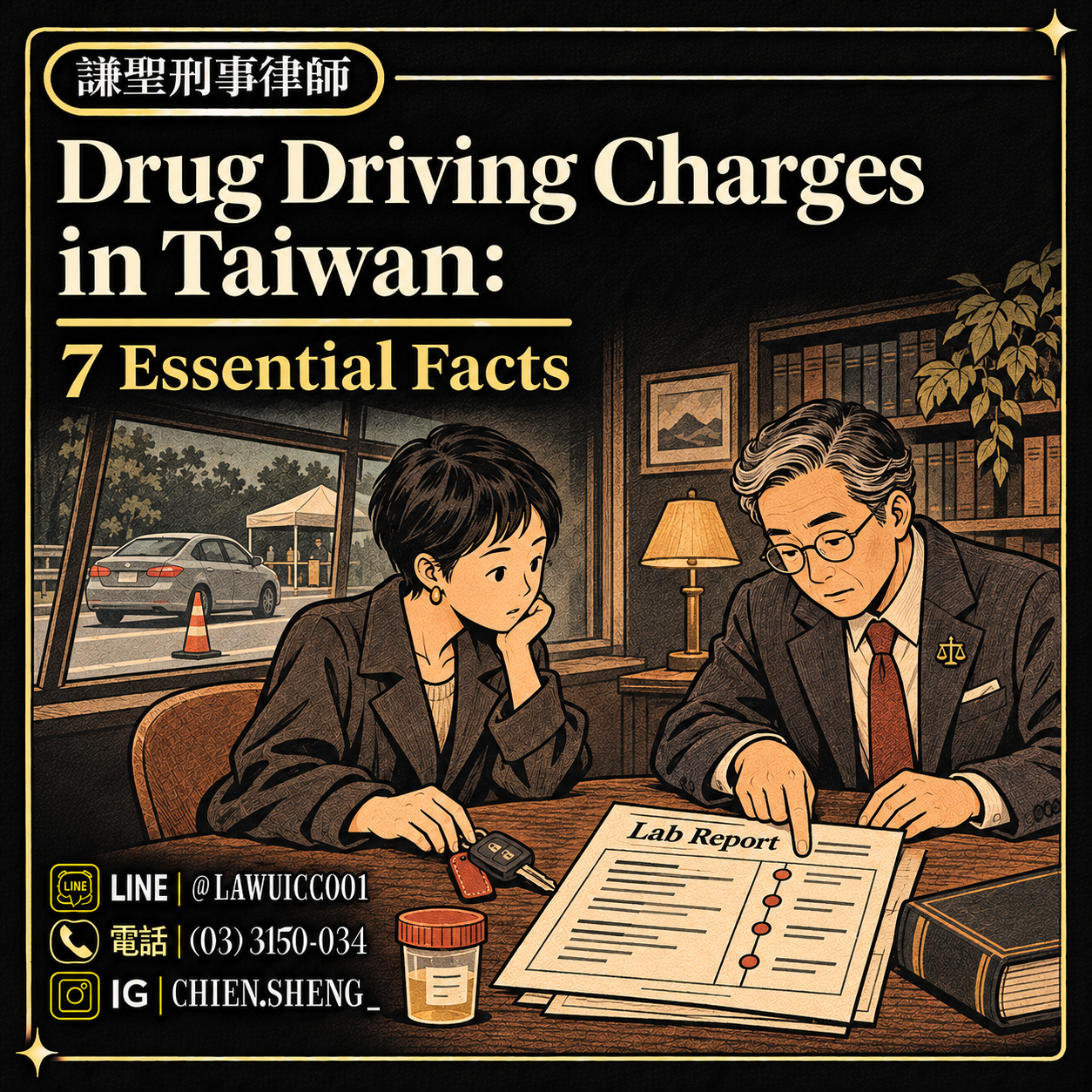
- 1. 1. Drug Driving Charges in Taiwan: What Must Prosecutors Prove?
- 2. 2. Does a Positive Urine or Saliva Test Mean You’ll Be Convicted?
- 3. 3. What If Police Found You in or Near a Parked Car?
- 4. 4. What Are the Criminal Penalties and License Consequences?
- 5. 5. What Should You Do After a Police Stop or Summons?
- 6. 6. Can a First Offender Receive Non-Prosecution or Deferred Prosecution?
- 7. 7. Can a Court Suspend the Sentence or Allow an Alternative to Prison?
- 8. Frequently Asked Questions
- 9. 📢【24-Hour Free Legal Consultation】
Drug driving charges in Taiwan can lead to prison, but a positive roadside saliva screen or urine result does not establish guilt on its own. Prosecutors still need evidence that you drove a powered vehicle and that the case meets one of the two drug-related grounds under Article 185-3 of Taiwan’s Criminal Code. If you’ve received a police notice or a prosecutor’s summons, start by identifying what was tested, when the sample was taken, and what evidence shows who was driving. mojlaw.moj.gov.tw
1. Drug Driving Charges in Taiwan: What Must Prosecutors Prove?
Article 185-3 of Taiwan’s Criminal Code provides two ways to establish the drug-related part of the offense. Both require proof that the person drove a powered vehicle. mojlaw.moj.gov.tw
- Concentration-based cases: A urine or blood test shows a substance or metabolite covered by an Executive Yuan notice at or above the applicable cutoff. When this ground is established, prosecutors do not need to separately prove that the driver was swerving, visibly impaired, or involved in a crash. mojlaw.moj.gov.tw
- Impairment-based cases: Other evidence shows that using a drug, narcotic, or similar substance left the person unable to drive safely. This ground may still apply when a result falls below the published cutoff or when no applicable cutoff has been established. Driving footage, witness accounts, officers’ observations, and the timing of substance use may all matter. mojlaw.moj.gov.tw
➥The distinction matters because the same evidence can answer one question without answering the other. A laboratory report may establish what was in a sample. Parking footage or a witness may be needed to establish who drove and when. mojlaw.moj.gov.tw
2. Does a Positive Urine or Saliva Test Mean You’ll Be Convicted?
No. A roadside saliva screen, an initial urine screen, and a laboratory confirmation report serve different purposes. Under Taiwan’s roadside testing rules, a positive saliva result can support an administrative traffic citation. It does not substitute for the urine or blood evidence required by the concentration-based provision of Article 185-3. motclaw.motc.gov.tw
💡For a laboratory result, check the exact substance or metabolite, the reported concentration and unit, the sample ID, and the time of collection. Also check which cutoff applies to the alleged conduct. For example, the Executive Yuan’s July 2026 notice changed the confirmatory urine cutoff for etomidate to 25 ng/mL, effective July 25, 2026. That figure is a urine testing cutoff for a particular substance. It is not a universal cutoff for every drug or every type of sample. gazette.nat.gov.tw
➥The collection record matters as much as the number. In criminal investigations, nonconsensual urine collection is subject to statutory conditions. A lawyer can review the stated legal basis, any authorization, the collection and transfer records, and whether the report corresponds to the correct sample. A procedural concern calls for checking what happened and how it affects the evidence; it does not automatically end the case. law.moj.gov.tw
3. What If Police Found You in or Near a Parked Car?
Being in the driver’s seat or standing near a parked car does not establish that you drove after taking a substance. Police do not have to witness the driving themselves, however. Dashcam footage, parking records, witnesses, or earlier statements may establish that the person drove before officers arrived. The key question is what the evidence shows about the alleged trip and its timing. mojlaw.moj.gov.tw
👨🏻⚖️Chien Sheng case example: No prosecution where driving could not be established
➥In a case handled by attorney Wang Sheng-jie of Chien Sheng Law Firm, the client tested positive and police encountered the client near a parked vehicle. The firm reviewed the police records, available footage, the vehicle’s condition, and the timeline. The evidence did not establish that the client had actually driven after using the substance. The prosecutor issued a non-prosecution disposition on the alleged driving offense.
➥The client’s identity, location, substance, and other identifying details have been withheld. The outcome turned on the evidence in that case and does not predict the result of another investigation.
4. What Are the Criminal Penalties and License Consequences?
The basic offense under Article 185-3 carries up to three years in prison and may include a criminal fine of up to NT$300,000. A crash is not required. If the offense causes serious injury, the statutory prison range rises to one to seven years. If it causes death, the range is three to ten years. An ordinary injury can still raise separate questions about negligent injury and compensation, while a qualifying repeat offense within ten years that causes serious injury or death can carry higher penalties. mojlaw.moj.gov.tw
⚠️Administrative consequences are assessed separately. Under the road traffic rules effective October 31, 2026, Article 35 sets the basic drug-driving administrative fine at NT$120,000 for motorcyclists and NT$150,000 for car drivers. License revocation and immediate vehicle impoundment can also apply, and the law provides for forfeiture in qualifying cases. A first refusal of a lawfully required drug test can carry a separate NT$270,000 administrative fine. If the same conduct also leads to a criminal fine, Taiwan’s rules govern how the monetary penalties interact; they should not simply be added together. laws.gov.taipei
➥Keep any traffic citation, license notice, or vehicle paperwork alongside the criminal summons. A decision in the criminal case does not by itself tell you whether an administrative notice has been withdrawn or whether its response deadline has changed. motclaw.motc.gov.tw
5. What Should You Do After a Police Stop or Summons?
- Identify the allegation. Check whether you are being questioned about driving, drug use, possession, or more than one allegation. If questioned as a suspect, you have the right to remain silent, retain defense counsel, and request that favorable evidence be investigated. law.moj.gov.tw
- Identify the test. Write down whether officers used a roadside saliva kit or collected urine or blood, when it happened, and what records or notices you received. Ask about the legal basis for collection if it is unclear. The right to remain silent during questioning is separate from the rules governing lawful testing and refusal. law.moj.gov.tw
- Preserve the original records. Save dashcam files, parking receipts, ride or designated-driver bookings, relevant messages, and prescription records if medication is involved. Start a timeline showing who drove, when the vehicle stopped, when police arrived, and when the sample was taken. If a parking camera may have captured the trip, record its location promptly so counsel can assess how to request the footage.
- Read any statement before signing. If the record says you drove at a time you did not give, or turns an uncertain recollection into a definite answer, ask for a correction. If you don’t remember a detail, say so. If someone was injured in a crash, prioritize emergency assistance and preserve the scene and insurance records once it is safe to do so.
6. Can a First Offender Receive Non-Prosecution or Deferred Prosecution?
Non-prosecution and deferred prosecution are different outcomes. If the investigation does not produce sufficient evidence of an offense, such as evidence of actual driving, Article 252 of Taiwan’s Code of Criminal Procedure provides for a non-prosecution disposition. If the case has a sufficient evidentiary basis, the prosecutor may instead consider whether deferred prosecution is legally available and appropriate. law.moj.gov.tw
➥Under Article 253-1, eligible cases may be deferred for one to three years. The basic offense can qualify, but first-offender status does not guarantee it. The prosecutor considers the circumstances and the public interest. Relevant information can include the harm caused, steps taken to compensate an injured person, and concrete measures to prevent another incident. Depending on the case, the disposition may require payment, community service, or treatment. A serious breach of conditions may lead to revocation and prosecution. The aggravated offense of causing death under Article 185-3 carries a minimum of three years and falls outside Article 253-1. law.moj.gov.tw
If there is also a separate investigation for drug use or possession, check which allegation each notice or disposition covers. Treatment or deferred prosecution in a drug-use case does not automatically resolve the driving case. mojlaw.moj.gov.tw
7. Can a Court Suspend the Sentence or Allow an Alternative to Prison?
A suspended sentence is available only after a conviction. Under Article 74 of the Criminal Code, the court may suspend a sentence for two to five years if the sentence imposed is no more than two years’ imprisonment, detention, or a fine, the defendant meets the statutory prior-record requirements, and the court finds suspension appropriate. The court may impose conditions such as compensation, community service, or treatment. mojlaw.moj.gov.tw
➥A fine in lieu of imprisonment is a separate option at the enforcement stage. In general, Article 41 requires a statutory maximum of five years’ imprisonment or less and an actual sentence of six months or less, or detention. Even when the judgment states a conversion rate, approval is not automatic. Community service in lieu of imprisonment may also be available in eligible cases and is assessed separately. mojlaw.moj.gov.tw
If you have received a summons or test report, Chien Sheng Law Firm can help review the driving evidence, laboratory findings, and procedural options. You can also browse the firm’s drug offense legal guides and drug offense case examples.
Frequently Asked Questions
Q1. Can drug driving charges in Taiwan lead to prison for a first offense?
Yes. The basic offense carries up to three years in prison, and a first offense does not guarantee deferred prosecution or a suspended sentence. The evidence, seriousness of the conduct, any injuries, and the applicable legal requirements all affect the outcome. mojlaw.moj.gov.tw
Q2. Can I still be prosecuted if police never saw me driving?
Yes, if other evidence establishes that you drove. A witness, parking camera, or dashcam may establish the earlier trip. If the evidence only places you in or near a parked vehicle and does not establish driving, that gap can support a request for non-prosecution. mojlaw.moj.gov.tw
Q3. Does a valid prescription rule out criminal liability?
No. A prescription helps explain why you took a medication and how it was prescribed. The criminal question still depends on the substance, the applicable legal ground, the test evidence, and the circumstances of the driving. If a medication may affect alertness or reaction time, follow the label and ask your doctor or pharmacist when it is safe to drive. mojlaw.moj.gov.tw
Q4. Does deferred prosecution mean I received a suspended sentence?
No. A prosecutor may issue deferred prosecution during the investigation, before a conviction. A court can suspend execution of a sentence only after finding the defendant guilty and imposing a sentence. Both outcomes may come with conditions, but they apply at different stages. law.moj.gov.tw
※ Legal information reviewed as of November 10, 2026. The applicable rules and outcome depend on the date of the alleged conduct, the evidence, and the stage of the proceedings.
📢【24-Hour Free Legal Consultation】
🏛 Taipei Office: 6F., No. 64, Kangding Rd., Wanhua Dist., Taipei City|02-2388-8962
🏛 Taoyuan Office: 17F., No. 95, Xinpu 6th St., Taoyuan Dist., Taoyuan City|(03)3150-034
🏛 Kaohsiung Office: 3F., No. 687, Mingcheng 3rd Rd., Gushan Dist., Kaohsiung City
Contact Us on LINE for a Free Consultation: @lawuicc001
IG: chien.sheng_
FB: Chien Sheng International Law Firm
💳 We Accept Cash, Credit Cards, and Bank Transfers.