
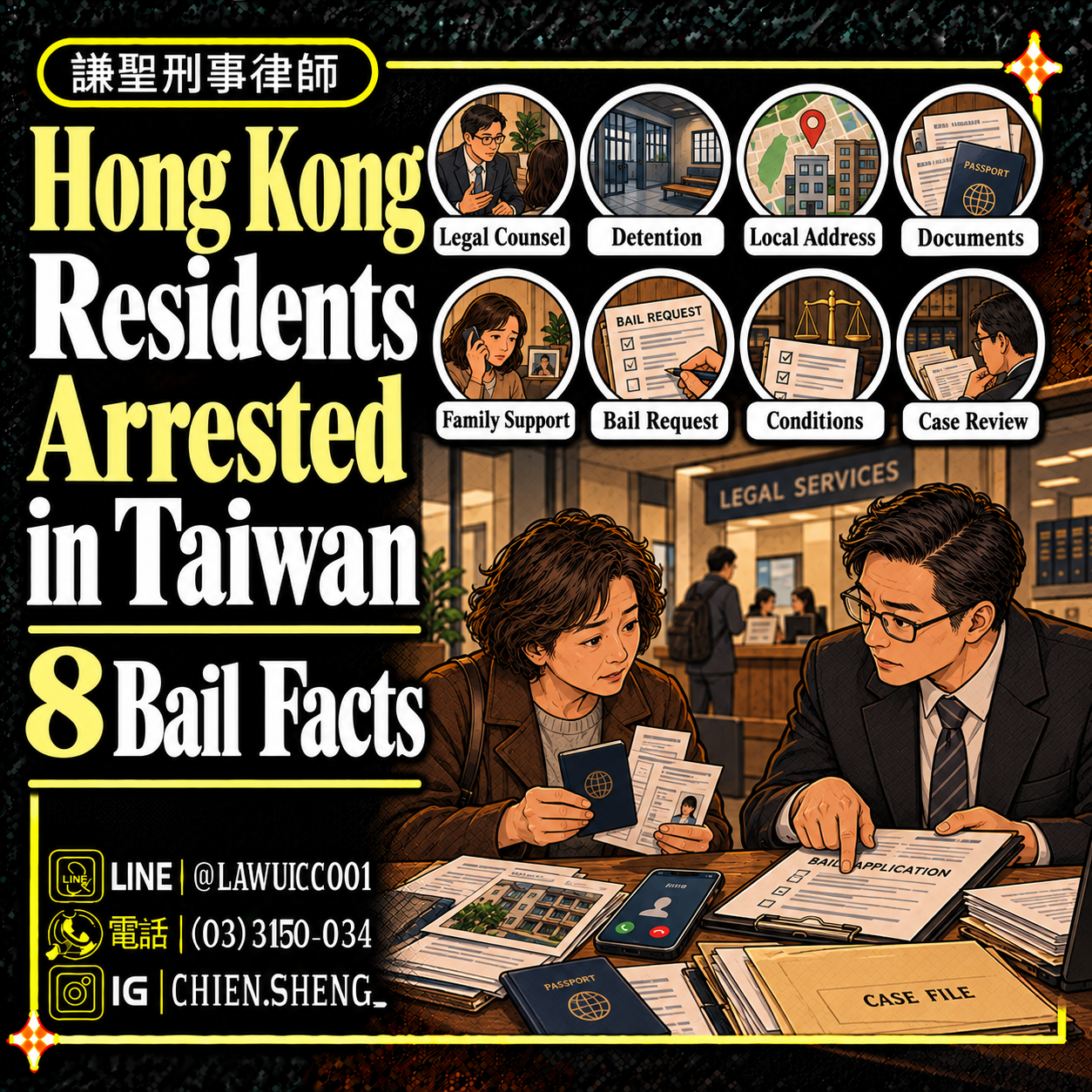
- 1. 1. Hong Kong Residents Arrested in Taiwan: What Happens First?
- 2. 2. Does Hong Kong Residency Mean Automatic Detention?
- 3. 3. Can Renting a Home in Taiwan Help a Bail Application?
- 4. 4. Can Someone Obtain Bail After a No-Contact Detention Order?
- 5. 5. Can a Lawyer Visit Someone Who Is Denied Family Visits?
- 6. 6. How Are Job Scams and Drug-Transport Allegations Defended?
- 7. 7. What Can Family Members in Hong Kong Do?
- 8. 8. What Happens After Release?
-
9.
Frequently Asked Questions
- 9.1. Q1. Can Hong Kong Residents Arrested in Taiwan get bail despite a no-contact order?
- 9.2. Q2. Will a Taiwan rental agreement guarantee release?
- 9.3. Q3. Can I appoint a lawyer while I am still in Hong Kong?
- 9.4. Q4. Can my family visit if a lawyer is allowed to visit?
- 9.5. Q5. Does release on bail allow an immediate return to Hong Kong?
- 9.6. Q6. Does being accused of a serious drug offence make bail impossible?
- 9.7. Q7. Is a lawyer allowed to guarantee that my relative will avoid prison?
- 10. Contact Chien Sheng International Law Firm
- 11. 📢【24-Hour Free Legal Consultation】
Hong Kong Residents Arrested in Taiwan may be able to obtain release on bail, including after a court orders detention with restrictions on family visits and communication. Eligibility depends on the evidence, detention grounds and proposed safeguards. Hong Kong residency alone does not make detention mandatory, and providing a rental agreement does not automatically secure release.
👨🏻⚖️For families overseas, the immediate priorities are to locate the person, appoint Taiwanese criminal defence counsel and obtain accurate information about the proceedings. Chien Sheng International Law Firm explains how detention, lawyer visits and a practical release proposal fit together in fraud and drug investigations.
1. Hong Kong Residents Arrested in Taiwan: What Happens First?
An arrest, a prosecutor’s questioning and a court detention order are different stages. A family member being taken to a police station does not automatically mean that a court has ordered continued detention.
💡The first task is to establish:
- Which police or investigative agency is handling the case.
- Whether the person is being questioned, referred to a prosecutor or brought before a judge.
- The alleged offences and available case reference.
- Whether a detention order has been issued.
- Where the person is currently held.
Under Article 95 of Taiwan’s Code of Criminal Procedure, defendants have rights including remaining silent, appointing defence counsel and requesting investigation of favourable evidence. law.moj.gov.tw
➠If the person cannot adequately understand the questioning language, they should raise that difficulty and request appropriate interpretation. Conversational Mandarin ability does not necessarily mean someone understands legal terminology or a written statement.Before signing, the person should check that the record accurately reflects their answers. Uncertain dates, amounts or names should be checked against records rather than guessed.
2. Does Hong Kong Residency Mean Automatic Detention?
No. Article 101 requires serious suspicion of an offence, applicable detention grounds and a finding that detention is necessary for the proceedings. Relevant concerns include flight, destruction or fabrication of evidence, and collusion with accomplices or witnesses. law.moj.gov.tw
Limited local ties and an unstable address may be considered when assessing flight risk. However, being from Hong Kong is not a substitute for an individual assessment.The court may also examine the seriousness of the alleged offence, access to travel documents, conduct during the investigation and whether less restrictive measures can address the identified risks.
Fraud and drug cases can involve several defendants, overseas contacts and outstanding evidence. These features may require a more detailed release proposal, but they do not mean every accused person must remain detained until the case ends.
➠Article 108 sets detention periods and extension procedures. The ordinary initial limits are two months during investigation and three months during trial; extensions and other statutory provisions require separate examination. Continued detention must be reviewed through the applicable legal procedures. law.moj.gov.tw
3. Can Renting a Home in Taiwan Help a Bail Application?
A genuine, verifiable place to live may support a release proposal, particularly where the detention reasons include concerns about locating the defendant.
However, a lease addresses only part of the assessment. It does not automatically resolve concerns about evidence, witnesses, overseas contacts or compliance with future hearings.
👨🏻⚖️What makes accommodation evidence useful?
Depending on the case, counsel may prepare:
- A valid lease identifying the property and tenancy period.
- Evidence that the accommodation is actually available.
- Accurate information about who will live there.
- A reliable address for official documents.
- A realistic plan for living expenses and attending proceedings.
➠Families should discuss the detention reasons with counsel before committing to an expensive lease. The accommodation must be genuine and suitable for the proposed arrangement.A paper address that will not actually be used can undermine credibility. The aim is to show how the person will remain contactable and comply with proceedings.
Chien Sheng International Law Firm can help families organise accommodation documents and explain their relevance in a release application. The decision remains with the competent authority.
4. Can Someone Obtain Bail After a No-Contact Detention Order?
Yes, an application can be assessed. Restrictions on outside contact do not create an automatic legal bar to seeking release.Article 110 allows the defendant, defence counsel and other statutorily eligible persons to apply to the court for suspension of detention on bail. During investigation, the prosecutor may also request such a court order. law.moj.gov.tw
➠A useful application responds to the actual detention reasons. For example, counsel may explain that important evidence has been secured, relevant interviews have been completed, or practical safeguards can address the remaining concerns.
📝What conditions might accompany release?
Under Article 116-2, the court may impose conditions such as:
- Reporting periodically to a designated authority.
- Restrictions on contact with specified people.
- Remaining at an approved residence or within a designated area.
- Surrendering passports or travel documents.
- Appropriate electronic monitoring where ordered. law.moj.gov.tw
Available money alone does not establish entitlement to bail. The proposed amount and conditions must be considered alongside the legal grounds and procedural risks.Any release order should be read carefully. A family should not assume that paying the required security automatically permits travel back to Hong Kong.
5. Can a Lawyer Visit Someone Who Is Denied Family Visits?
Generally, yes. Ordinary visits and confidential defence access are legally distinct.Article 105 permits restrictions on outside visits, correspondence and items where necessary to address specified procedural risks. The precise scope of the order matters. law.moj.gov.tw
Article 34 separately protects defence counsel’s access to a detained defendant and correspondence with that person. Such access cannot simply be treated as an ordinary family visit. Any restriction must meet the statutory requirements. law.moj.gov.tw
🔎A lawyer’s visit can help clarify:
- What questioning has already taken place.
- What the person understood and said.
- Whether the written statements contain inaccuracies.
- The person’s health and immediate needs.
- The detention reasons and available defence materials.
➠Counsel must also observe confidentiality, professional duties and lawful communication restrictions. A lawyer is not an unrestricted messenger between a detainee and possible co-defendants.Families should not use friends or other detainees’ relatives to pass instructions, coordinate accounts or contact witnesses on the person’s behalf.
6. How Are Job Scams and Drug-Transport Allegations Defended?
Some people travel to Taiwan after receiving job offers, requests to repay debts or promises of easy earnings. These circumstances need evidence-based investigation.
▫️Fraud, cash collection and account transfers
For an alleged courier or money mule, counsel should reconstruct the recruitment process, instructions, payments and the person’s understanding at each stage.
Useful materials may include job advertisements, contracts, full conversations, travel arrangements and evidence of promised or received remuneration.Being recruited for work does not automatically prove innocence. Equally, collecting money or appearing in a bank record does not automatically prove a shared fraudulent plan.
▫️Drug transportation and luggage or parcel handling
Where the allegation concerns transporting drugs, important questions include what the person knew about the contents, who arranged the journey, who controlled the luggage and what communications occurred before departure.
➠The substance identified, the date of conduct and the applicable law also matter. The seriousness of a drug allegation does not remove the need to prove the elements of the charged offence.
▫️Keep release arguments and the merits of the case distinct
A bail application concerns whether detention remains necessary. The defence to the charge concerns whether the alleged crime is proved.A lawyer may challenge criminal intent while separately proposing conditions that ensure attendance. Neither applying for bail nor obtaining release determines guilt or innocence.
7. What Can Family Members in Hong Kong Do?
Families can start organising lawful assistance without waiting for permission to make an ordinary visit.Article 27 allows a defendant or suspect to appoint counsel and permits specified relatives and other eligible persons to appoint counsel independently. The required relationship and appointment documents should be confirmed with the lawyer. law.moj.gov.tw
📑Prepare the information and documents available:
- The person’s name, date of birth and identification details.
- Official notices, detention documents and case references.
- Travel bookings and the reason for visiting Taiwan.
- Original recruitment or other relevant conversations.
- Employment, study, family and medical records.
- Genuine accommodation and financial-support information.
➠Preserve original files and devices where possible. Do not alter messages, prepare a false contract or ask another person to provide a coordinated version of events.
A single family contact can help keep documents and instructions organised. Counsel can then explain what may lawfully be shared, what remains uncertain and what additional evidence is needed.Fees, the scope of representation and arrangements for urgent attendance should be clarified through the firm’s official channels. No payment to an intermediary can guarantee bail or a particular judgment.
8. What Happens After Release?
💡Release changes the person’s custody status; it does not end the criminal case.
The defendant must follow the written conditions and attend required proceedings. Before changing address, travelling or contacting anyone covered by an order, obtain advice about the applicable restrictions.
Immigration permission and criminal-procedure restrictions are separate matters. A rental agreement or bail order should not be treated as permission to remain indefinitely, work or leave Taiwan. Any necessary immigration steps should be checked promptly with the appropriate authority.
The defence work also continues. Depending on the evidence and stage, counsel may seek non-prosecution, an acquittal or a legally supported sentencing outcome. A suspended sentence is a conviction with execution suspended under statutory conditions; it is different from acquittal or bail.
The firm’s related case page concerning a foreign resident accused of acting as a fraud courier describes a suspended-sentence outcome. That outcome should not be presented as proof that a Hong Kong defendant will obtain bail or the same sentence.
🔎Related reading: Foreign resident accused of acting as a fraud courier: suspended-sentence case.
Frequently Asked Questions
Q1. Can Hong Kong Residents Arrested in Taiwan get bail despite a no-contact order?
Potentially, yes. Counsel can assess an application addressing the detention grounds and suitable safeguards. A no-contact order does not itself guarantee refusal or approval.
Q2. Will a Taiwan rental agreement guarantee release?
No. Genuine accommodation can address concerns about residence and contactability, but the court must also consider the other detention reasons and proposed conditions.
Q3. Can I appoint a lawyer while I am still in Hong Kong?
Eligible family members may appoint counsel under Article 27. Contact the firm to confirm the relationship documents, appointment requirements and practical arrangements.
Q4. Can my family visit if a lawyer is allowed to visit?
Not necessarily. Defence access and ordinary visits are different. Family visits depend on the order’s scope and the detention facility’s applicable procedures.
Q5. Does release on bail allow an immediate return to Hong Kong?
Do not assume so. Travel-document requirements, residence conditions and any departure restrictions must be checked before making travel plans.
Q6. Does being accused of a serious drug offence make bail impossible?
There is no automatic answer based solely on the label. The statutory grounds, evidence, necessity of detention and feasibility of safeguards require individual assessment.
Q7. Is a lawyer allowed to guarantee that my relative will avoid prison?
No reliable assessment can promise a result before examining the evidence and applicable law. Bail, acquittal and a suspended sentence are separate decisions with different requirements.
Contact Chien Sheng International Law Firm
If a relative has been arrested or detained in Taiwan, gather the official documents and contact Chien Sheng International Law Firm through its official consultation channel.
The team can assess lawyer access, the detention reasons, a genuine accommodation proposal and the evidence relevant to fraud or drug allegations. Early preparation helps turn family concerns into specific matters the competent authority can examine.Legal information reviewed on 16 October 2026. This article provides general information and does not guarantee release, a particular judgment or any immigration outcome. Individual advice requires the relevant orders, documents and case evidence.
Official Legal References📝
- Article 27: Appointment of defence counsel
- Article 34: Defence counsel’s access to detained defendants
- Article 95: Rights during questioning
- Article 101: Grounds for detention
- Article 108: Detention periods and extensions
- Article 110: Applications for release on bail
- Article 116-2: Conditions accompanying release
📢【24-Hour Free Legal Consultation】
🏛 Taipei Office: 6F., No. 64, Kangding Rd., Wanhua Dist., Taipei City|02-2388-8962
🏛 Taoyuan Office: 17F., No. 95, Xinpu 6th St., Taoyuan Dist., Taoyuan City|(03)3150-034
🏛 Kaohsiung Office: 3F., No. 687, Mingcheng 3rd Rd., Gushan Dist., Kaohsiung City
Contact Us on LINE for a Free Consultation: @lawuicc001
IG: chien.sheng_
FB: Chien Sheng International Law Firm
💳 We Accept Cash, Credit Cards, and Bank Transfers.