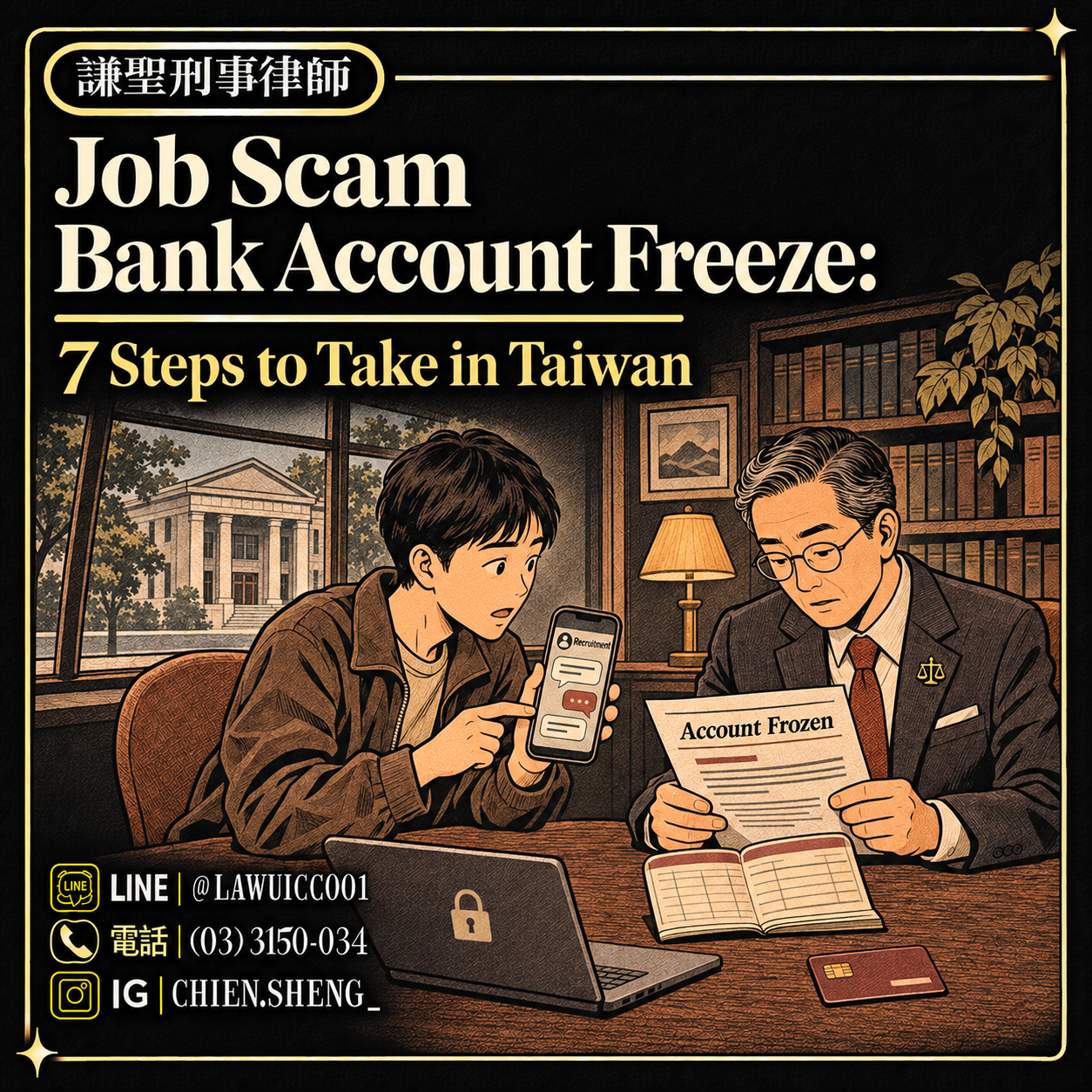
- 1. 1. Job Scam Bank Account Freeze: Confirm What the Bank Actually Restricted
- 2. 2. Stop the Transfers and Secure Your Banking Access
- 3. 3. Preserve the Job Offer, Full Chats, and Transaction Records
- 4. 4. Separate Fraud, Money Laundering, and Unlawful Account Provision
- 5. 5. Prepare for Police Questioning and Identify Every Active Case
- 6. 6. Ask the Original Reporting Authority to Review the Flag
- 7. 7. Check Separately for a Written Warning and Plan Your Next Step
-
8.
Frequently Asked Questions
- 8.1. Does a job scam bank account freeze mean I have been charged with fraud?
- 8.2. Can I go to any police station to remove the flag?
- 8.3. What if I only provided my account number for payroll?
- 8.4. Does a non-prosecution decision automatically restore my banking access?
- 8.5. Should I return an unfamiliar deposit to the account named by the recruiter?
- 9. 📢【24-Hour Free Legal Consultation】
A job scam bank account freeze in Taiwan calls for two immediate steps: ask your bank what kind of restriction applies, and stop moving money for the recruiter. If the bank confirms that the account has been formally flagged, ask which authority originally reported it. That is the authority to contact about lifting the flag. A restricted account can trigger an investigation, but the restriction alone does not establish that you helped commit fraud or money laundering. law.moj.gov.tw
💡This guide explains how a fake job can turn your personal account into a payment channel, what investigators look for, and what to do if your salary account is affected, the police call, or you receive a separate written warning.
1. Job Scam Bank Account Freeze: Confirm What the Bank Actually Restricted
Start by calling the bank through its official app, the number on your card, or a number listed on its website. “Frozen” is a useful everyday description, but it does not tell you which process applies. Your account may be formally flagged, restricted because another account in your name was flagged, or subject to a separate bank review for unusual activity. If the bank identifies another legal basis for the restriction, ask which authority or department handles it. law.moj.gov.tw
A formally flagged account, known in Taiwan as a 警示帳戶, is an account reported to a bank by a court, prosecutors’ office, or judicial police authority for a criminal investigation. Under Article 10 of the official bank account management regulations, the bank lifts the formal restriction after receiving notice from the original reporting authority or when the applicable flagging period expires. Other restrictions, including derivative restrictions and bank controls for suspicious activity, follow a separate review process. law.moj.gov.tw
👨🏻⚖️Ask the bank to clarify:
- Which account was originally flagged, and which of your other accounts or services are affected?
- Which authority reported it, and what contact details or reference number can the bank provide?
- Can you still obtain statements and records for the affected period?
- Are incoming payments, cash withdrawals, online transfers, or scheduled payments affected?
- Does the bank see a separate restriction that might remain even after the original flag is lifted?
➠Write down the date, the department you spoke with, and the bank’s explanation. If your salary, rent, or loan payments are affected, make a list of upcoming transactions and ask what banking arrangements are available. An upcoming payday makes the situation urgent for you, but it does not give a branch employee authority to lift a formal flag. law.banking.gov.tw
2. Stop the Transfers and Secure Your Banking Access
A fake recruiter may describe the work as remote payment processing, customer settlement, foreign exchange assistance, or account verification. The warning sign is a request to let company or customer funds pass through your personal account, or to give someone access to it. A payroll department may need an account number to pay your salary. It does not need your ATM card, PIN, online banking password, or one-time verification code to do so. chiensheng.com
If unfamiliar funds appear, stop following the recruiter’s instructions. Do not withdraw the money, buy cryptocurrency with it, forward it, or send it to a different account on the recruiter’s claim that it was deposited by mistake. Tell your bank which transactions you do not recognize and ask how to handle them. If you already gave someone a card, password, or verification code, tell the bank exactly what you shared and follow its instructions to secure access. You can report the suspected scam to the police and keep the report reference. law.moj.gov.tw
➠Two situations can look similar on a bank statement but require different explanations. In one, the applicant hands over an ATM card or banking credentials because a recruiter says they are needed for verification. In the other, the applicant keeps access to the account but personally transfers funds under instructions presented as job duties. The first raises questions about who controlled the account. The second also raises questions about who performed each transfer, what the applicant was told about the funds, and what they understood at the time. law.moj.gov.tw
When you speak to the bank, distinguish transactions you authorized from ones you do not recognize. A transfer you made after being misled and a transfer made by someone else using your credentials are different events. Describe what happened accurately, including any transaction you completed before you realized the offer might be fraudulent.
3. Preserve the Job Offer, Full Chats, and Transaction Records
Keep the evidence that explains why the job looked credible at the time. A bank statement can show that money moved; the job listing and recruitment messages can show what the recruiter told you that money was for. Investigators need both sides of the record to assess what you did and what you understood. law.moj.gov.tw
⚠️Save the following where available:
- The original job listing, recruiter profile, application, interview messages, contract, and any description of duties or pay.
- Complete conversations, including voice messages, attachments, call logs, and instructions about account access or transactions.
- Bank statements, transfer receipts, ATM notices, and relevant exchange records if cryptocurrency was involved.
- Records of when you contacted the bank, stopped following instructions, or reported the suspected scam.
- Police notices, prosecutor summonses, case numbers, and any written warning sent to you.
➠Save original files or chat exports where possible. Screenshots help when a listing or profile may disappear, but a few selected messages can leave out the instructions that came before or the objections that came after. Keep complete copies, including messages that are awkward or unfavorable. Do not edit originals or ask other people to change their accounts of what happened.
Next, write a chronology for your own reference. Begin with the first contact. Mark when you provided account details, whether anyone else gained access, when each disputed payment arrived, and what you did afterward. Record when you first noticed something was wrong and what prompted that realization. If you cannot remember a date, label it as uncertain and identify a record that might verify it.
For example, “I noticed the job was fake after my account was restricted” may be accurate, but it does not explain an earlier transfer. A more useful chronology records the instruction received before that transfer, the explanation given at the time, and any bank or app notice the applicant actually saw. The purpose is to reconstruct the sequence from evidence so you can explain it accurately without guessing. chiensheng.com
4. Separate Fraud, Money Laundering, and Unlawful Account Provision
Three legal issues can arise from the same bank records. They have different elements, so evidence that matters for one issue may not resolve the others. law.moj.gov.tw
▫️Aiding fraud: What did you know when you helped?
Fraud is addressed in Article 339 of Taiwan’s Criminal Code, while Article 30 governs aiding an offense. The fact that someone used your account to receive a victim’s payment does not, by itself, prove that you intentionally assisted the fraud. Investigators may still examine whether you recognized the possibility that your actions would help fraud and went ahead accepting that possibility. The relevant question is what the evidence shows about your state of mind when you acted. law.moj.gov.tw
A credible-looking job offer, a recruitment history, or prompt reporting after discovery can support your explanation. Evidence of unusually high payment for access to an account, clear warnings, or continued transfers after you noticed irregularities may point in a different direction. No single message, payment, or police report necessarily settles the issue. law.moj.gov.tw
▫️Money laundering: Who moved the funds, and under what circumstances?
The Money Laundering Control Act separately addresses money laundering. An investigation may examine who actually operated the account, whether you received, withdrew, or transferred the funds, the role those actions played, and what you knew about their source. An incoming payment and a series of outgoing transfers you personally authorized are different facts. The prosecution still has to establish the applicable elements of the offense. law.moj.gov.tw
▫️Article 22: Did you provide an account for another person to use?
Article 22 separately restricts handing over or providing accounts for someone else’s use. It recognizes exceptions for ordinary commercial or financial practice, trust between relatives or friends, and other legitimate reasons. Giving an employer an account number for payroll should be distinguished from giving a recruiter access to operate the account. If you made the transactions yourself, explain who controlled the account and what the other person was able to direct or do. law.moj.gov.tw
➠Depending on the facts, unlawful account provision can result in a formal police warning. Article 22 also sets out circumstances that can carry criminal liability, including agreeing to receive or receiving consideration for providing access, providing three or more accounts in total, or reoffending within five years after a qualifying warning. A written warning and a formal flag on a specific bank account should be treated as separate matters. law.moj.gov.tw
5. Prepare for Police Questioning and Identify Every Active Case
If police contact you, verify the call using the station’s published number. Ask for the unit, case reference, scheduled appearance, and the capacity in which you are being questioned. Save any written notice. If you are asked to attend at a time you cannot make, contact the unit promptly to clarify the procedure rather than assuming you can ignore it.
For the interview, bring your identification, notice, chronology, and organized copies of records. You should be able to explain which details come from memory, which you verified afterward, and which transactions you did not personally make. If the officer asks about a particular transfer, confirm the date and amount before answering. Read the written statement before signing and ask for corrections if it does not reflect what you said. If you are questioned as a suspect, you can exercise the right to remain silent and retain counsel. law.moj.gov.tw
➠It is also possible to have your own report as a scam victim and a separate investigation arising from someone else’s payment into your account. Keep both sets of records. If two police units contact you, ask whether the notices concern the same transaction or different reports. That distinction matters later: a decision in one case may not resolve a restriction linked to another. law.moj.gov.tw
📝For a practical example, read Chien Sheng’s published case involving a job applicant pressured to hand over account access. The firm reports an acquittal in that case. The account history, recruitment messages, and evidence of pressure mattered to the defense. The result illustrates why the surrounding facts matter; it does not determine the outcome of another case. chiensheng.com
6. Ask the Original Reporting Authority to Review the Flag
If your account was formally flagged, contact the authority that reported it. In practice, this is often the police unit that made the report. Start with the details provided by your bank and confirm the correct unit before sending documents or traveling to a station. The Taipei District Prosecutors Office’s official guidance explains that an account holder can generally present the relevant non-prosecution disposition or final judgment to the original reporting authority and ask it to notify the bank. law.moj.gov.tw
When you contact that authority, ask which case supports the flag and what documents it requires at the current stage. Depending on the outcome, those may include identification, a release request form, the relevant disposition or judgment, and evidence that the decision is final or that applicable conditions or enforcement have been completed. Keep a copy of your submission and ask how to confirm that notice was sent to the bank. tpc.moj.gov.tw
➠Do not assume that receiving a non-prosecution disposition restores banking access the same day. The bank may still be waiting for notice. Another report, a separate Article 22 warning, or a different banking restriction may also remain in effect. If the bank says the account is still restricted after the reporting authority has acted, ask the bank which restriction remains and who can review it. law.moj.gov.tw
➠Under the management regulations, the ordinary flagging period is two years from the report. Where continued flagging is necessary, the original reporting authority may extend it once for up to one year. If you want to know when a restriction will end, verify the actual reporting date and whether an extension or separate flag applies. The date you first noticed the restriction may be later than the date it was reported. law.moj.gov.tw
7. Check Separately for a Written Warning and Plan Your Next Step
If you received a formal police warning under Article 22, keep the warning and its delivery records. Read the stated grounds and the instructions for challenging it. A criminal investigation, the reporting authority’s review of a flagged account, and a challenge to a formal warning can proceed on different tracks. A favorable decision on one track does not automatically cancel the others. law.moj.gov.tw
👨🏻⚖️Your next step depends on the document or notice in front of you:
- If the bank gave you only a generic restriction message, confirm its legal or operational basis first.
- If you received an interview notice, verify the unit and prepare the full recruitment and banking chronology.
- If you already received a criminal disposition, check whether it is final and whether it covers the case linked to the flag.
- If you also received a written warning, check its stated remedy and deadline promptly while you deal with the criminal case or bank restriction.
Chien Sheng International Law Firm can review the recruitment messages, transaction history, and official notices together. Bring the documents you already have, even if the bank or police have not given you a complete record. The first question is often straightforward: which authority made which decision, and what evidence is relevant to that particular decision?
Frequently Asked Questions
Does a job scam bank account freeze mean I have been charged with fraud?
No. A bank restriction or formal account flag does not establish that you have been charged or found guilty. Confirm your status with the investigating unit. Whether aiding fraud or money laundering can be established depends on the facts and evidence, including your actions and what you understood at the time. law.moj.gov.tw
Can I go to any police station to remove the flag?
For a formal flag, contact the original reporting authority identified by your bank. Another station may help you report a new scam or identify the right unit, but the original reporting authority is the one to approach about sending the bank a notice to lift the flag. law.moj.gov.tw
What if I only provided my account number for payroll?
A genuine request for payroll details is different from a request for a card, password, verification code, or permission to route customer funds through your account. Preserve the job offer and the exact request so investigators can see what you supplied, why you supplied it, and whether anyone else gained the ability to use the account. law.moj.gov.tw
Does a non-prosecution decision automatically restore my banking access?
No. A final disposition can support a request to the original reporting authority, but the bank generally still needs the authority’s notice to lift a formal flag before expiry. If there is a separate warning or restriction, check its status independently. law.moj.gov.tw
Should I return an unfamiliar deposit to the account named by the recruiter?
Do not follow the recruiter’s payment instructions. Contact the bank through an official channel, identify the transaction, and ask how to handle it. Preserve the original messages and receipt. A request to send the money to a different account is not proof that the recipient is entitled to it. law.moj.gov.tw
※ This article provides general information on Taiwan law. Individual outcomes depend on the facts, applicable law, and evidence.
📢【24-Hour Free Legal Consultation】
🏛 Taipei Office: 6F., No. 64, Kangding Rd., Wanhua Dist., Taipei City|02-2388-8962
🏛 Taoyuan Office: 17F., No. 95, Xinpu 6th St., Taoyuan Dist., Taoyuan City|(03)3150-034
🏛 Kaohsiung Office: 3F., No. 687, Mingcheng 3rd Rd., Gushan Dist., Kaohsiung City
Contact Us on LINE for a Free Consultation: @lawuicc001
IG: chien.sheng_
FB: Chien Sheng International Law Firm
💳 We Accept Cash, Credit Cards, and Bank Transfers.