
- 1. 1. Why Can a Simple Account Loan Become a Criminal Case?
- 2. 2. What Does Article 22 of the Money Laundering Control Act Prohibit?
- 3. 3. An Administrative Reprimand Is Different from a Warning Account
- 4. 4. When Can Lending a Bank Account in Taiwan Become a Crime?
- 5. 5. How Is Account-Transfer Liability Different from Aiding Fraud?
- 6. 6. When Can Account Use Become Money Laundering?
- 7. 7. What Qualifies as a Justifiable Reason?
- 8. 8. What Evidence Will Police and Prosecutors Examine?
- 9. 9. What Other Consequences May Follow?
- 10. 10. What Should You Do After Providing an Account?
- 11. 11. What Should You Do After Receiving a Police Notice or Prosecutor’s Summons?
-
12.
12. Main Defense Issues in an Account-Transfer Case
- 12.1. ▪️Was the account actually delivered or made available for another person’s use?
- 12.2. ▪️Was there a genuine and justifiable transaction?
- 12.3. ▪️Was consideration promised or received?
- 12.4. ▪️How many accounts were supplied?
- 12.5. ▪️Was there a prior reprimand?
- 12.6. ▪️Was there knowledge or acceptance of fraud?
- 12.7. ▪️Did the person participate in moving criminal proceeds?
- 12.8. ▪️Is civil settlement appropriate?
-
13.
13. Frequently Asked Questions
- 13.1. 1. Is Lending a Bank Account in Taiwan always a criminal offense?
- 13.2. 2. Can I be charged if I only provided the account number?
- 13.3. 3. If I received no commission, am I automatically safe?
- 13.4. 4. Does using an account for a family member eliminate liability?
- 13.5. 5. If I was deceived by a fake job or loan company, can I obtain a non-prosecution decision?
- 13.6. 6. Can I transfer suspicious money to another account to protect it?
- 13.7. 7. Does a warning account mean I have been convicted?
- 13.8. 8. Can victims sue the account holder even if the criminal case is dismissed?
- 14. 14. How Chien Sheng International Law Firm Can Assist
- 15. Conclusion: The Reason, Access, Knowledge, and Response All Matter
- 16. 📢【24-Hour Free Legal Consultation】
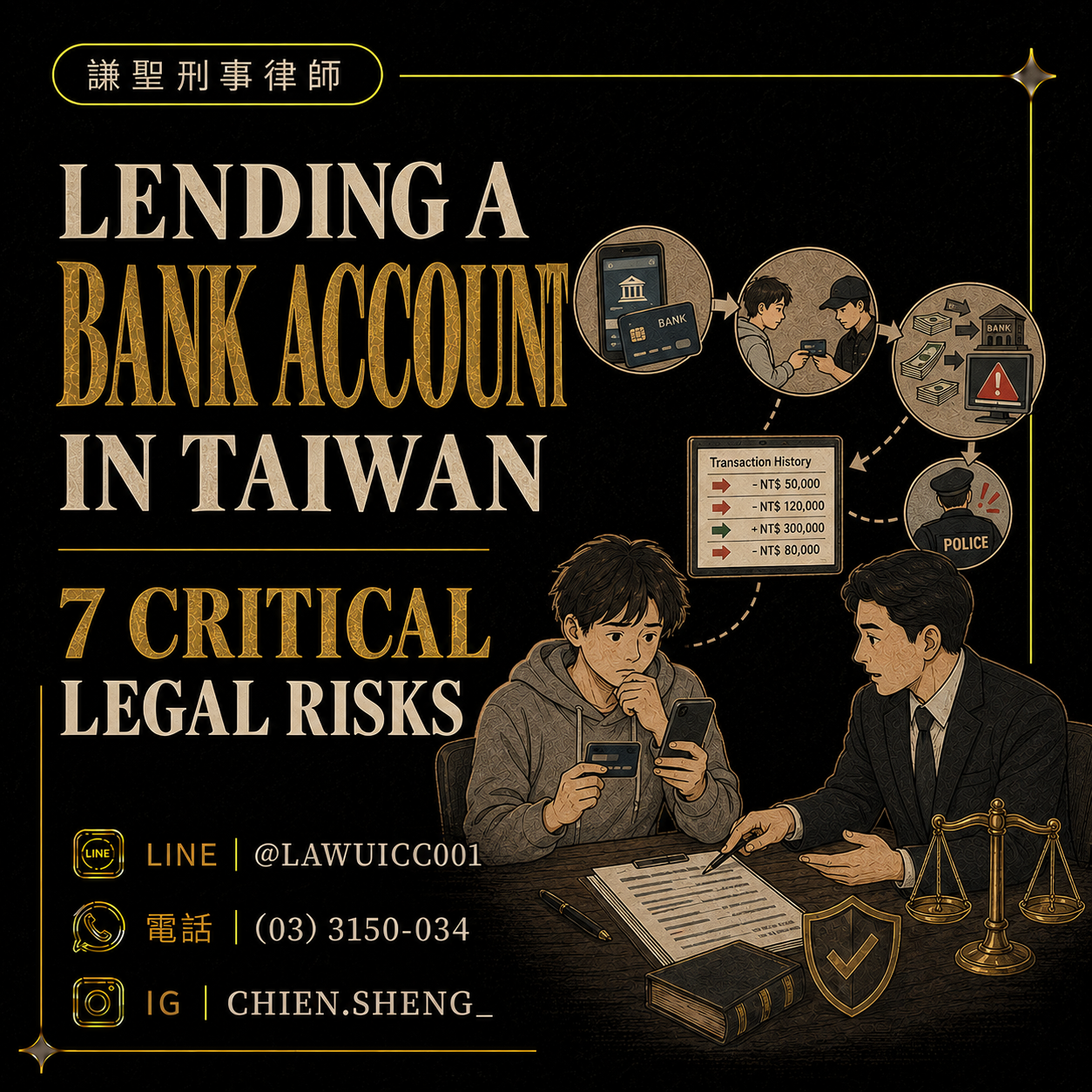
Lending a Bank Account in Taiwan may look like a harmless favor, especially when a friend, employer, online contact, loan agent, or trading partner asks to receive money through your account. However, once the account is used to collect fraud proceeds, transfer suspicious funds, purchase cryptocurrency, or withdraw cash, the account holder may face banking restrictions, a police investigation, criminal charges, and civil claims from victims.
Statements such as “I only helped receive one payment,” “I did not contact any victim,” or “I did not receive a commission” do not automatically eliminate legal responsibility. Investigators will examine why the account was provided, what access information was handed over, whether the transaction had a legitimate purpose, how the money moved, and what the account holder knew or could reasonably foresee.
💡Under Taiwan law, an account-related case may involve three separate issues:
- Liability for providing an account without a justifiable reason under Article 22 of the Money Laundering Control Act.
- Possible aiding fraud or money-laundering liability.
- Civil compensation claims brought by fraud victims.
These issues have different legal requirements. An account being used in a crime does not automatically prove that its owner was a member of a fraud organization, but the owner must still explain the transaction with specific and verifiable evidence.
1. Why Can a Simple Account Loan Become a Criminal Case?
Bank accounts, third-party payment accounts, and virtual-asset accounts can be used to receive, divide, transfer, or conceal criminal proceeds. After a victim reports fraud, law enforcement will usually trace the destination of the payment. The account holder may then become one of the first identifiable persons in the investigation.
Common high-risk situations include:
- Giving a debit card and PIN to another person.
- Providing online-banking login details or one-time verification codes.
- Opening a new account at another person’s request.
- Allowing someone else to control an electronic-payment account.
- Receiving money and immediately transferring it to another account.
- Withdrawing cash and delivering it to an unknown person.
- Purchasing cryptocurrency for another person with incoming funds.
- Renting out an account in exchange for a commission or monthly payment.
- Helping an online friend, loan broker, or alleged employer receive unexplained funds.
➠Even when the account holder did not personally deceive the victim, the account may have provided the payment channel needed to complete the fraud or move its proceeds.
The legal issue is therefore not limited to who sent the fraudulent message. Prosecutors may also investigate the person who supplied the financial tool or processed the funds.
2. What Does Article 22 of the Money Laundering Control Act Prohibit?
Article 22 of Taiwan’s Money Laundering Control Act generally prohibits a person from delivering or making available to another person:
- A financial account opened in the person’s own or another person’s name.
- An account opened with a virtual-asset service provider.
- An account opened with a third-party payment service provider.
➠The prohibition does not apply when the arrangement is consistent with ordinary business or financial practices, based on a genuine relationship of trust between relatives or friends, or supported by another justifiable reason.
This exception does not mean that every request from a friend, family member, customer, or employer is lawful. The reason must be consistent with the actual transaction and the degree of control provided.
⚠️For example, giving an employer an account number for salary payments is very different from giving the employer a debit card, PIN, online-banking password, and verification codes. A legitimate payment normally requires only the information necessary to send the money. It rarely requires surrendering control of the entire account.
The same distinction applies to ordinary sales. A seller may provide an account number to receive payment for goods, but a purported buyer has no legitimate reason to demand the seller’s online-banking password or remote access to the seller’s phone.
3. An Administrative Reprimand Is Different from a Warning Account
Two concepts are frequently confused in account-related cases.The first is the administrative reprimand imposed under Article 22 of the Money Laundering Control Act. If a person provides an account without a justifiable reason, the competent municipal, county, or city police authority may issue a reprimand.
The second is a warning-account classification or other banking restriction connected with a criminal investigation. This may occur after a law-enforcement notification concerning suspicious funds or an alleged fraud payment.An administrative reprimand is not the same as a criminal conviction. However, it may still lead financial institutions, virtual-asset service providers, and third-party payment providers to suspend, restrict, or close existing accounts and to restrict the opening of new ones.
Possible practical consequences include:
- Suspension of debit-card functions.
- Inability to use online or mobile banking.
- Rejection or return of incoming payments.
- Difficulty receiving salary payments.
- Restrictions affecting other accounts held under the same name.
- Additional review when applying for new accounts or financial services.
- Disruption of loan, rent, utility, insurance, or credit-card payments.
Receiving only an administrative reprimand at the beginning does not guarantee that no criminal case will follow. Investigators may separately examine whether the same conduct also constituted aiding fraud or money laundering.
4. When Can Lending a Bank Account in Taiwan Become a Crime?
Under Article 22, criminal punishment may apply when a person provides an account without a justifiable reason and one of the following circumstances exists:
4.1 Payment was promised or received
The consideration does not have to be described as rent. It may take the form of a commission, processing fee, referral payment, profit share, loan benefit, debt reduction, cryptocurrency, or another financial advantage.
A person who was promised payment may still face this issue even if the payment was never ultimately received.
4.2 Three or more accounts were provided
The law refers to the combined number of accounts or account identifiers provided. Bank accounts, virtual-asset accounts, and third-party payment accounts may all require examination.
This requirement concerns the number of accounts supplied, not the number of incoming transfers or victims.
4.3 The conduct was repeated within five years after a reprimand
A new violation committed within five years after a police reprimand may trigger criminal responsibility. If another violation occurs after the five-year period, the law provides for another reprimand rather than automatically applying this repeat-offense condition.
Where criminal liability under Article 22 is established, the maximum punishment is three years’ imprisonment, short-term imprisonment, or a fine of up to NT$1 million, or both imprisonment and a fine.The facts must still be individually examined. The mere existence of an account does not prove that the owner delivered it to another person without justification.
5. How Is Account-Transfer Liability Different from Aiding Fraud?
Article 22 focuses on the act of supplying an account for another person’s use without a legitimate reason. Aiding fraud requires additional proof that the defendant intentionally assisted another person’s fraudulent conduct.
Under Articles 30 and 339 of Taiwan’s Criminal Code, a person may be treated as an aider if the person knowingly provides assistance that makes the fraud easier to complete. In practice, prosecutors may argue that indirect intent existed when the account holder recognized a substantial risk of fraud but nevertheless accepted that risk and continued to provide the account.
💡Relevant facts may include:
- The other person’s identity was unknown or unverifiable.
- The account holder was offered unusually high compensation.
- Multiple cards or accounts were requested.
- The explanation for using another person’s account was unreasonable.
- The account holder was instructed to conceal the arrangement from the bank.
- Funds had to be transferred immediately after arrival.
- The account holder was asked to withdraw cash or purchase cryptocurrency.
- The account holder continued after receiving a bank warning or discovering suspicious transfers.
However, suspicion alone is not enough. The prosecution must establish the required objective assistance and criminal intent. Evidence showing that the person was deceived through a fake job, fraudulent loan application, online relationship, or fabricated trading arrangement may be important to the defense.
📝The relevant provisions can be reviewed in the official Criminal Code of the Republic of China.
6. When Can Account Use Become Money Laundering?
Money-laundering liability is not automatically established merely because criminal proceeds entered an account.
Under Articles 2 and 19 of the Money Laundering Control Act, relevant conduct may include:
- Concealing criminal proceeds or disguising their source.
- Obstructing the investigation, discovery, preservation, confiscation, or recovery of criminal proceeds.
- Receiving, possessing, or using another person’s criminal proceeds.
- Using one’s own criminal proceeds in a transaction with another person.
The investigation will examine whether the account holder merely provided payment information or actively handled the funds. Conduct such as dividing transfers, withdrawing cash, converting money into virtual assets, transferring assets to designated wallets, or handing cash to another person may create substantially greater exposure.
The account holder’s knowledge remains important. Prosecutors must examine whether the person knew or accepted that the funds were connected to crime. Ownership of the receiving account, without more, should not replace proof of the required criminal elements.
7. What Qualifies as a Justifiable Reason?
A justifiable reason must be supported by the real purpose of the transaction and by evidence.
💡Examples that may support a legitimate explanation include:
- Receiving salary from an identifiable employer.
- Receiving payment under a genuine sale or service contract.
- Collecting documented rent, repayment, or business income.
- Using an account for a verified family emergency.
- Receiving funds under a genuine and traceable commercial arrangement.
💡Useful supporting documents may include:
- Employment contracts and salary statements.
- Sales contracts, purchase orders, invoices, or receipts.
- Complete messages with the payer or trading party.
- Delivery records and platform transaction histories.
- Loan documents or repayment schedules.
- Company registration and contact information.
- Documents explaining the source and purpose of the funds.
The scope of access must also be proportionate. A legitimate payer may need an account number, but normally does not need possession of the debit card, PIN, online-banking credentials, verification codes, or account holder’s phone.
A family or friendship relationship is relevant but not automatically decisive. If a relative asks to receive payments from strangers, operate the account freely, or move unexplained funds, the relationship alone may not establish a lawful reason.
8. What Evidence Will Police and Prosecutors Examine?
Courts and prosecutors do not decide these cases solely from the account holder’s statement that “I did not know.”
They may examine:
- How the account holder met the other person.
- Whether the other person’s identity was verified.
- The reason given for using the account.
- Whether any contract or genuine transaction existed.
- What account information and credentials were provided.
- Whether the account holder retained control.
- Whether compensation was promised or paid.
- The number of accounts involved.
- The amounts and frequency of incoming payments.
- How quickly the funds were withdrawn or transferred.
- Whether cryptocurrency was purchased.
- Whether any records were deleted.
- Whether the account holder continued after discovering irregularities.
- Whether the account holder contacted the bank or police.
- Whether the account holder had previously received a reprimand or warning.
A strong explanation should connect the account holder’s statement to objective records. Complete messages, original transaction files, banking notices, delivery records, advertisements, contracts, and reports made immediately after discovery may help demonstrate what the person actually believed at the time.Deleting messages or manufacturing documents after the event can seriously damage credibility and may create additional legal problems.
9. What Other Consequences May Follow?
9.1 Banking and payment restrictions
The account may be suspended, restricted, or classified as high risk. Other accounts under the same name may also be affected, depending on the applicable banking measures and the facts of the case.
9.2 Civil compensation claims
Fraud victims may seek damages from the account holder under Taiwan’s Civil Code. A criminal non-prosecution decision does not automatically eliminate civil exposure because criminal and civil proceedings apply different legal elements and standards of proof.
The relevant general tort provisions can be reviewed in the official Civil Code.
9.3 Preservation, seizure, or return of funds
Money remaining in the account may be frozen, preserved, seized, or considered for return to victims. The account holder should not transfer unexplained funds elsewhere without first obtaining appropriate guidance.
9.4 Employment and daily-life disruption
Restrictions may interfere with salary payments, rent, mortgage installments, automatic deductions, business operations, or applications for financial services.
10. What Should You Do After Providing an Account?
If the card, password, payment account, or other access information has already been supplied, take the following steps promptly.
Contact the bank or service provider
Explain that the account may have been compromised or used in suspicious activity. Ask whether the card, online-banking function, payment account, or transaction function can be suspended.
Preserve all original evidence
Keep complete copies of:
- Messages and voice recordings.
- Job, loan, investment, or transaction advertisements.
- Emails and social-media profiles.
- Contracts and transaction documents.
- Delivery records for cards, phones, or SIM cards.
- Bank statements and transfer records.
- Cryptocurrency transaction histories.
- Wallet addresses and transaction hashes.
- Records of calls made to the bank or police.
Screenshots are useful, but original files and complete conversations are generally more valuable than selected images.
Do not move unexplained money
Do not withdraw, transfer, return, convert, or hand over suspicious funds on your own. Contact the bank and police so that the funds can be handled through a traceable process.
Report suspected fraud
You may contact the official National Police Agency 165 Anti-Fraud website or report the matter to the police. Keep the case number, report receipt, and the name of the receiving authority.
Prepare a complete timeline
Record:
- When contact began.
- What the other person claimed.
- Why the request appeared credible.
- What information or items were provided.
- Whether compensation was discussed.
- When funds entered the account.
- What instructions were received.
- When the irregularity was discovered.
- What actions were taken afterward.
The timeline should be based on actual records. Do not fill gaps with guesses.
11. What Should You Do After Receiving a Police Notice or Prosecutor’s Summons?
Receiving a notice does not mean that a conviction has already been entered. Nevertheless, a police interview or prosecutorial investigation should not be treated as an informal conversation.First determine whether you are being questioned as a witness, complainant, suspect, or defendant. If you are a suspect or defendant, Taiwan’s Code of Criminal Procedure provides rights that include the right to remain silent and the right to retain defense counsel.
The official provisions can be reviewed in the Code of Criminal Procedure.
Before the interview:
- Review the entire transaction history.
- Identify every account involved.
- Preserve all messages and documents.
- Separate facts you personally know from assumptions.
- Confirm whether any payment or benefit was received.
- Check whether you have received a prior reprimand.
- Prepare evidence supporting the original transaction or deception.
- Consult a criminal defense lawyer when the case involves fraud proceeds, cash withdrawals, virtual assets, or multiple victims.
During questioning, answer only from actual memory and records. If a date, amount, identity, or conversation cannot be confirmed, do not guess merely to provide an immediate answer.Repeating “I did not know” is rarely enough. The explanation should show why you trusted the person, what you believed the transaction was, what access was provided, and what you did after discovering the problem.
12. Main Defense Issues in an Account-Transfer Case
A proper defense should address the evidence rather than rely on a single slogan.
▪️Was the account actually delivered or made available for another person’s use?
It is necessary to distinguish between supplying an account number for payment and surrendering operational control through a card, PIN, password, verification code, device, or remote-access application.
▪️Was there a genuine and justifiable transaction?
The defense should identify the other party, transaction purpose, agreement, payment basis, and supporting documents.
▪️Was consideration promised or received?
The nature of any commission, referral fee, salary, loan benefit, or other advantage must be examined. The absence of payment may be relevant but does not automatically resolve all potential charges.
▪️How many accounts were supplied?
The number of bank, payment, and virtual-asset accounts can directly affect Article 22 liability.
▪️Was there a prior reprimand?
The date and legal basis of any previous reprimand must be checked to determine whether the five-year repeat-offense provision may apply.
▪️Was there knowledge or acceptance of fraud?
Prosecutors must prove more than the fact that an account received money. Communications, warnings, payment arrangements, transfer instructions, and the account holder’s response to suspicious circumstances all require examination.
▪️Did the person participate in moving criminal proceeds?
Withdrawing money, transferring funds, purchasing cryptocurrency, or handing cash to another person may change the case from passive account provision to active participation in the financial flow.
▪️Is civil settlement appropriate?
If victim funds entered the account, settlement, repayment, and proof of payment should be carefully coordinated. Payment should not be made repeatedly to different claimants without confirming the amount, legal basis, and effect of the settlement.
13. Frequently Asked Questions
1. Is Lending a Bank Account in Taiwan always a criminal offense?
No. The result depends on whether the account was made available to another person, whether a justifiable reason existed, what access was provided, and whether the statutory criminal conditions were met. A legitimate salary or business payment is different from handing over account-control credentials.
2. Can I be charged if I only provided the account number?
Not necessarily. Supplying an account number for a genuine payment is different from allowing another person to control the account. Investigators will still examine the purpose of the payment, the payer’s identity, and whether the transaction was legitimate.
3. If I received no commission, am I automatically safe?
No. The absence of compensation may be relevant to one Article 22 condition, but investigators must still examine the number of accounts, prior reprimands, possible fraud assistance, and any participation in moving the money.
4. Does using an account for a family member eliminate liability?
No. A genuine relationship of trust may be relevant, but it is not an automatic exemption. Receiving unexplained money from strangers or giving a family member unrestricted access may still create legal risk.
5. If I was deceived by a fake job or loan company, can I obtain a non-prosecution decision?
It may be possible if the evidence shows that you lacked criminal intent and were genuinely deceived. The result depends on the complete messages, transaction history, conduct after discovery, and other surrounding evidence.
6. Can I transfer suspicious money to another account to protect it?
Do not move the money on your own. Transferring, withdrawing, or converting unexplained funds may complicate the investigation. Contact the bank, police, and a lawyer before taking further action.
7. Does a warning account mean I have been convicted?
No. A banking restriction or warning-account classification is not a criminal conviction. However, it may indicate that the account is connected with an investigation and should be addressed promptly.
8. Can victims sue the account holder even if the criminal case is dismissed?
Yes. Criminal and civil liability have different requirements. A non-prosecution decision or acquittal does not automatically prevent a victim from pursuing a civil claim.
14. How Chien Sheng International Law Firm Can Assist
Account-transfer cases frequently involve overlapping banking, fraud, money-laundering, cryptocurrency, and civil-liability issues. A complete defense requires more than saying that the account holder was also a victim.
👨🏻⚖️Chien Sheng International Law Firm can assist with:
- Reconstructing the event and transaction timeline.
- Reviewing bank and virtual-asset records.
- Analyzing Article 22 liability.
- Distinguishing account provision from aiding fraud or money laundering.
- Preparing for police and prosecutorial questioning.
- Organizing evidence showing deception or lack of criminal intent.
- Addressing warning-account restrictions.
- Evaluating settlement and civil-compensation issues.
- Representing clients during investigation and trial.
⚠️Related case discussions include:
- Online job scam resulting in a warning account—non-prosecution obtained
- Loan scam involving account documents—acquittal obtained
- Online job scam and warning-account allegations—successful acquittal
Conclusion: The Reason, Access, Knowledge, and Response All Matter
A bank account should not be rented, sold, or handed over casually. Providing an account number for a legitimate payment is legally different from giving another person a debit card, password, verification code, or unrestricted operational control.
When assessing potential liability, four questions are especially important:
- Why was the account provided?
- What information and control were supplied?
- Was there a genuine transaction or other justifiable reason?
- What did the account holder do after discovering suspicious activity?
Early evidence preservation, immediate suspension of unauthorized access, and a consistent explanation based on objective records may prevent further loss and help clarify whether the account holder was an intentional participant or another person deceived by the scheme.
👨🏻⚖️Chien Sheng International Law Firm reminds readers that this article provides general legal information only. It does not guarantee the outcome of any individual case and does not replace legal advice based on the specific evidence. Anyone facing account restrictions, an administrative reprimand, police questioning, fraud or money-laundering allegations, or a civil compensation claim should obtain legal advice as early as possible.
Legal information reviewed on September 21, 2026. If the English translation differs from the official Chinese text, the Chinese text published by Taiwan’s Ministry of Justice prevails.
📢【24-Hour Free Legal Consultation】
🏛 Taipei Office: 6F., No. 64, Kangding Rd., Wanhua Dist., Taipei City|02-2388-8962
🏛 Taoyuan Office: 17F., No. 95, Xinpu 6th St., Taoyuan Dist., Taoyuan City|(03)3150-034
🏛 Kaohsiung Office: 3F., No. 687, Mingcheng 3rd Rd., Gushan Dist., Kaohsiung City
Contact Us on LINE for a Free Consultation: @lawuicc001
IG: chien.sheng_
FB: Chien Sheng International Law Firm
💳 We Accept Cash, Credit Cards, and Bank Transfers