- 1. 1. Testifying in a Sexual Assault Case in Taiwan: Make a Plan Before the Hearing
- 2. 2. Request Separate Questioning or a Protected Identification Procedure
- 3. 3. Arrange Support and Ask How the Court Will Protect Your Privacy
-
4.
4. Frequently Asked Questions
- 4.1. Q1 : Can I avoid seeing the defendant when testifying in a sexual assault case in Taiwan?
- 4.2. Q2 : Can I ask for protection without hiring a lawyer?
- 4.3. Q3 : Can I bring a trusted friend to the hearing?
- 4.4. Q4 : What if I am too distressed to attend as scheduled?
- 4.5. Q5 : Can I request help on the day if I did not call ahead?
- 5. 📢【24-Hour Free Legal Consultation】
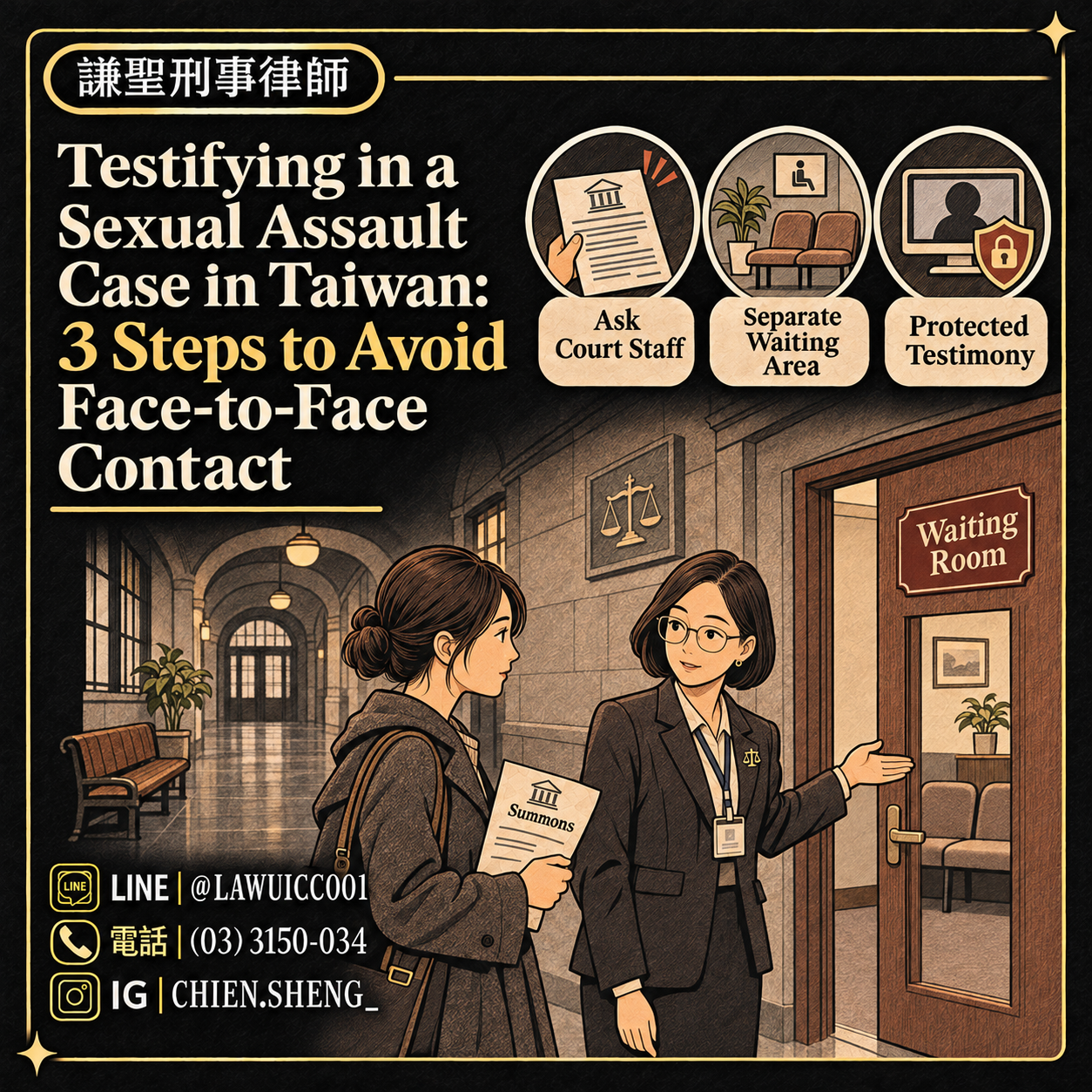
If you are testifying in a sexual assault case in Taiwan and are worried about seeing the defendant, contact the court before your hearing. You can ask for two different arrangements: a separate place to wait at the courthouse and a way to give evidence without sitting face-to-face with the defendant. Ask about both, since an arrangement for giving evidence does not necessarily cover the time you spend arriving, waiting, or leaving. judicial.gov.tw
1. Testifying in a Sexual Assault Case in Taiwan: Make a Plan Before the Hearing
Use the contact information on your court summons or hearing notice. Have your case number, hearing date, and hearing time ready. You can explain that you are concerned about encountering the defendant without describing the incident at a public counter or to everyone who answers the phone.
💡You could say : I have been called to testify in case [case number] on [date]. I am concerned about seeing the defendant at the courthouse. Can I wait separately, and how do I request a protected way to give evidence?
Ask the court to confirm:
- Where to check in and whom to ask for when you arrive.
- Whether you can wait in a separate area before being called.
- How to request separate questioning and whether the court needs a written application.
- Whether someone you trust can accompany you and where that person may stay.
- Whom to contact if you are concerned about crossing paths with the defendant when you leave.
▫️What to do when you arrive
If no meeting point has been arranged, show your notice to courthouse security or a volunteer and ask to speak privately with the person handling your case. The Judicial Yuan advises that entrance staff can contact the responsible personnel and help direct victims to a designated waiting area. Ask where to stay until you are called. If you see the defendant in a hallway or waiting area, tell a bailiff or security officer and ask for help moving to another location. judicial.gov.tw
2. Request Separate Questioning or a Protected Identification Procedure
Article 23 of Taiwan’s Sexual Assault Crime Prevention Act allows the court, upon request or on its own initiative, to question a victim outside the courtroom, use audio or video technology, or adopt another suitable measure to separate the victim from the defendant or judge. The court may choose the setup based on the circumstances. A request for separation does not automatically mean you can testify from home or choose a particular type of equipment. law.moj.gov.tw
★For a child, adolescent, person with an intellectual disability, or person with physical or psychological trauma who has been summoned to testify, the court must use protective separation if questioning in open court would risk preventing them from speaking freely or fully. If seeing or hearing the defendant would make it difficult for you to answer, tell the court what you are concerned about and what arrangement would help. law.moj.gov.tw
▫️Can the defense still ask questions?
Yes. Separation changes how the questions reach you. It does not eliminate cross-examination. If a question is unclear, ask for it to be repeated or rephrased. If you become overwhelmed, tell the judge and ask for a pause. Under Article 23, if the court bars improper questioning by a party or defense counsel, it may ask the questions itself instead. law.moj.gov.tw
▫️What if the court asks you to identify the defendant?
Tell the court in advance if you are worried about being asked to identify the defendant in the same room. The Judicial Yuan describes protective identification arrangements such as one-way glass and voice-altering equipment. Ask the court handling your case which measures are available and how identification would be conducted. The availability of equipment and whether it will be used should be confirmed with that court. judicial.gov.tw
➥If you are unsure about an identification, say what you can and cannot recognize. You do not need to guess.
3. Arrange Support and Ask How the Court Will Protect Your Privacy
Article 18 allows a person you trust, a family member, a social worker, or another eligible support person to accompany you during the investigation or trial with your consent, subject to statutory exceptions. If the victim is a child or adolescent, the local authority generally must assign a social worker to accompany them unless that support is clearly unnecessary. Tell the court in advance who you would like to bring and confirm where that person may accompany you. law.moj.gov.tw
A support person can help you feel more comfortable. A lawyer can help you explain your needs to the court, prepare a request for separate questioning, and clarify what to expect at the hearing. If you need language or accessibility assistance, raise that when you first contact the court so staff can tell you how to request it.
Sexual assault trials in Taiwan are generally closed to the public. Under Article 27, the general exception requires an adult victim’s consent and a court finding that a public hearing is necessary. A closed hearing does not mean the defendant will be absent or that the court has already arranged separate waiting or testimony. Request those protections separately. law.moj.gov.tw
4. Frequently Asked Questions
Q1 : Can I avoid seeing the defendant when testifying in a sexual assault case in Taiwan?
You can ask the court to arrange separate waiting and protected questioning. Contact the court before the hearing and confirm both arrangements. If your concern also extends to the entrance, hallways, or exit, explain that when you call. judicial.gov.tw
Q2 : Can I ask for protection without hiring a lawyer?
Yes. You can contact the court directly and ask how to request protective arrangements. A lawyer can help prepare a written request, and a social worker or other support person can help you communicate your practical needs. judicial.gov.tw
Q3 : Can I bring a trusted friend to the hearing?
A trusted person may accompany you with your consent, subject to the applicable rules. Tell the court who you want to bring and ask whether they can stay with you in the waiting area, during questioning, or both. law.moj.gov.tw
Q4 : What if I am too distressed to attend as scheduled?
Contact the court promptly. Explain the difficulty and ask whether protective arrangements or a change of date can be considered. If you have been summoned, do not assume that requesting assistance excuses your attendance. Confirm the court’s instructions before making plans.
Q5 : Can I request help on the day if I did not call ahead?
Yes. Show your notice to courthouse security or a volunteer and ask to speak privately with the staff handling your case. Calling ahead gives the court more time to arrange a separate waiting area or prepare equipment, but you can still raise your concerns when you arrive. judicial.gov.tw
Chien Sheng International Law Firm can help you review your hearing notice and prepare a request for protective arrangements. For an initial consultation, have your case number, hearing date, and a short list of your concerns ready. It is useful to identify whether you need help with waiting, giving evidence, identification, or leaving the courthouse.
🔎Related reading: Criminal procedure and legal guides · Chien Sheng International Law Firm
🔎Official references: Judicial Yuan guidance on avoiding contact with the defendant · Taiwan Sexual Assault Crime Prevention Act
📢【24-Hour Free Legal Consultation】
🏛 Taipei Office: 6F., No. 64, Kangding Rd., Wanhua Dist., Taipei City|02-2388-8962
🏛 Taoyuan Office: 17F., No. 95, Xinpu 6th St., Taoyuan Dist., Taoyuan City|(03)3150-034
🏛 Kaohsiung Office: 3F., No. 687, Mingcheng 3rd Rd., Gushan Dist., Kaohsiung City
Contact Us on LINE for a Free Consultation: @lawuicc001
IG: chien.sheng_
FB: Chien Sheng International Law Firm
💳 We Accept Cash, Credit Cards, and Bank Transfers.