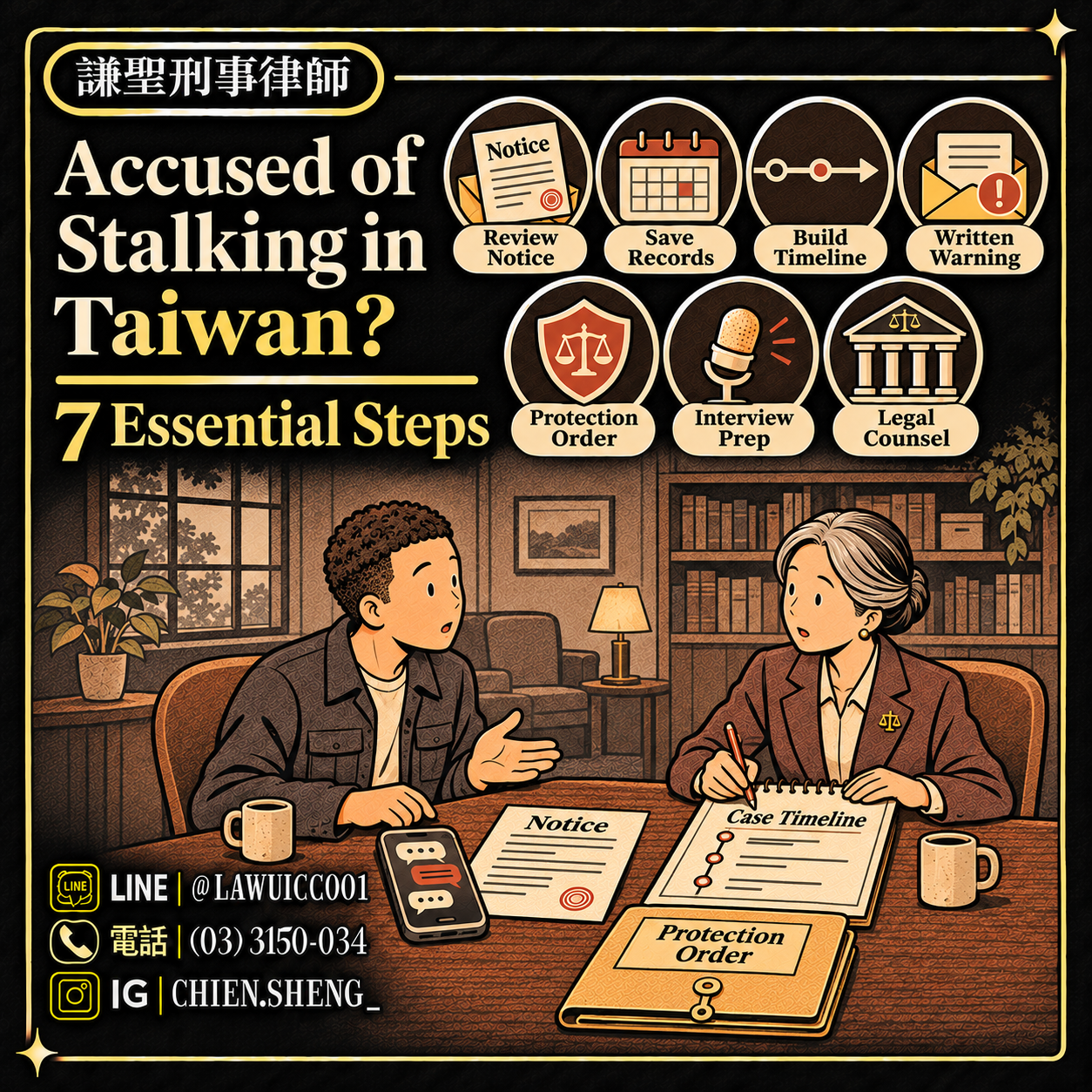
- 1. 1. Accused of Stalking in Taiwan? Identify the document and its deadline
- 2. 2. Check what the prosecution must prove under Article 3
- 3. 3. Review repeated messages, consent, and evidence of fear
- 4. 4. Test the claim that there was no sexual intent
- 5. 5. Respond to a written police warning within 10 days
- 6. 6. Follow the protection order while considering an appeal
- 7. 7. Preserve evidence and check whether a complaint is required
-
8.
Frequently asked questions
- 8.1. Q1. What should I do if I’m accused of stalking in Taiwan?
- 8.2. Q2. Can repeated LINE messages be enough to support a charge?
- 8.3. Q3. Does it matter that I never asked for sex or a date?
- 8.4. Q4. Can I be investigated if police never gave me a written warning?
- 8.5. Q5. Can I contact the complainant to apologize if I have appealed the protection order?
- 9. 📢【24-Hour Free Legal Consultation】
Accused of Stalking in Taiwan? Start by identifying what you received: a police interview notice, a prosecutor’s summons, a written police warning, or a court protection order. Each calls for a different response. Preserve the complete messages and original files, record when the document was delivered, and avoid contacting the complainant directly to explain or apologize while you clarify the allegations and any restrictions.
⚠️A criminal case under Taiwan’s Stalking and Harassment Prevention Act turns on what the evidence proves about the conduct, its context, and its effect. Repeated messages may qualify, but there is no fixed number that makes them criminal. Likewise, the absence of a sexual proposition does not, by itself, rule out a connection to sex or gender. law.moj.gov.tw
1. Accused of Stalking in Taiwan? Identify the document and its deadline
A police interview notice or prosecutor’s summons tells you when and where to appear. Verify the issuing office, case number, and whether you are being questioned as a suspect, defendant, or witness. If you cannot attend, contact the issuing office promptly to ask how to request a different date and confirm whether it has been approved.
A written police warning has a separate objection process: you have 10 days after receipt to submit a written objection through the police agency that issued it. A court protection order also generally has a 10-day appeal period after service, but the appeal goes through the court that issued the ruling. Filing an appeal does not suspend enforcement of the order. law.moj.gov.tw
➠If you are questioned as a suspect or defendant, you have the right to remain silent and retain counsel. If you have difficulty understanding the language being used, ask for an interpreter before giving a statement. Read the interview record before signing and ask for any inaccuracies to be corrected. law.moj.gov.tw
2. Check what the prosecution must prove under Article 3
Under Article 3(1) of the Stalking and Harassment Prevention Act, the conduct must target a specific person, fall within one of the eight statutory categories, be repeated or continuous, occur against that person’s wishes, and relate to sex or gender. It must cause fear of a kind sufficient to affect the person’s daily life or social activities. law.moj.gov.tw
💡The eight categories cover:
- Monitoring a person or tracking their whereabouts.
- Waiting for, following, or approaching them in a similar way near their home, school, workplace, or places they frequent.
- Directing threats, insults, ridicule, discriminatory behavior, or similar words or actions at them.
- Interfering with them through calls, messages, online services, or other devices.
- Seeking dates, contact, or otherwise pursuing them.
- Sending, leaving, displaying, or broadcasting messages, images, recordings, or objects directed at them.
- Showing or communicating material to them that harms their reputation.
- Misusing their personal information or ordering goods or services without their permission. law.moj.gov.tw
➠Article 3(2) also covers certain conduct directed at a person’s spouse, direct blood relative, relative living with them, or someone closely connected to their social life. The conduct toward that third person can qualify even if it is unrelated to sex or gender. The other requirements still apply, including repeated or continuous unwanted conduct and fear sufficient to affect daily life or social activity. law.moj.gov.tw
3. Review repeated messages, consent, and evidence of fear
Article 3 sets no minimum number of messages, calls, or encounters. A burst of messages in one evening or a prolonged wait outside someone’s workplace can raise issues under the Act. The key questions are what happened, how long it lasted, whether the incidents were connected, and whether the same event appears more than once in the evidence. A delivery record, work roster, or full chat history may help explain why someone was present or why contact occurred. law.moj.gov.tw
Prior consent has limits. Agreeing to discuss the return of belongings does not necessarily mean agreeing to calls about getting back together. A polite reply does not settle whether later contact was welcome. In Supreme Court criminal judgment No. 3224 of 2025, the Court explained that someone can discover surveillance or following afterward. The statute does not require immediate awareness or direct contact. judgment.judicial.gov.tw
👨🏻⚖️The prosecution must also establish fear and show that the conduct was serious enough to affect ordinary life or social activity. Changes in travel routes, requests for someone to accompany the complainant, and reports made at the time may help establish that connection. Medical records may be relevant, but the statute does not require a diagnosis, a move, or a resignation. law.moj.gov.tw
4. Test the claim that there was no sexual intent
The legal question is whether the conduct was related to sex or gender. In Supreme Court judgment No. 3224 of 2025, the Court explained that the connection can include exploiting an inequality related to sex or gender. The appellate court had considered a pattern of appearances near the complainant’s workplace and conduct after she left work. A defense that focuses only on the absence of explicit sexual messages would miss the evidence the courts considered. judgment.judicial.gov.tw
➠Taiwan High Court criminal judgment No. 90 of 2025 illustrates why the facts still matter. Although the court recognized that unequal power or control can be relevant, it found the necessary connection unproven in a dispute between neighbors over noise. A useful defense identifies what the evidence shows about the purpose and context of the contact. A work dispute, debt, or prior relationship can help explain the background, but its label does not decide the case. 財團法人民間司法改革基金會
5. Respond to a written police warning within 10 days
Article 4 allows police to issue a written warning when their investigation identifies suspected stalking or harassment. The warning is neither a criminal conviction nor a court protection order. A prosecutor also does not need a prior warning to pursue an Article 18 offense. law.moj.gov.tw
🚨To object, submit a written objection through the issuing police agency within 10 days after receipt. Include the warning date and reference number, identify the specific events you dispute, explain why, and attach supporting evidence. Keep a copy and proof of filing. Taiwan’s Supreme Administrative Court, in Order No. 2 of 2025 issued on March 4, 2026, held that administrative courts lack jurisdiction over a lawsuit challenging this type of warning. Do not let the statutory objection deadline pass while considering a different procedure. law.moj.gov.tw
6. Follow the protection order while considering an appeal
Under Article 5, a person may generally petition for a stalking protection order if further qualifying conduct occurs within two years after service of the warning takes legal effect. Police or prosecutors can petition on their own authority based on the circumstances and are not subject to the prior-warning requirement. For qualifying family members and current or former intimate partners who do not live together, the protection-order procedure instead falls under the Domestic Violence Prevention Act. law.moj.gov.tw
📝Read the actual order for prohibited conduct, locations, and distances. An order under Article 12 can restrict specified conduct, require distance from certain places, prohibit access to household registration information, or require treatment. It takes effect when issued and can initially last up to two years. If you dispute it, an appeal is generally due within 10 days after service, and you must continue to comply while the appeal is pending. 臺北市法規查詢系統
➠Violating an order made under Article 12(1), items 1 through 3, can be a separate crime under Article 19, punishable by up to three years’ imprisonment. If you share a workplace, need to collect belongings, or must address a practical issue, ask counsel how to proceed within the terms of the order before taking action. law.moj.gov.tw
7. Preserve evidence and check whether a complaint is required
Build one timeline with the alleged incidents, the dates of any refusal or blocking, and the dates the warning or order was served. Keep full chat exports, call logs, original images or video, and records showing where you were or why you were there. If a screenshot is disputed, check the account, sender, recipient, timestamp, and surrounding conversation. Keep the originals intact even if a record appears unfavorable.
The basic offense under Article 18(1) carries up to one year’s imprisonment and requires a criminal complaint. Under Articles 237 and 238 of the Code of Criminal Procedure, a person entitled to complain generally has six months from learning the offender’s identity to file and may withdraw the complaint before the close of arguments at first instance. If the alleged conduct spans multiple dates, have the timeline reviewed before assuming the complaint was late. The aggravated offense involving a weapon or other dangerous object under Article 18(2), and the protection-order violation under Article 19, do not depend on a complaint in the same way. A settlement does not automatically close every proceeding. law.moj.gov.tw
➠Taiwan’s Act took effect on June 1, 2022. If the allegations span that date, separate the conduct before and after it when assessing what can be prosecuted under the Act. Even if a stalking allegation is unproven, alleged threats, coercion, or invasions of privacy may still require separate review. tph.moj.gov.tw
🚨For a practical example, see how Chien Sheng Law Firm addressed a stalking allegation that ended in non-prosecution. If you need a case assessment, bring your notice, warning, or order and the original records to Chien Sheng International Law Firm. chiensheng-law.com.tw
Frequently asked questions
Q1. What should I do if I’m accused of stalking in Taiwan?
Identify the document, record when you received it, and preserve the original evidence. If it is a summons, confirm your status and appearance date. If it is a police warning or protection order, check the applicable 10-day deadline. Comply with any court order while considering an appeal. law.moj.gov.tw
Q2. Can repeated LINE messages be enough to support a charge?
Yes, if the messages and surrounding evidence support the applicable requirements under Article 3. The number of messages alone does not decide the case. Their content, timing, purpose, and what happened after any refusal all matter. law.moj.gov.tw
Q3. Does it matter that I never asked for sex or a date?
It can matter as part of the evidence, but it does not resolve the legal question. Conduct can have a connection to sex or gender without an explicit proposition. Article 3(2) also covers certain conduct toward closely connected people even without that connection. law.moj.gov.tw
Q4. Can I be investigated if police never gave me a written warning?
Yes. A written warning is not a prerequisite for a criminal case under Article 18. It has a separate role in the ordinary procedure for a person to petition for a protection order. law.moj.gov.tw
Q5. Can I contact the complainant to apologize if I have appealed the protection order?
An appeal does not suspend enforcement. If the order prohibits the proposed contact, do not make it or use a friend to pass along the message. Ask counsel to check what the order permits before attempting any communication. law.moj.gov.tw
⚠️This article provides general information about Taiwan law. The published court decisions discussed above were not handled by Chien Sheng International Law Firm. Case outcomes depend on the evidence and the applicable procedure.
📢【24-Hour Free Legal Consultation】
🏛 Taipei Office: 6F., No. 64, Kangding Rd., Wanhua Dist., Taipei City|02-2388-8962
🏛 Taoyuan Office: 17F., No. 95, Xinpu 6th St., Taoyuan Dist., Taoyuan City|(03)3150-034
🏛 Kaohsiung Office: 3F., No. 687, Mingcheng 3rd Rd., Gushan Dist., Kaohsiung City
Contact Us on LINE for a Free Consultation: @lawuicc001
IG: chien.sheng_
FB: Chien Sheng International Law Firm
💳 We Accept Cash, Credit Cards, and Bank Transfers.